Hildegart Rodríguez Carballeira
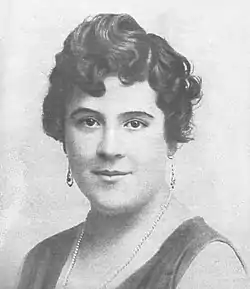
Hildegart Rodríguez Carballeira (December 9, 1914 in Madrid – June 9, 1933 in Madrid) was an activist for socialism and sexual revolution, born and raised by her mother as a model for the woman of the future. She spoke six languages when eight years old, finished law school as a teenager, and was a leader of the Spanish Socialist Workers' Party which she abandoned in favour of extreme republicanism. When she was 18 years old and had become internationally known, her mother shot her to death.
Childhood
Hildegart was conceived in Ferrol by her mother Aurora Rodríguez Carballeira with an undisclosed biological father chosen by her mother with eugenic intentions. When Carballeira was certain that she was pregnant, she moved to Madrid, where Hildegart was born. During her pregnancy, Aurora had set a clock to wake herself up every hour, allowing her to change sleep position so blood could flow to the fetus uniformly.
Hildegart's birth certificate and baptism act give her name as: Hildegart Leocadia Georgina Hermenegilda Maria del Pilar Rodriguez Carballeira, but she only used her first name.[1] In spite of Aurora's atheism and opposition to birth registration, she had her daughter baptised, somewhat late, on 23 March 1915 and then registered on 29 April. Her mother said that Hildegart meant "Garden of Wisdom" in German, but there is no basis for that, and the name was either an invention or an alternative spelling of the Nordic/German name Hildegard.
According to later research by Rosa Cal, her father was a brilliant military chaplain, Alberto Pallás.[2]
In June 1928, at the age of 13½, Hildegart enrolled in the School of Law of the Complutense University of Madrid. She later gave lessons at its School of Philosophy during the Second Spanish Republic.
The sexual revolution
Hildegart was one of the most active people in the Spanish movement for sex reformation. She was connected to the European vanguard, corresponding with Havelock Ellis, whose work she translated, and Margaret Sanger. At the foundation of the Spanish League for Sexual Reform, presided over by Dr Gregorio Marañón, she was chosen as Secretary without opposition.
She had correspondence with many other European personalities, and accompanied the author H. G. Wells on a visit he made to Madrid, but rejected his offer to go to London as his secretary. This offer by Wells, who wanted her to develop away from the influence of her mother, may have furthered the persecution ideas held by Aurora.
Death
There were several hypotheses about the motive for the murder. Hildegart may have fallen in love. She intended to separate from her mother who, out of paranoia, threatened suicide. Aurora's explanation was that "the sculptor, after discovering a minimal imperfection in his work, destroys it." She shot her daughter twice in the head and twice in the heart, (three shots to the head and one to the heart, according to Spanish Wikipedia) or (one shot to the head and three to the heart, according to Giles Tremlett's Ghosts of Spain).
Aurora was sentenced to imprisonment for 26 years, but was later transferred to a mental institution in Ciempozuelos, Madrid, where she died in 1955.
Works by Hildegart
- La rebeldía sexual de la juventud. Madrid: Javier Morata 1931.
- Republished with a prologue by Eduardo de Guzmán. Editorial Anagrama, Barcelona, 1977. 262 pages. ISBN 84-339-1302-6
- Profilaxis Anticoncepcional, Valencia 1931
- Malthusimo y neomalthusismo, Madrid 1932
- ¿Se equivocó Marx?, Madrid, Edición Novela Proletaria, 1932
- ¿Quo vadis, burguesía?, Madrid, Edición Novela Proletaria, 1932
- El problema sexual tratado por una mujer española. Madrid, Ediciones Morata, 1977 258 PP. ISBN 84-7112-057-7
- Métodos para evitar el embarazo. (Maternidad voluntaria). Zaragoza, Guara, 1978 128 p. ISBN 84-85303-04-0
Bibliography
- A mi no me doblega nadie: Aurora Rodríguez, su vida y su obra (Hildegart) - Rosa Cal Martínez. Sada : Edicións do Castro, D.L. 1991 ISBN 84-7492-542-8
- Hildegart, la virgen roja. Joan Llarch, Barcelona, Producciones editoriales, 1979. 155 p.
- El manuscrito encontrado en Ciempozuelos Guillermo Rendueles Endymion, 1989 ISBN 84-7731-023-8 Study on her mother's medical report on the asylum.
- De Pepito Arriola a Hildegart Francisco Martinez López y Ventura Ferrero Delso, sociedad de Cultura Valle-Inclán, Ferrol ISBN 84-95289-77-6
Works inspired by her life
Novels
- Aurora de sangre (Vida y muerte de Hildegart) Eduardo De Guzmán 1972 Editorial Mundo Actual.
- Aurora de sangre o la virgen roja. Rafael Azcona. Jet Films 1977. Script for Fernán Gómez's film, based on De Guzmán's novel.
- Auroras Anlaß, Erich Hackl, Zürich 1987 (described in the German Wikipedia article Auroras Anlaß).
- La virgen roja, Fernando Arrabal, Barcelona, Seix Barral, 1987.
Films
- Mi hija Hildegart (Fernando Fernán Gómez, 1977)
- The Red Virgin (Sheila Pye, 2011)
References
- Benito, Carlos (3 December 2010). "Sangre de su sangre". www.elcorreo.com (in Spanish). Diario El Correo. Retrieved 13 April 2018.
- Ramírez de Arellano, Irene (7 February 2018). "La mujer española 'creada' y asesinada por su madre por no ser perfecta". www.vice.com (in Spanish). Vice. Retrieved 15 January 2020.
External links
- Sanger and the Red Virgin Margaret Sanger Papers Newsletter, Spring 2002.
- Aurora's Motive Erich Hackl Alfred A. Knopf, 1989
Authority control  | |
|---|---|
| General | |
| National libraries | |
| Other | |