Hisham ibn Abd al-Malik
Hisham ibn Abd al-Malik (Arabic: هشام بن عبد الملك, romanized: Hishām ibn ʿAbd al-Malik; 691 – 6 February 743), usually known simply as Hisham, was the tenth Umayyad caliph who ruled from 724 until his death in 743.
| Hishām ibn ‘Abd al-Malik هشام بن عبد الملك | |||||
|---|---|---|---|---|---|
| Khalīfah Amir al-Mu'minin | |||||
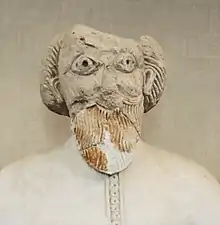 Bust of the standing caliph statue, most likely depicting Hisham ibn Abd al-Malik | |||||
| 10th Caliph of the Umayyad Caliphate | |||||
| Reign | 26 January 724 – 6 February 743 | ||||
| Predecessor | Yazid II | ||||
| Successor | Al-Walid II | ||||
| Born | 691 Damascus, Bilad al-Sham, Umayyad Caliphate | ||||
| Died | 6 February 743 (aged 52) (6 Rabiʽ al-Thani 125 AH) Damascus, Umayyad Caliphate | ||||
| Spouse | Umm Hakim bint Yahya ibn al-Hakam | ||||
| Issue | |||||
| |||||
| Dynasty | Umayyad | ||||
| Father | Abd al-Malik | ||||
| Mother | A'isha bint Hisham | ||||
| Religion | Islam | ||||
Life and background
Hisham was born in Damascus, the capital of the Umayyad Caliphate, in 691 CE (72 AH). He was the son of caliph Abd al-Malik (r. 685–705) and A'isha, the daughter of Hisham ibn Isma'il al-Makhzumi, after whom he was named.[1]
Caliph Yazid II died in Irbid in the Balqa (i.e. Transjordan) subdistrict of Jund Dimashq (military district of Damascus) on 28 January 724 CE (26 Sha'ban 105 AH).[2] His son al-Walid or half-brother Hisham led his funeral prayers.[3] Yazid had intended to appoint al-Walid as his immediate successor, but was persuaded by Maslama to appoint Hisham instead, followed by al-Walid.[4]
Reign
Inheriting the caliphate from his brother Yazid II, Hisham was ruling an empire with many different problems. He would, however, be effective in attending to these problems, and in allowing the Umayyad empire to continue as an entity. His long rule was an effective one, and it saw a rebirth of reforms that were originated by Umar bin Abd al-Aziz.
Like his brother al-Walid I, Hisham was a great patron of the arts, and he again encouraged arts in the empire. He also encouraged the growth of education by building more schools, and perhaps most importantly, by overseeing the translation of numerous literary and scientific masterpieces into Arabic. He returned to a stricter interpretation of the Sharia as Umar had, and enforced it, even upon his own family. His ability to stand up to the Umayyad clan may have been an important factor in his success, and may point to why his brother Yazid was ineffective.
According to tradition, Hisham ordered the hadith scholar Ibn Shihab al-Zuhri (d.742) to commit the hadith he had memorized to writing.
Succession plans
Following his accession, Hisham attempted to secure Maslama (his son) as his successor in place of the appointed successor, his predecessor's son al-Walid ibn Yazid II (known as al-Walid II).[5] Hisham's initial attempts following the Hajj of 735 to persuade al-Walid to step down in favor of Maslama or give Maslama the oath of allegiance as al-Walid's successor were rejected by al-Walid.[6][7][8] Afterward, Hisham sought to undermine al-Walid and secretly gathered support for Maslama.[9] The latter's nomination was supported by his paternal uncle, the famous general Maslama ibn Abd al-Malik, Hisham's maternal grandfather, the former governor of Medina Hisham ibn Isma'il al-Makhzumi,[10] and his sons Ibrahim and Muhammad, and the sons of the influential Banu Abs chief of northern Syria, al-Qa'qa' ibn Khulayd.[11] Maslama's mother Umm Hakim also lobbied for her son's succession.[12] Opposed to Maslama's proposed succession was Khalid al-Qasri, the governor of Iraq, to which Maslama responded by insulting him and his dead brother Asad.[13] Maslama ibn Abd al-Malik's death in the late 730s was a major setback to Hisham's succession plans as it represented the loss of the plan's key supporter in the Umayyad dynasty.[10]
Military activities
On the military front his empire suffered a series of setbacks, especially in the Caucasus against the Khazars (the Battle of Marj Ardabil) and in Transoxiana against the Turgesh (the "Day of Thirst" and the Battle of the Pass). Hisham sent armies to end the Hindu rebellion in Sindh, and was successful when the Hindu ruler Jai Singh was killed. This allowed the Umayyads to reassert their rule over some portions of their provinces in India. Some invasions of Indian kingdoms were led by the Arab governors of Sindh but they were unsuccessful.
Under Hisham's rule, regular raids against the Byzantine Empire continued. One regular commander of Arab forces was the redoubtable Maslama, Hisham's half-brother. He fought the Byzantines in 725–726 CE (A.H. 107) and the next year captured Caesarea Mazaca. He also fought the Khazars in the Caucasus. In 728, he fought for a month against the Khaqan there and defeated him. Hisham's son Mu'awiyah ibn Hisham was another Arab commander in the almost-annual raids against the Byzantine Empire. In 728, he took the fort of Samalu in Cilicia. The next year Mu'awiyah thrust left and Sa'id ibn Hisham right, in addition to a sea raid. In 731, Mu'awiyah captured Kharsianon in Cappadocia.
Mu'awiyah raided the Byzantine Empire in 731–732 (A.H. 113). The next year he captured Aqrun (Akroinos), while Abdallah al-Battal took a Byzantine commander prisoner. Mu'awiyah raided Byzantium from 734–737. In 737, al Walid ibn al Qa'qa al-Absi led the raid against the Byzantines. The next year Sulayman ibn Hisham captured Sindirah (Sideroun). In 738–739, Maslama captured some of Cappadocia and also raided the Avars. Theophanes the Confessor (p. 103) states that while some Arabs raided successfully in 739 and returned home safely, others were soundly defeated at the Battle of Akroinon. He records that internal Byzantine strife (the struggle between Constantine V and the usurper Artabasdos) facilitated Arab raids by Sulayman ibn Hisham in 741–742 (p. 106) that made many Byzantines Arab captives. Al-Tabari refers to the same raid.[14]
In North Africa, Kharijite teachings combined with natural local restlessness to produce a significant Berber revolt. In 740, a large Berber force surrounded a loyal army at Wadi Sherif, where the loyalists fought to the death. Hisham dispatched a force of 27,000 Syrians, which was destroyed in 741. In 742 Handhala ibn Safwan began successfully, but soon was besieged in Qairawan. He led a desperate sortie from the city that scattered the Berbers, killing thousands and re-establishing Umayyad rule.
Hisham also faced a revolt by the armies of Zayd ibn Ali, grandson of Husayn bin Ali, which was put down because of the betrayal of the Kufans. The Kufans encouraged Zayd to revolt. Zayd was ordered to leave Kufah and though he appeared to set out for Mecca, he returned and dwelt secretly in Kufah moving from house to house and receiving the allegiance of many people. Yusuf ibn Umar al-Thaqafi, Iraq's governor, learned of the plot, commanded the people to gather at the great mosque, locked them inside and began a search for Zayd. Zayd with some troops fought his way to the mosque and called on people to come out. He then pushed back Yusuf's troops, but was felled by an arrow. Although his body was initially buried, the spot was pointed out and it was extracted, beheaded and the head sent to Hisham and later to Medina.
%252C_califfo_hisham%252C_dirhem_omayyade%252C_724-743.JPG.webp)
In Spain, the internal conflicts of the years past were ended, and Hisham's governor, Abd ar Rahman ibn Abdallah, assembled a large army that went into France. He besieged Bordeaux and pushed to the Loire. This marked the limit of Arabic conquest in Western Europe. The wave was halted at the Battle of Tours by Charles Martel who ruled the kingdom of the Franks.
Death and succession
Hisham died on 6 February 743 (6 Rabiʽ al-Thani 125 AH),[15] and Maslama led the funeral prayers.[16] Al-Walid II acceded to the caliphate and immediately ordered that Hisham's sons at Rusafa, near Palmyra, be arrested by their cousin al-Abbas ibn al-Walid, but expressly forbade that Maslama or his household be disturbed in deference to their old companionship and Maslama's defense of al-Walid from Caliph Hisham.[8][17]
Bibliography
- Hinds, M. (1991). "Makhzum". In Bosworth, C. E.; van Donzel, E. & Pellat, Ch. (eds.). The Encyclopaedia of Islam, New Edition, Volume VI: Mahk–Mid. Leiden: E. J. Brill. pp. 137–140. ISBN 978-90-04-08112-3.
- Powers, Stephan, ed. (1989). The History of al-Ṭabarī, Volume XXIV: The Empire in Transition: The Caliphates of Sulaymān, ʿUmar, and Yazīd, A.D. 715–724/A.H. 96–105. SUNY Series in Near Eastern Studies. Albany, New York: State University of New York Press. ISBN 978-0-7914-0072-2.
- Blankinship, Khalid Yahya, ed. (1989). The History of al-Ṭabarī, Volume XXV: The End of Expansion: The Caliphate of Hishām, A.D. 724–738/A.H. 105–120. SUNY Series in Near Eastern Studies. Albany, New York: State University of New York Press. ISBN 978-0-88706-569-9.
- Blankinship, Khalid Yahya (1994). The End of the Jihâd State: The Reign of Hishām ibn ʻAbd al-Malik and the Collapse of the Umayyads. Albany, New York: State University of New York Press. ISBN 978-0-7914-1827-7.
- Hawting, Gerald R. (2000). The First Dynasty of Islam: The Umayyad Caliphate AD 661–750 (Second ed.). London and New York: Routledge. ISBN 0-415-24072-7.
- Brown, Daniel W. (1996). Rethinking tradition in modern Islamic thought. Cambridge University Press. ISBN 0521570778. Retrieved 10 May 2018.
- Gabrieli, F. (1960–2007). "Hishām". In Bearman, P.; Bianquis, Th.; Bosworth, C.E.; van Donzel, E.; Heinrichs, W.P. (eds.). Encyclopaedia of Islam, Second Edition. doi:10.1163/1573-3912_islam_SIM_2901.
- Marsham, Andrew (2009). The Rituals of Islamic Monarchy: Accession and Succession in the First Muslim Empire. Edinburgh: Edinburgh University Press. ISBN 978-0-7486-2512-3.
- Hillenbrand, Carole, ed. (1989). The History of al-Ṭabarī, Volume XXVI: The Waning of the Umayyad Caliphate: Prelude to Revolution, A.D. 738–744/A.H. 121–126. SUNY Series in Near Eastern Studies. Albany, New York: State University of New York Press. ISBN 978-0-88706-810-2.
- Bosworth, C. Edmund (1994). "Abū Ḥafṣ 'Umar al-Kirmānī and the Rise of the Barmakids". Bulletin of the School of Oriental and African Studies. 57 (2): 268–282. doi:10.1017/S0041977X0002485X. JSTOR 620573.
- Judd, Steven (July–September 2008). "Reinterpreting al-Walīd b. Yazīd". Journal of the American Oriental Society. 128 (3): 439–458. JSTOR 25608405.
References
- Gabrieli 1960–2007.
- Al-Tabari as translated by Powers 1989, pp. 193–194. Gabrieli 1960–2007 only mentions Sha'ban 105/January 724.
- Al-Tabari as translated by Powers 1989, p. 194.
- Blankinship 1989, p. 87, note 439.
- Marsham 2009, pp. 119–120.
- Al-Tabari as translated by Hillenbrand 1989, p. 89.
- Bosworth 1994, p. 279.
- Judd 2008, p. 453.
- Al-Tabari as translated by Hillenbrand 1989, p. 89.
- Marsham 2009, p. 121.
- Al-Tabari as translated by Hillenbrand 1989, p. 89.
- Marsham 2009, p. 131, note 30.
- Al-Tabari as translated by Hillenbrand 1989, pp. 90–91.
- Al-Tabari, v. 26, p. 68
- Gabrieli 1960–2007.
- Al-Tabari as translated by Hillenbrand 1989, p. 72.
- Al-Tabari as translated by Hillenbrand 1989, p. 100.

Authority control  | |
|---|---|
| General | |
| National libraries | |
| Other | |