Hladnikia pastinacifolia
Hladnikia pastinacifolia is a Slovenian paleoendemic and monotypic plant species of Hladnikia genus that belongs to the Apiaceae family.[4][5] Being the only extant survivor of its endemic genus, the species is restricted to the area of only 4 km2, located in Trnovo Forest Plateau, karst plateau of Western Slovenia.[6] German botanist Heinrich Gottlieb Ludwig Reichenbach named genus after Carniolan botanist and founder of Ljubljana Botanical Garden Franz Hladnik.[4][7]
| Hladnikia pastinacifolia | |
|---|---|
 | |
Scientific classification  | |
| Kingdom: | Plantae |
| Clade: | Tracheophytes |
| Clade: | Angiosperms |
| Clade: | Eudicots |
| Clade: | Asterids |
| Order: | Apiales |
| Family: | Apiaceae |
| Genus: | Hladnikia |
| Species: | H. pastinacifolia |
| Binomial name | |
| Hladnikia pastinacifolia | |
| Synonyms[3] | |
| |
Description
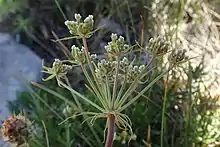
Hladnikia pastinacifolia is a plant species of the Apiaceae family.[8] It is a monocarpic herbaceous perennial plant, which takes a few vegetation periods to develop into a flowering plant.[6] Individuals, which have erect flowering stem, can reach from 15 to 30 centimetres of height.[9] At first plant's leathery and glossy leaves are simple shaped and arranged into rosettes. Later on, as their area increases, leaves also change shape into lobate.[6][9] Hladnikia pastinacifolia resembles well known celery (Apium graveolens), but has thicker foliage and shorter leaf stems.[4] Species' root is long and lignified. The plant's flower has white, heart-shaped and 1 mm long petals.[9]
Not much is known about the plant's exact breeding system. This plant species is entomophilous and has multiple different pollinators. It is thought that outcrossing happens occasionally.[6] The species flowering period is between Mai and July.[4] After successful pollination seeds that don't have any special dispersal adaptation develop between the end of August and into September. Fruit is a schizocarp, which after maturing splits into two 4 mm sized mericarps,[6] 2 mm wide.[9]
Hladnikia pastinacifolia chromosome number is 2n = 22.[9]
Distribution and conservation
The plant is a Slovenian paleoendemic species restricted to small area (4 km2) in Trnovski gozd. There these plants grow only on southern slopes of the plateau and two isolated areas located 9 km away on the northern slopes.[6] As the plant species is not a habitat specialist its growing areas are various; Hladnikia pastinacifolia was found on stony grasslands, rock crevices and screes. Laboratory molecular analyses have shown that Hladnikia pastinacifolia is a Pleistocene survivor in situ.[9]
Even though its population trend is labeled as stable by IUCN Red list, it has data deficient (DD) conservation status.[10][11] Among mentioned threats are human intrusions and disturbance (such as recreational activities) as well as natural system modifications.[11] The Trnovo Forest Plateau is listed as Natura 2000 site.[10][12] Because of its small area of distribution and different threats the species is studied for possible cryopreservation.[5][13][14]
References
- Bilz, Melanie (2011-08-02). "IUCN Red List of Threatened Species: Hladnikia pastinacifolia". IUCN Red List of Threatened Species. Retrieved 2021-08-15.
- "Hladnikia pastinacifolia Rchb". www.gbif.org. Retrieved 2021-08-15.
- "Hladnikia pastinacifolia Rchb". www.gbif.org. Retrieved 2021-08-15.
- "Hladnikia pastinacifolia (rebrinčevolistna hladnikija)". www.botanicni-vrt.si. Retrieved 2021-08-15.
- Ciringer, Terezija (2016). "Krioprezervacija rebrinčevolistne hladnikovke (Hladnikia pastinacifolia Rchb.) z optimizacijo inkapsulacijske dehidracije in vitrifikacije". undefined. Retrieved 2021-08-15.
- "(PDF) Population Genetics of the Narrow Endemic Hladnikia Pastinacifolia RCHB. (Apiaceae) Indicates Survival in Situ During the Pleistocene". ResearchGate. Retrieved 2021-08-15.
- "Info in English | Botanično društvo Slovenije" (in Slovenian). Retrieved 2021-08-15.
- "Hladnikia pastinacifolia Rchb". www.gbif.org. Retrieved 2021-08-15.
- Sajna, Nina; Šuštar-Vozlič, Jelka; Kaligarič, Mitja (2014-10-28). "New Insights into the Anatomy of an Endemic Hladnikia Pastinacifolia Rchb". Acta Botanica Croatica. 73 (2): 375–384. doi:10.2478/botcro-2014-0005. ISSN 0365-0588.
- "Hladnikia pastinacifolia - Rchb". eunis.eea.europa.eu. Retrieved 2021-08-15.
- Bilz, Melanie (2011-08-02). "IUCN Red List of Threatened Species: Hladnikia pastinacifolia". IUCN Red List of Threatened Species. Retrieved 2021-08-15.
- "ArcGIS Web Application". natura2000.eea.europa.eu. Retrieved 2021-08-15.
- "Vpliv velikosti vcepka in gojišča na regeneracijo brstov rebrinčevolistne hladnikovke (Hladnikia pastinacifolia Rchb.) v tkivni kulturi". openscience.si. Retrieved 2021-08-15.
- "Mikropropagacija in krioprezervacija z inkapsulacijsko dehidracijo rebrinčevolistne hladnikovke (Hladnikia pastinacifolia Rchb.)". openscience.si. Retrieved 2021-08-15.