Hoeffding's lemma
In probability theory, Hoeffding's lemma is an inequality that bounds the moment-generating function of any bounded random variable.[1] It is named after the Finnish–American mathematical statistician Wassily Hoeffding.
The proof of Hoeffding's lemma uses Taylor's theorem and Jensen's inequality. Hoeffding's lemma is itself used in the proof of McDiarmid's inequality.
Statement of the lemma
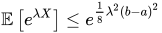
Let X be any real-valued random variable with expected value , such that almost surely, i.e. with probability one. Then, for all ,



or equivalently

A brief proof of the lemma
Replacing by , for which almost surely we may assume and .





Since is a convex function of , we have



So,
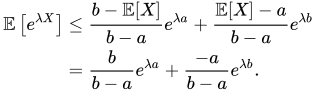
Let , and
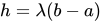


Then, Taking derivative of ,


- for all .


By Taylor's expansion, for some


Hence,
(The proof below is the same proof with more explanation.)
More detailed proof
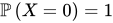
For the second form of the inequality, if it is clear that if it holds for for some constant it holds for because the left hand side is obviously invariant under this substitution and the right hand side depends only on the length of the interval bounding the range. Thus w.l.o.g. we may replace by and assume that . We then note that if one of or is zero, then and the inequality follows. If both are nonzero, then must be negative and must be positive.


Next, recall that is a convex function on the real line:


Applying to both sides of the above inequality gives us:

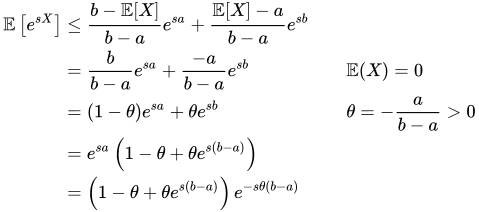
Let and define:


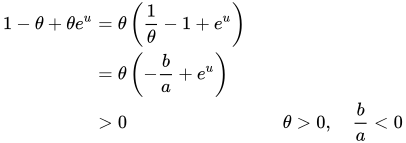
is well defined on , to see this we calculate:


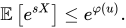
The definition of implies
By Taylor's theorem, for every real there exists a between and such that



Note that:
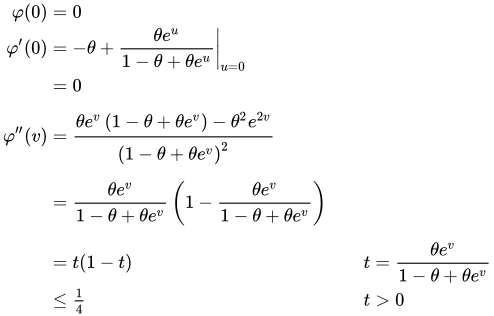
Therefore,

This implies

Notes
- Pascal Massart (26 April 2007). Concentration Inequalities and Model Selection: Ecole d'Eté de Probabilités de Saint-Flour XXXIII - 2003. Springer. p. 21. ISBN 978-3-540-48503-2.