Homogeneous function
In mathematics, a homogeneous function a function of several variables such that, if all its arguments are multiplied by a scalar, then its value is multiplied by some power of this scalar, called the degree of homogeneity; that is, if k is an integer, a function f of n variable is homogeneous of degree k if

for every and


For example a homogeneous polynomial of degree k defines a homogeneous function of degree k.
The above definition extends to functions whose domain and codomain are vector spaces over a field F: a function between two F-vector space is homogeneous of degree if


-
(1)
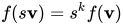
for all nonzero and This definition is often further generalized to functions whose domain is not V, but a cone in V, that is, a subset C of V such that implies for every nonzero scalar s.


In the case of functions of several real variables and real vector space, a slightly more general form of homogeneity, called positive homogeneity is often considered, by requiring only that the above identities hold for and allowing any real number k as a degree of homogeneity. Every homogeneous real function is positevely homogeneous. The converse is not true, but is locally true in the sense that (for integer degrees) the two kinds of homogeneity cannot be distinguished by considering the behavior of a function near a given point.

A norm over a real vector space is a example of positively homogeneous function that is not homogeneous. A special case is the absolute value of real numbers. The quotient of two homogeneous polynomials of the same degree gives an example of homogeneous function of degree zero. This example is fundamental in the definition of projective schemes.
Examples
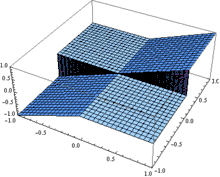




Example 1
The function is homogeneous of degree 2:


For example, suppose and Then


- and


Linear functions
Any linear map is homogeneous of degree 1 since by the definition of linearity

for all and

Similarly, any multilinear function is homogeneous of degree since by the definition of multilinearity



for all and

It follows that the -th differential of a function between two Banach spaces and is homogeneous of degree


Homogeneous polynomials
Monomials in variables define homogeneous functions For example,


is homogeneous of degree 10 since

The degree is the sum of the exponents on the variables; in this example,

A homogeneous polynomial is a polynomial made up of a sum of monomials of the same degree. For example,

is a homogeneous polynomial of degree 5. Homogeneous polynomials also define homogeneous functions.
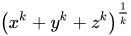
Given a homogeneous polynomial of degree it is possible to get a homogeneous function of degree 1 by raising to the power So for example, for every the following function is homogeneous of degree 1:


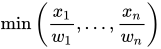
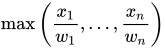
Min/max
For every set of weights the following functions are homogeneous of degree 1:

Polarization
A multilinear function from the -th Cartesian product of with itself to the underlying field gives rise to a homogeneous function by evaluating on the diagonal:




The resulting function is a polynomial on the vector space

Conversely, if has characteristic zero, then given a homogeneous polynomial of degree on the polarization of is a multilinear function on the -th Cartesian product of The polarization is defined by:


These two constructions, one of a homogeneous polynomial from a multilinear form and the other of a multilinear form from a homogeneous polynomial, are mutually inverse to one another. In finite dimensions, they establish an isomorphism of graded vector spaces from the symmetric algebra of to the algebra of homogeneous polynomials on

Rational functions
Rational functions formed as the ratio of two homogeneous polynomials are homogeneous functions in their domain, tht is, off of the linear cone formed by the zeros of the denominator. Thus, if is homogeneous of degree and is homogeneous of degree then is homogeneous of degree away from the zeros of


Non-examples
The homogeneous real functions of a single variable have the form for some constant c. So, the affine function the natural logarithm and the exponential function are not homogeneous.


Definitions
The concept of a homogeneous function was originally introduced for functions of several real variables. With the definition of vector spaces at the end of 19th century, the concept has been naturally extended to functions between vector spaces, since a tuple of variable values can be considered as a coordinate vector. This is this more general point of view that is described in this article.
There are two commonly used definitions. The general one works for vector spaces over arbitrary fields, and is restricted to degrees of homogeneity that are integers.
The second one supposes to work over the field of real numbers, or, more generally, over an ordered field. This definition restricts to positive values the scaling factor that occurs in the definition, and is therefore called positive homogeneity, the qualificative positive being often ommitted when there is no risk of confusion. Positive homogeneity leads to consider more functions as homogeneous. For example, the absolute value and all norms are positively homogeneous functions that are not homogeneous.
The restriction of the scaling factor to real positive value allows also considering homogeneous functions whose degree of homogeneity is any real number.
Euler's theorem
Continuously differentiable positively homogeneous functions are characterized by the following theorem:
Euler's homogeneous function theorem — Suppose that the function is continuously differentiable. Then is positively homogeneous of degree if and only if


This result follows at once by differentiating both sides of the equation with respect to applying the chain rule, and choosing to be
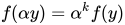


The converse is proved by integrating. Specifically, let Since
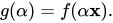


Thus, This implies Therefore, : is positively homogeneous of degree

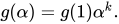


As a consequence, suppose that is differentiable and homogeneous of degree Then its first-order partial derivatives are homogeneous of degree The result follows from Euler's theorem by commuting the operator with the partial derivative.


One can specialize the theorem to the case of a function of a single real variable (), in which case the function satisfies the ordinary differential equation

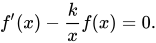
This equation may be solved using an integrating factor approach, with solution where


Application to differential equations
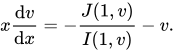
The substitution converts the ordinary differential equation

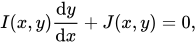
where and are homogeneous functions of the same degree, into the separable differential equation


Generalizations
Homogeneity under a monoid action
The definitions given above are all specializes of the following more general notion of homogeneity in which can be any set (rather than a vector space) and the real numbers can be replaced by the more general notion of a monoid.
Let be a monoid with identity element let and be sets, and suppose that on both and there are defined monoid actions of Let be a non-negative integer and let be a map. Then is said to be homogeneous of degree over if for every and



If in addition there is a function denoted by called an absolute value then is said to be absolutely homogeneous of degree over if for every and



A function is homogeneous over (resp. absolutely homogeneous over ) if it is homogeneous of degree over (resp. absolutely homogeneous of degree over ).

More generally, it is possible for the symbols to be defined for with being something other than an integer (for example, if is the real numbers and is a non-zero real number then is defined even though is not an integer). If this is the case then will be called homogeneous of degree over if the same equality holds:



The notion of being absolutely homogeneous of degree over is generalized similarly.
Distributions (generalized functions)
A continuous function on is homogeneous of degree if and only if


for all compactly supported test functions ; and nonzero real Equivalently, making a change of variable is homogeneous of degree if and only if



for all and all test functions The last display makes it possible to define homogeneity of distributions. A distribution is homogeneous of degree if



for all nonzero real and all test functions Here the angle brackets denote the pairing between distributions and test functions, and is the mapping of scalar division by the real number
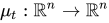
Glossary of name variants
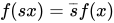
Let be a vector space over a field and let be a vector space over a field where and will usually be (or possibly just contain as subsets) the real numbers or complex numbers Let be a map.[note 1] If is a set of scalars, such as for example, then is said to be homogeneous over if




while it is called conjugate homogeneous (resp. absolutely homogeneous) over this set if (resp. if ) holds for all such For instance, every additive map between vector spaces is homogeneous over the rational numbers although it might not be homogeneous over the real numbers



The following commonly encountered special cases have their own terminology:[note 2]
- Strict positive homogeneity: for all and all positive real
- Nonnegative homogeneity: for all and all non-negative real
- A non-negative real-valued functions with this property can be characterized as being a Minkowski functional.
- This property is used in the definition of a sublinear function.
- Positive homogeneity: This is usually defined to mean "nonnegative homogeneity" but it is also frequently defined to instead mean "strict positive homogeneity".
- Which of these two is chosen as the definition is usually[note 3] irrelevant because for a function valued in a vector space or field, nonnegative homogeneity is the same as strict positive homogeneity; the definitions will be logically equivalent.[proof 1]
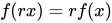
- Real homogeneity: for all and all real
- This property is used in the definition of a real linear functional.
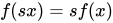
- Homogeneity: for all and all scalars
- It is emphasized that this definition depends on the scalar field underlying the domain .
- This property is used in the definition of linear functionals and linear maps.
- Conjugate homogeneity: for all and all scalars
- If then typically denotes the complex conjugate of But more generally, as with semilinear maps for example, could be the image of under some distinguished automorphism of
- Along with additivity, this property is assumed in the definition of an antilinear map. It is also assumed that one of the two coordinates of a sesquilinear form has this property (such as the inner product of a Hilbert space).




All of the above definitions can be generalized by replacing the condition with in which case that definition is prefixed with the word "absolute" or "absolutely." For example,

- Absolute real homogeneity: for all and all real
- Absolute homogeneity: for all and all scalars

If is a fixed real number then the above definitions can be further generalized by replacing the condition with (and similarly, by replacing with for conditions using the absolute value, etc.), in which case the homogeneity is said to be "of degree " (where in particular, all of the above definitions are "of degree "). For instance,
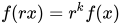
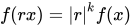
- Nonnegative homogeneity of degree : for all and all real
- Real homogeneity of degree : for all and all real
- Homogeneity of degree : for all and all scalars
- Absolute real homogeneity of degree : for all and all real
- Absolute homogeneity of degree : for all and all scalars
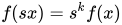
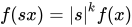
A nonzero continuous function that is homogeneous of degree on extends continuously to if and only if


Notes
- Note in particular that if then every -valued function on is also -valued.
- For a property such as real homogeneity to even be well-defined, the fields and must both contain the real numbers. We will of course automatically make whatever assumptions on and are necessary in order for the scalar products below to be well-defined.
- In fields like convex analysis, the codomain of is sometimes the set of extended real numbers, in which case the multiplication will be undefined whenever In this case, the conditions "" and "" may not necessarily be used interchangeably. However, if such an satisfies for all and then necessarily and whenever are both real then will hold for all






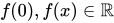
- Proofs
- Assume that is strictly positively homogeneous and valued in a vector space or a field. Then so subtracting from both sides shows that Writing then for any which shows that is nonnegative homogeneous.




References
- Blatter, Christian (1979). "20. Mehrdimensionale Differentialrechnung, Aufgaben, 1.". Analysis II (2nd ed.) (in German). Springer Verlag. p. 188. ISBN 3-540-09484-9.
External links
- "Homogeneous function", Encyclopedia of Mathematics, EMS Press, 2001 [1994]
- Eric Weisstein. "Euler's Homogeneous Function Theorem". MathWorld.