Hospital Bahagia Ulu Kinta
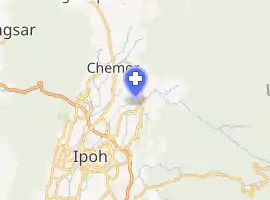
Colloquially called "Hospital Tanjung Rambutan", Hospital Bahagia Ulu Kinta is a government-funded public psychiatric hospital, located in the town of Tanjung Rambutan, Perak. This hospital features 2,600 beds and 79 wards which consisted of 54 male wards and 25 female wards.
| Hospital Bahagia Ulu Kinta | |
|---|---|
| Ministry of Health (Malaysia) | |
| |
| Geography | |
| Location | Hospital Bahagia Ulu Kinta, Tanjung Rambutan, 31250, Perak, Malaysia |
| Coordinates | 4.6756°N 101.1507°E |
| Organisation | |
| Type | Specialist |
| Services | |
| Beds | 2,600 |
| Speciality | Psychiatric hospital |
| History | |
| Opened |
|
| Links | |
| Website | hbuk |
| Lists | Hospitals in Malaysia |
Hospital Bahagia Ulu Kinta is the oldest psychiatric hospital in Malaysia.
History
In 1910, the idea of a mental asylum was proposed by Dr Samuel, Medical Superintendent and he chooses Tanjung Rambutan for the site of the construction of the Federal Lunatic Asylum. It was completed in 1911. Construction was completed in 1911 and Dr. WF Samuels was appointed the first Medical Superintendent of the hospital. In the early year of Federal Lunatic Asylum, it was a small mental asylum consisting of 3 male wards and a female ward which were separated by a kitchen space.
In 1928 Federal Lunatic Asylum was renamed Central Mental Hospital, during World War II, After Singapore surrendered to the Japanese in 1942, The Japanese transferred about 600 people in 1944 to the hospital. Of these 600, after the war, only 329 returned.
In the early 1970s the name was changed to Hospital Bahagia Ulu Kinta to give it a less stigmatized look on the psychiatric treatment. Today, Hospital Bahagia Ulu Kinta is the largest psychiatric hospital in Malaysia
The original area of Hospital Bahagia Ulu Kinta is 544 acres of which about 300 acres are used to erect various buildings and the rest is used for patient rehabilitation activities such as agriculture, livestock and fisheries. However, in 2007 a total of 41 acres were handed over for the construction of the Ulu Kinta Allied Health Sciences College.