Hot Coffee (mod)
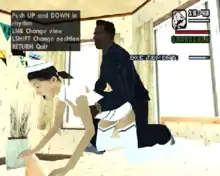
"Hot Coffee" is an unofficial name for a minigame in Grand Theft Auto: San Andreas, a 2004 video game developed by Rockstar North. The minigame is not playable through normal means; the game must be modded to access it. When enabled, "Hot Coffee" allows players, as protagonist Carl "CJ" Johnson, to have animated sexual intercourse with an in-game girlfriend.
"Hot Coffee" was included in San Andreas as part of the boundary-pushing vision that company president Sam Houser had for the Grand Theft Auto games. Before development concluded, Rockstar operations director Jennifer Kolbe warned Houser that explicit sexual content would likely bring restrictive assessments from ratings boards, harming retail sales. "Hot Coffee" could not be fully removed, so the content was hidden from players using cutscenes. Data miners discovered evidence of explicit sexual content after San Andreas was released for the PlayStation 2 in 2004, and confirmed its existence when the Windows version released on June 7, 2005. Modder Patrick Wildenborg released a patch to unlock the minigame two days later.
While players found "Hot Coffee" humorous, it led to San Andreas becoming embroiled in controversy. Within a month of the patch's release, the American Entertainment Software Rating Board (ESRB) and Australian Office of Film and Literature Classification (OFLC) re-evaluated San Andreas's content rating. The ESRB rerated the game Adults Only, causing many retailers to pull it from sale, while the OFLC issued a Refused Classification, banning it from sale in Australia. Rockstar recalled all retail copies of San Andreas and released a new version that blocked access to "Hot Coffee" by the end of 2005, and issued a patch for existing owners to prevent access. The "Hot Coffee" source code remains in all versions of San Andreas but takes more effort to restore due to missing models and animations.
"Hot Coffee" raised concerns from lawmakers related to mandatory game ratings, and several civil suits were launched against Rockstar. Rockstar's parent company, Take-Two Interactive, was already under investigation by the U.S. Securities and Exchange Commission (SEC) related to insider trading, and lawmaker actions due to "Hot Coffee" triggered a separate investigation by the Federal Trade Commission. These events led to Take-Two losing over $163 million by 2006, and caused shareholders to oust the company's founder and chairman Ryan Brant and replace him with Strauss Zelnick.
Gameplay
In Grand Theft Auto: San Andreas, the player, as Carl "CJ" Johnson, progresses through the action-adventure game through a series of story-based missions. Between missions, the player can engage in a number of side activities to earn in-game money, rewards, or to boost Carl's attributes. CJ may date up to six girlfriends, carrying out various "date missions" to improve his relationship with a particular woman. If CJ's relationship builds up high enough with one of these women, they will invite him to her home for "coffee" (slang for sexual intercourse). This, in the unmodified game, is shown as a cutscene from the exterior of a house with muffled sounds of sexual activity. Achieving this rewards the player with benefits related to that woman; for example, successfully reaching this point with a nurse allows the player to heal CJ at any hospital free of charge.
If the game is altered through the use of a modification ("mod"), instead of cutscene, the player can access a minigame in which they witness the intercourse and can control CJ's actions. While both CJ and the girlfriend are clothed, the motions of both characters and actions the player can have CJ take are unmistakably sexual activities, such as CJ spanking the girlfriend.[1]
Development
Grand Theft Auto is a series of action-adventure games featuring story-driven missions within an open world, following one or more characters engaged in criminal-related activities. Grand Theft Auto 3, released in 2001, redefined the approach to the series and became one of the best-selling games at the time, and Rockstar's followup Grand Theft Auto: Vice City in 2002 was similarly successful. Both games had drawn criticism from parents and similar groups for the levels of violence and language within the game. Both were rated as mature titles on various content rating systems, such as the Entertainment Software Ratings Board (ESRB) for the United States, and still were allowed to be sold in stores in most countries. Rockstar's president, Sam Houser, had stated that the violence had been justified as these games were meant as commentary on the time periods and places of these games.[2][3]
In planning for their next title, Grand Theft Auto: San Andreas, Houser had stated in internal emails that he would like to see them push the bar on content within the game by including sexually-explicit content, including cutscenes and minigames showing sexual acts. He had already had developers at Rockstar North include some of these elements as the game neared the final stages of release.[1] Houser asserted in an email that "In [GTA: San Andreas] we are keen to include new functionality and interaction in line with the 'vibe' of the game. To this end, in addition to the violence and bad language, we want to include sexual content, which I understand is questionable to certain people, but pretty natural (more than violence), when you think about it and consider the fact that the game is intended for adults."[1] Houser saw that incorporation of sex into the series was the natural progression, though such content within video games had generally been avoided despite other media aimed at adults frequently including it, and wrote "I know this is a tricky area, but I want to find a way for this to work."[1]
Rockstar's operations director Jennifer Kolbe warned Houser that inclusion of these sexually-explicit cutscenes would very likely force content ratings groups like the ESRB to rate San Andreas as an Adults-Only title. This rating would either ban or restrict it from sale in some countries, while retailers in most others would likely not sell it; either result would significantly harm sales. Houser conceded and wrote in this email "Graphic displays of sex cannot be shown in a Mature rated game… The sex scenes that are in San Andreas currently are going to be considered graphic."[1] Kolbe reviewed the current state of the game to list what needed to be cut to assure the game would not be rated Adults-Only, which was far more than Houser had been expecting; he said "The cuts are everywhere. It doesn't feel like we are pushing any boundaries now. Why bother? I really, really do not want to change this stuff. It feels SO wrong at the behest of psychotic, mormon [sic], capitalist retailers."[1] The list of material to be cut also included content that had been engrained within the game that it would have been difficult to remove in such a short time without potentially breaking other parts of the game. For these parts, the developers found a way to hide the sexual content behind other content that would otherwise be shown to the player, without having to rewrite other parts of the game's code as to assure the game made its target release date.[1]
Discovery
After San Andreas was released for PlayStation 2 in October 2004, modders began data mining the game. Past Grand Theft Auto games had known to have a number of Easter eggs and secrets, and modders began searching through files and creating mods to help locate them and for video game trainers that made the game easier for other players. One mod group, which included Patrick Wildenborg, started evaluating files from the PlayStation 2 version in anticipation of preparing mods for the Windows release in June 2005. The group found references to animations and script files related to sexual acts, and while they could not fully visualise these in the PlayStation 2 version, they recognised these animations were clearly of sexual acts. They decided to revisit them when the Windows version was released since, from their past experience, this version would be easier to work with. The group opted not to speak about their discovery until they could confirm with the Windows release.[1]
Between the PlayStation 2 and the Windows launch, Houser had wrote in internal emails if they could push more on the sexual content for the Windows release, including the possibility of a separate Adults-Only release that included all the prior cut and hidden sexual material. After internal debates, they opted to go with plans to release an Adults-Only patch that would unlock the content they had hidden, and the Windows version was shipped effectively in the same state as the PlayStation 2 version for this patch to work.[1] The Windows version was released on June 7, 2005; that same day, Wildenborg's group acquired their copies of the game and confirmed their assumptions of sexual content. They also discovered how to unhide the sexual intercourse dating minigame.[1]
Wildenborg created a patch file named "Hot Coffee", given the purported reason the girlfriend invited CJ to her home, and released it to the Internet at GTAGarage.com (the primary site for Grand Theft Auto mods at the time) two days after San Andreas's release, on June 9, 2005.[1][4] According to Wildenborg, the "Hot Coffee" patch was downloaded over a million times within the first four weeks of release. Most Grand Theft Auto players found the minigame "hilarious", and the gaming media covered the patch positively rather than with shock.[1]
Product rating and reissue
On July 8, 2005, the ESRB announced that it was aware of and opening an investigation into the circumstances surrounding "Hot Coffee". The investigation examined "whether the mod unlocks preexisting code...or is actually a purely third-party creation."[5] The Australian Office of Film and Literature Classification (OFLC) also opened an investigation into the game.[6] The ratings reviews by the ESRB and OFLC caught the attention of mainstream media to the "Hot Coffee" mod, with Wildenborg as a focal point since he had released the mod.[1][7][8] Because of misconceptions by the media of how the mod worked, Wildenborg clarified that the sex scenes were only accessible by modifying the code and were not immediately available from the retail version of the game, which he claimed that Rockstar thanked him for clarifying.[1] Rockstar asserted that it was not responsible for the "Hot Coffee" mod, claiming that "Hackers created the 'Hot Coffee' modification by disassembling and then combining, recompiling and altering the game's source code."[6]
 |
Wikinews has related news: |
The ESRB announced on July 20, 2005, that it was changing the rating of Grand Theft Auto: San Andreas from "Mature" (M) to "Adults Only" (AO), making it the first and only Grand Theft Auto game and the only mass-released game in North America to receive an AO rating.[9] Major retailers including GameStop, Sears, Hudson's Bay Company, Zellers, Hollywood Video, Blockbuster, Wal-Mart, Target, Best Buy, and Electronics Boutique removed the game from sale with the AO rating.[10][1] The OFLC revoked San Andreas's original rating of "MA15+" on July 29, 2005, and instead gave it a "Refused Classification", which under Australian law, banned any retail sales of the game.[11] Rockstar stated that it would discontinue manufacturing the current version of the game, recall existing copies, and produce a new version that would not include the content that is unlocked by the "Hot Coffee" mod.[1] The product recalled was estimated to cost Rockstar $24 million.[12] The company issued a patch in August 2005 for existing owners of the game that disabled access to the "Hot Coffee" scenes even with use of the mod.[13] By the fourth quarter of 2005, Rockstar had rereleased new retail versions of the game that similarly blocked any access to the "Hot Coffee" scenes, restoring the ESRB's original M rating and OFLC's MA15+ rating.[14][15]
It is still possible to unlock the "Hot Coffee" minigame through mods for the new version, but according to Wildenborg, it takes much more effort to create the necessary patch.[4] A data miner quoted by Eurogamer explained that the "Hot Coffee" source code is still present in every rerelease of San Andreas, but the necessary models and animations were removed, rendering the minigame unplayable by normal means.[16]
Federal and legal action
|
Wikinews has related news: |
After the ESRB announced its investigation into re-rating San Andreas in July 2005, U.S. Senator Hillary Clinton suggested that new regulations be put on video game sales.[17] Congress passed a resolution to have the Federal Trade Commission (FTC) investigate whether Rockstar intentionally undermined the ESRB by including the content in the game.[18] In December 2005, Senators Clinton, Joe Lieberman, and Evan Bayh introduced the Family Entertainment Protection Act, which called for a federal mandate enforcement of the ESRB ratings system in order to protect children from inappropriate content.[19] The bill expired at the end of the 109th Congress.[20] Hilary Clinton's role in the controversy would later be satirised by Rockstar in the next mainline entry in the series, Grand Theft Auto IV, where a parody of the Statue of Liberty called the "Statue of Happiness" bears a strong resemblance to Clinton, also replacing the torch with a steaming cup of coffee in reference to the "Hot Coffee" mod controversy.[21]
Rockstar, Take-Two, and the FTC announced they had reached a settlement on June 8, 2006. As part of the deal, Rockstar and Take-Two were required to "clearly and prominently disclose on product packaging and in any promotion or advertisement for electronic games, content relevant to the rating, unless that content had been disclosed sufficiently in prior submissions to the rating authority." Should the companies violate the settlement, they would be liable for $11,000 in civil penalties.[12]
Civil class actions
In New York, a class-action lawsuit was filed by Florence Cohen, an 85-year-old grandmother who purchased the game for her 14-year-old grandson (according to the old rating of "M", the game is considered inappropriate for this age). Cohen's lawsuit claimed that Rockstar Games and Take-Two Interactive, the publisher of the game, were guilty of deception, false advertising, fraud, and abuse. The accusation of deception was based on the change in rating from M to AO, meaning according to the lawsuit that the original rating was a deceptive practice.[22]
In 2006, attorneys brought several class actions alleging Take-Two committed consumer fraud. In December 2007, a settlement of the litigation was reached.[23] In 2008, Ted Frank filed an objection to the settlement on the grounds that the settlement sought $1 million for attorneys' fees, but the total payout to class members was less than $27,000.[24][25] A court hearing was already scheduled on June 25, 2008. Frank previously told GamePolitics that the lawsuits were meritless and extortionate.[26]
As part of the settlement, Take-Two will pay an $873,000 cy-près award to the National Parent-Teacher Association and the ESRB.[24][25]
As of June 25, 2008, fewer than 2,700 claimants responded to the settlement, for which the plaintiff's attorneys expressed disappointment.[27] Frank expressed that this was further proof that the case had no merit.
On January 27, 2006, the city of Los Angeles filed a lawsuit against Take-Two Interactive, the game's publisher, accusing the company of failing to disclose the game's sexual content.[28]
As of September 1, 2009, Take-Two agreed to settle a securities class-action suit related to the controversy over the game and over backdating allegations for just over $20 million.[29]
Impact
The revelation of the minigame sparked a fair amount of new controversy around the already controversial Grand Theft Auto: San Andreas, with some politicians firing harsh words at both the game's developer and the Entertainment Software Rating Board (ESRB), the organisation which establishes content ratings for video games in North America. It also rekindled the debate over the influence of video games in general, with new protests against several other games such as Killer7, The Sims 2, and Bully. A protest group known as the Peaceholics organised a protest on August 4, 2005, at Rockstar's headquarters. The group demonstrated against San Andreas as well as the game Bully, the latter due to fears that the content could inspire children to become bullies themselves.[30][31]
The "Hot Coffee" mod controversy occurred around the same time that Take-Two's leadership was undergoing investigation by the United States Securities and Exchange Commission (SEC) on charges of inside trading that involved Take-Two's founder and current chairperson, Ryan Brant (son of Peter Brant). On the same day of release of the "Hot Coffee" patch, on June 9, 2007, Take Two had been fined US$7.5 million from the SEC.[1] The company had lost US$163.3 million in 2006 as a combined result of these issues. A group of Take-Two shareholders worked together to arrange a buyout of a majority holding of the company, ousting Brant and naming shareholder Strauss Zelnick as the new CEO.[32]
The modding scene around Grand Theft Auto and other games was impacted by the negative attention from ratings groups and media. Though Rockstar had initially blamed the modders for adding the "Hot Coffee" material but later backed off once it was shown the material had shipped with the game, this had created the impression that modders could introduce undesirable content into a released game.[4] The ESRB began incorporating language into its review policies to developers and publishers to consider the impact of modders on the ratings of a game and to avoid the inclusion of content that could be unveiled in the same manner as Hot Coffee. The "Hot Coffee" mod itself was voluntarily taken down from GTAGarage.com once the controversy began to ignite, but this had left other modders in fear of becoming either legal or media targets for mods, according to Wildenborg, and creating a chilling effect on the modding community in the year that followed.[4]
In 2006, the ESRB re-rated The Elder Scrolls IV: Oblivion from Teen to Mature after it was discovered, through a mod, that the game included art assets with nudity and violent imagery. This led Congress to call the ESRB to testify on matters related to how it reviewed video games, and the ESRB to implement changes to its policies, such that if the publisher of the game did not reveal the extent of content on a shipped game and was later discovered by similar means, they could be subject to a fine of up to $1 million.[33] Senator Sam Brownback introduced the Truth in Video Game Rating Act in 2006 following these hearings that would have made ESRB required to review all portions of a game, as well as having the FTC oversee the ratings definitions and the Government Accountability Office oversee ESRB. This Act failed to reach the Senate floor for voting.[34]
Dan Houser commented on the occurrence in 2012 that "We never felt that we were being attacked for the content, we were being attacked for the medium, which felt a little unfair. If all of this stuff had been put into a book or a movie, people wouldn't have blinked an eye".[35]
Grand Theft Auto V released in 2013, featuring various sex animations when the player's character rents a prostitute. This has been juxtaposed with the "Hot Coffee" scandal.[36]
A user had recreated a similar "Hot Coffee" modification for Rockstar's Red Dead Redemption 2 in February 2020; unlike the San Andreas version, the mod is based on reusing models and animation assets but does not reflect content wholly available in the game as distributed. The mod involves the game's protagonist, Arthur Morgan, engaging in sex with a prostitute, though no nudity is shown. Take-Two had sent a cease and desist letter to the modder, claiming the mod violated the game's terms of use, but the modder argued that the mod "doesn't enable anything that was previously hidden by the devs, and only uses animations/audio that are still used in the game".[37]
On its initial release, the Windows version of the 2021 Grand Theft Auto: The Trilogy – The Definitive Edition, which included San Andreas, was pulled by Rockstar a few days after launch, claiming that it was released with "unintentionally included" files. Data miners found that the version still included content that the "Hot Coffee" mod would have accessed.[16][38]
References
- Parkin, Simon (December 2, 2012). "Who spilled Hot Coffee?". Eurogamer. Retrieved November 14, 2021.
- "Sam Houser Interview". 1UP.com. Archived from the original on 19 March 2016. Retrieved 19 March 2013.
- Kushner, David (March 29, 2007). "The Road to Ruin: How Grand Theft Auto Hit the Skids". Wired. Retrieved November 14, 2021.
- Brathwaite, Brenda (October 27, 2006). "Hot Coffee's Effects on the Mod Scene". Gamasutra. Retrieved November 14, 2021.
- "ESRB to investigate San Andreas sex content". CNET. CNET Networks. July 8, 2005. Retrieved May 20, 2014.
- Feldman, Curt (July 14, 2005). "Hackers behind sex change, says 'Grand Theft' maker". CNet. Retrieved November 14, 2021.
- Lohr, Steve (July 11, 2005). "In Video Game, a Download Unlocks Hidden Sex Scenes". The New York Times. Retrieved November 14, 2021.
- "Sex controversy over GTA game". BBC News. July 11, 2005. Retrieved November 14, 2021.
- "San Andreas rated AO, Take-Two suspends production". GameSpot. CNET Networks. Retrieved July 1, 2006.
- Chris Morris (July 20, 2005). "Wal-Mart and Target Pull Grand Theft Auto". CNN Money. Retrieved August 4, 2015.
- The Classification Board and Classification Review Board
- Adams, David (June 8, 2006). "Rockstar, FTC Settle Over Hot Coffee". IGN. Retrieved November 14, 2021.
- "No more 'Hot Coffee' sex for GTA". BBC News. August 11, 2005. Retrieved November 14, 2021.
- "FTC Hot Coffee ruling scalds, but doesn't burn Take-Two". GameSpot. CNET Networks. Archived from the original on July 8, 2006. Retrieved July 1, 2006.
- The Classification Board and Classification Review Board
- Yin-Poole, Wesley (November 13, 2021). "Dataminers discover Hot Coffee code in GTA: The Trilogy - The Definitive Edition". Eurogamer. Retrieved November 14, 2021.
- "Clinton calls for federal game regulation". GameSpot. Archived from the original on July 21, 2005. Retrieved July 14, 2005.
- "Take-Two sued, confirms FTC investigation". GameSpot. Retrieved July 27, 2005.
- Jennie Lees (December 16, 2005). "Family Entertainment Protection Act Now Filed". Engadget. Retrieved August 4, 2015.
- Govtrack.us. "S. 2126 [109th]: Family Entertainment Protection Act". Retrieved August 31, 2007.
- Parkin, Simon (November 30, 2012). "Who spilled Hot Coffee?". Eurogamer. Retrieved July 9, 2021.
- "Grandma Sues Rockstar Over San Andreas". TeamXbox. Archived from the original on July 30, 2005. Retrieved July 27, 2005.
- "GTA Settlement". Archived from the original on December 24, 2007.
- "Did Lawyers Inflate Fees in Hot Coffee Class Action Suit?". Gamepolitics.com. May 27, 2008. Archived from the original on September 6, 2008.
- "Grand Theft Auto: Class Action Settlement - $26,505 for the unrepresented class, $1 million fee request". Overlawyered. May 26, 2008.
- "Overlawyered Disses Hot Coffee Class Action Settlement". Gamepolitics.com. April 29, 2008.
- Matt Martin (June 25, 2008). "Lawyers shocked at lack of Hot Coffee claimants". gamesindustry.biz. Retrieved June 26, 2008.
- Eric Bangeman (January 27, 2006). "Take-Two Interactive Sued over Hot Coffee Mod". Ars Technica. Retrieved August 4, 2015.
- "Take-Two Interactive Software, Inc. Announces Settlement of Securities Class Action". Thomson Reuters. September 1, 2009. Archived from the original on September 5, 2009. Retrieved September 1, 2009.
- "March against Bully". Joystiq. Retrieved August 4, 2005.
- "Group Releases Rockstar Demands". Joystiq. Archived from the original on November 25, 2005. Retrieved August 4, 2005.
- Peters, Jeremy (March 30, 2007). "Stockholders Oust Chief at Take-Two". The New York Times. Archived from the original on September 3, 2018. Retrieved September 3, 2018.
- Loughrey, Paul (June 15, 2006). "ESRB promises heavy fines for publisher nondisclosure". GamesIndustry.biz. Archived from the original on June 30, 2006.
- "Senate Proposes New ESRB Legislation". Gamasutra. Archived from the original on March 11, 2007. Retrieved September 27, 2006.
- Stuart, Keith (November 18, 2012). "How Dan Houser helped turn Grand Theft Auto into a cultural phenomenon". The Guardian. Retrieved November 24, 2021.
- Cook, James (November 18, 2014). "The New 'Grand Theft Auto' Lets You Have Realistic Sex With Prostitutes". Business Insider. Retrieved November 24, 2021.
- Yin-Poole, Wesley (February 22, 2020). "Red Dead Redemption 2 Hot Coffee mod creator defiant despite legal threat". Eurogamer. Retrieved February 22, 2020.
- Robinson, Andy (November 13, 2021). "GTA Trilogy chaos continues as 'Hot coffee sex mini-game files' reportedly uncovered". Video Games Chronicle. Retrieved November 13, 2021.
| Main games | |||||
|---|---|---|---|---|---|
| Other games | |||||
| Other media | |||||
| People | |||||
| Related articles | |||||
| |||||
