House of Aberffraw
The House of Aberffraw was a cadet branch of the Kingdom of Gwynedd.[2] The establishment of a Royal court (Welsh: Llys) in line with the Crown of the King of Wales arose in the 9th century with Rhodri Mawr assigning the Aberffraw Commote as the new location to rule Wales.[3]
| House of Aberffraw | |
|---|---|
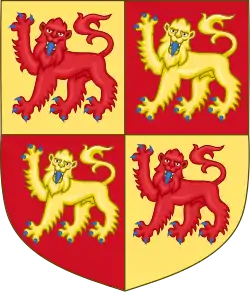 Traditional Arms of the Aberffraw House of Gwynedd | |
| Parent house | House of Gwynedd |
| Country | Wales |
| Founded | c. 9th century |
| Founder | Anarawd ap Rhodri |
| Final ruler | Dafydd ap Gruffydd |
| Titles | King of the Britons, King of the Welsh, Prince of Wales, Prince of the Welsh, Prince [and king] of Gwynedd, of Powys, Prince of Aberffraw, Lord of Snowdon, of Ynys Môn, of Meirionnydd, and of Ceredigion.[1] |
Definitive carbon dating has proven a presence on the site starting between 1st to 4th centuries AD, and a settlement prior to the Roman conquest of Anglesey.[1][4] With the Roman's came Christianity, St Beuno's Church, Aberffraw was established in the 7th century, and shows the locals were keen to adapt to their new religion, a place of worship has stood on the site for over a millennium.[5]
When Aberffraw is mentioned, the Royal familial branch describes a historiographical and genealogical term historians use to illustrate of the clear line of succession from Rhodri the Great of Wales through his eldest son Anarawd.[1][ab 1]
Founding
Anarawd and his immediate heirs made the village of Aberffraw on Anglesey (Welsh: Ynys Môn) their early principal family seat.
In the 10th century, Rhodri the Great had inherited Gwynedd from his father and Powys from his mother, and he added Seisyllwg (Ceredigion and Carmarthenshire) by a dynastic marriage to Angharad of Seisyllwg.[6]
Power base
The family were able to assert their influence within Gwynedd, their traditional sphere of influence, but by the 11th century they were ousted from Powys (Mid Wales) and Deheubarth (West Wales) by a series of strong rulers from the House of Dinefwr in Deheubarth, their dynastically junior cousins. The Dinefwr family were descended from the second son of Rhodri the Great. However, Gruffudd ap Cynan Aberffraw was able to recover his heritage and position as Prince of Gwynedd from Norman invaders by 1100. Owain Gwynedd, Gruffudd's son, defeated King Henry II of England and the vast Angevin host in 1157 and 1166, which led to Owain being proclaimed as Princeps Wallensium, the Prince of the Welsh, by other Welsh rulers. This proclamation reasserted and updated the Aberffraw claims to be the principal royal family of Wales, as senior line descendants of Rhodri the Great.[ab 2] This position was further reaffirmed in the biography The History of Gruffydd ap Cynan. Written in Latin, the biography was intended for an audience outside Wales.[1] The significance of this claim was that the Aberffraw family owed nothing to the English king for their position in Wales, and that they held authority in Wales "by absolute right through descent", wrote historian John Davies.[1]
By 1216 Llywelyn the Great had received the fealty and homage of the Dinefwr rulers of Deheubarth at the Council of Aberdyfi.[6] With homage and fealty paid by other Welsh lords to Llywelyn at the Council of Aberdyfi, Llywelyn the Great became the de facto first "Prince of Wales" in the modern sense, though it was his son Dafydd ap Llywelyn who was the first to adopt that title.[1][ab 3] However, the 1282 Conquest of Wales by Edward I greatly reduced the influence of the family. King Edward I of England forced the remaining members of the family to surrender their claim to the title of Prince of Wales under the Statute of Rhuddlan in 1284, which also abolished the independent Welsh peerage. The Aberffraw family members closest to Llywelyn II were imprisoned for life by Edward, while the more distant Aberffraw members went into deep hiding and fell into obscurity. Other members of the family did lay claim to their heritage; they included Owain Lawgoch in the 14th century.[7]
Succession
Royal succession within the House of Aberffraw (as with succession in Wales in general) was a complex matter due to the unique character of Welsh law.[1] According to Hurbert Lewis,[6] though not explicitly codified as such, the edling, or heir apparent, was by convention, custom, and practice the eldest son of the lord or Prince and was entitled to inherit the position and title as "head of the family" from the father. This was effectively primogeniture with local variations. However, all sons were provided for out of the lands of the father, and in certain circumstances so too were daughters (with children born both in and out of wedlock considered legitimate).[1] Men could also claim royal title through the maternal patrimony of their mother's line in certain circumstances (which occurred several times during the period of Welsh independence).[8][ab 4] The female line of the dynasty was also considered to remain royal, as marriage was an important means of strengthening individual claims to the various kingdoms of Wales and uniting various royal families to that of Aberffraw, or reuniting factions after dynastic civil wars (for example with the marriage of Hywel Dda, a member of the Dinefwr branch of the Aberffraw dynasty, and Elen of Dyfed, daughter of Llywarch ap Hyfaidd, King of Dyfed).[9][ab 5]
Members of the House of Aberffraw would include Idwal Foel, Iago ab Idwal, Cynan ab Iago, Gruffudd ap Cynan, Owain Gwynedd, Gwenllian ferch Gruffydd, Llywelyn the Great, Llywelyn ap Gruffudd, and Owain Lawgoch. Several later Welsh families, including the Wynn family of Gwydir and the Anwyl of Tywyn family, would claim to be heirs of the dynasty.[10]
History
Aberffraw court (Welsh: Llys Aberffraw),[11][12] was also called 'Llys Llywelyn'.[13] The area was once the Royal demesne of Malltraeth, on the south west on the Isle of Anglesey in North Wales. The history of the local people in the area goes back 9,000 years to the mesolithic period. The oldest monument in the Aberffraw vicinity is Din Dryfol, a Neolithic burial chamber built in phases beginning 5,000 years ago.[14][15] Also nearby there is a bronze age burial mound Barclodiad y Gawres and was built around 1,500 BC.[16][17] During the late later bronze age the first Hillforts in Britain were founded, and Parciau hill fort would have been local to Aberffraw, acting as a home and defensive fort for a millennia, up until the Roman invasion.[18][19] Starting in the 9th century, Mona's (Anglesey) Aberffraw commote was chosen as a Royal court by Rhodri Mawr, who made Aberffraw his home as the King of Wales.[3][6][20]
The original structure at Aberffraw was built in 450 AD.[21] The Kingdom of Gwynedd begun in conjunction during the 5th century, founded by Cunedda who bore a Roman named and hailed from Manaw Gododdin (south-east Scotland). With help from the Romans who established roads and forts throughout England and Wales, Aberffraw acted as a fort to help repel Irish Celts, who settled the island of Anglesey. Over the following centuries the Royal court grew and the land local farmed. The Kingdom of Wales survived Anglo-Saxon invasions and Viking raids. Eventually the Kingdom was dismantled by the Normans, beginning with Hugh d'Avranches, Earl of Chester from 1086. Aberffraw palace by then became abandoned, the roof had caved in, and nature took over the building turning it to ruin.[22]
Llys Aberffraw had similarities with the neighboring Llys Rhosyr (a replica is found in St Fagans National Museum of History). Llys Rhosyr was built by Welsh people after the Norman conquest of Wales, which saw Castles and Town Walls of King Edward in Gwynedd built to pacify locals. Llanfaes burgess was moved to Rhosyr from across the island, the relocation of the town allowed Beaumaris Castle to be built in its place.[23][24][25]
The Aberffraw palace was used for private and public use, acting as home and a Princely court. During excavations in the 1970's and late 80's an item carbon dated from Roman times was found, however the site was found to be a later prehistoric settlement founded in Roman times.[4][26] Similar to neighbouring courts, a fierce sandstorm buried the site in 1332, and the site was abandoned since then until excavations in the 20th century.[27]

No remains exist from the Llys, however the 'Palace Garden' (Welsh: Gardd-Y-Llys) is situated in the village.[28] There is also heritage centre at the former site, the aptly named 'Llys Llewelyn' is open to the public as a museum with a tea room.[29]
Aberffraw Dynasty : King of Wales, Princes of Aberffraw and Lords of Snowdon
The Aberffraw dynasty senior line represented a family who descended from royalty in Gwynedd, but endured civil strife due to Anglo-Welsh wars. Aberffraw itself became a settlement and principal seat for the Princes of Gwynedd in Wales in the High Middle Ages. Llys Aberffraw would have acted as a power base for the most successful war lords in Wales' history, they conquered all of Wales and went to battle with the English, as typified in the signing of the Magna Carta which benefited Llywelyn the Great. Their titles of 'Prince of Aberffraw', 'Lord of Snowdon' were recognized by the English Crown, and the Prince of Gwynedd would receive payments of gold from their subjects.[24][ab 6]
The Aberffraw senior line represent a new era of Welsh people in the Kingdom of Gwynedd, beginning with Gruffudd ap Cynan, whose mother was the daughter of the Irish / Hiberno-Norse, King of Dublin, Olaf Sigtryggsson (also named Amlaíb mac Sitriuc).[30][31] Introducing a non Welsh Princess signified a new beginning of the House of Cunedda which evolved from Sub-Roman Britain.[32] Generations following Cynan, Llywelyn Ab Iorwerth married Joan, Lady of Wales, the daughter of John, King of England, of the Duchy of Normandy in France, who was a descendant of Charlemagne the 'Emperor of Europe', via Rollo the Viking who married into Frankish nobility.[33]
During the Norman invasion of Wales, Llys Aberffraw replaced Deganwy as the capital of Wales, this was its golden age during the rule of Llywelyn ab Iorwerth who was recognised as ruler of all of Wales.[13][34][35] The 12th century court poet Llywarch ap Llywelyn addresses Dafydd ab Owain Gwynedd a son of Owain Gwynedd as 'Lord of Aberffraw' in name, and as 'inherent chief ruler' of all of Wales. As chief court poet he wrote 9 poems about Llywelyn the Great.[36]
Aberffraw senior line family tree
- Gruffudd ap Cynan (c. 1055–1137), Prince of Gwynedd.[37]
- Owain Gwynedd (c. 1100 – 28 November 1170), Prince of the Welsh, Prince of Gwynedd[ab 7]
Married Cristina ferch Gronw ap Owain ap Edwin.- Hywel ab Owain Gwynedd
- Caswallon ap Hywel [ab 8]
- Iorwerth ab Owain (1145–1174).
- Llywelyn ab Iorwerth (c. 1173 – 11 April 1240), de facto Prince of Wales, Prince of Gwynedd and Powys, Prince of Aberffraw and Lord of Snowdon.[40][ab 9]
- Rhodri ab Owain Gwynedd (c. 1146–1195), Lord of Anglesey
Married Annest ferch Rhys ap Gruffudd.
- Hywel ab Owain Gwynedd
- Owain Gwynedd (c. 1100 – 28 November 1170), Prince of the Welsh, Prince of Gwynedd[ab 7]
After the Dynasty
The Kingdom of Gwynedd, with the Aberffraw dynasty ended with the assassination of Owain Lawgoch in 1378.[41] Merely a century later it was the Meyrick (Welsh: Meurig) family of Bodorgan, Anglesey, who were given the Crown lease for the manor lands of the Aberffraw cantref. Llewelyn Ap Heilyn fought at the Battle of Bosworth alongside Henry VII of England. Also known as Henry Tudor, the King was a descendant of Ednyfed Fychan, ancestor of Tudors of Penmynydd who was seneschal to Llywelyn the Great. Then Heilyn's son Meurig ap Llewelyn became captain of the bodyguard to Henry VIII, and was rewarded with the lease. Today, the same family in Aberffraw is represented locally by the Tapps-Gervis-Meyrick baronets.[42]
References
- (Davies 1994)
- "House of Aberffraw". wappenwiki.org.
- (Pierce0 1959)
- "Aberffraw, Excavated Features, Rejected Roman Fort And Suggested Llys Site (401126)". Coflein. RCAHMW.
- Jones, Geraint I. L. (2006). Anglesey Churches. Carreg Gwalch. p. 29. ISBN 1-84527-089-4.
- (Hurbert 1889, pp. 192–200)
- Barrow, G. W. S., ed. (1956). Feudal Britain: the completion of the medieval kingdoms, 1066-1314. E. Arnold.
- (Lloyd 2004, p. 220)
- (Koch 2005)
- Wynn, Sir John, ed. (1669). History of the Gwydhir family. library.wales.
- "ABERFFRAW LLYS AND MOTTE". gatehouse-gazetteer.info.
- "The Royal Courts of the Kingdom of Gwynedd". ardal-wales.co.uk.
- "Aberffraw town". walesdirectory.co.uk.
- David Ross. "Din Dryfol Chambered Tomb". britainexpress.com.
- An Inventory of the Ancient Monuments in Anglesey, p. XL-XLI, at Google Books
- "Barclodiad y gawres burial chamber". cadw.gov.wales.
- "Aberffraw to port Cwyfan, Anglesey" (PDF). walescostalpath.gov.uk.
- Alcock, Leslie (1963). Dinas Powys: An Iron Age, Dark Age and Early Medieval Settlement in Glamorgan. Cardiff: University of Wales Press. pp. 22–25.
- "Parciau hill fort, Anglesey". trek.zone.
- "Aberffraw". sarahwoodbury.com.
- "About ABERFFRAW and its History". aberffraw.wales.
- "Aberffraw". red-dragon-wales.com.
- "One of Wales' favourite museums is having a big revamp and this is what you can expect". walesonline.co.uk.
- A History of Wales from the Earliest Times to the Edwardian Conquest: Volume 2, p. 257,286,298,327, at Google Books
- "Historic Landscape Characterisation, Penmon". heneb.co.uk.
- "Aberffraw palace (Llys) (15012)". Coflein. RCAHMW.
- Llangorse Crannog: The Excavation of an Early Medieval Royal Site in the Kingdom of Brycheiniog, p. 394, at Google Books
- "Llys Llewelyn is a unique innovation for Anglesey". nebula.wsimg.com. Summer 2008.
- "Aberffraw Anglesey". seearoundbritain.com.
- "Gruffydd ap Cynan". geni.com.
- Parry 1959.
- "Cunedda, founder of Gwynedd". sarahwoodbury.com.
- Mark, Joshua J. (27 November 2018). "Odo of West Francia". World History Encyclopedia.
- "Post-Roman Gwynedd (the Dark Ages)". ardal-wales.co.uk.
- (J-Pierce 1959)
- "LLYWARCH ap LLYWELYN ('Prydydd y Moch '; fl. 1173-1220); the most prominent court-poet of Gwynedd". Dictionary of Welsh Biography. National Library of Wales.
- "Family tree". owain-glyndwr.wales.
- Welsh Icons - Pentreath
- Bartrum, Peter, ed. (1974). Welsh Genealogies AD 300–1400. ISBN 9780708305614.
- "Llywelyn Ap Iorwerth Prince". familytreesgenopro.com.
- Davies, R R, ed. (2000). The Age of Conquest: Wales 1063–1415 (2nd ed.). Oxford: Oxford University Press. p. 436.
- "MEYRICK family, Bodorgan, Anglesey.". Dictionary of Welsh Biography. National Library of Wales.
Notes
- Pages noted :Davies 1994 novel,[1] Aberffraw primacy p. 116, Aberfraw relations with the English crown pages 128 & 135, family succession on page 136.
- Davies mentions, Latin: Princeps Wallensium / Prince of Wales.
- Davies 1994 novel,[1] Llywelyn receives homage of other lords, council of Aberdyfi, pages, 137–139.
- Lloyd 2004 novel,[8] Aberffraw Primacy is referenced on page 220.
- Succession laws meant that the female line was considered as a legitimate path of royal descent within the House of Aberffraw, with the claims of royal women to titles usually transferring to their sons.[9]
- A History of Wales,[24] pages 257, 286, 293, 327 and more.
- Prince Hywel of Gwynedd, chosen head of Aberffraw in 1170,(Eldest surviving son after the death of Rhun ab Owain was Hywel ab Owain Gwynedd) succeeding Owain, as chosen heir. Died 1170 in battle at Pentreath,[38] against his brother Dafydd. The Chronicle of the Princes (Brut y Tywysogyon) records the following entry in the year 1170: "One thousand one hundred and seventy was the year of Christ when Dafydd ab Owain slew Hywel ab Owain" (Red Book of Hergest version translated by Thomas Jones (1955)). See in genealogical tables in J.E. Lloyd's History of Wales:[8] The Line of Gwynedd.
- Welsh genealogies AD 300-1400 book extract,[39] chapter reference, Gruffudd ap Cynan, 10. "Caswallon has proven direct male ancestors who exist into the modern day and thereby represent the senior surviving male line of Owain Gwynedd" – the genealogy of a direct family was recorded by Peter Gwynn-Jones, late Garter Principal King of Arms, at The College of Arms.
- The last of the Llywelyn line died out with the death of Owain Lawgoch in 1378.[41]
Cited sources
- Hurbert, Lewis (1889). "VIII: Royal Succession; Rules to Marriage; Alienation". The Ancient Laws of Wales. pp. 192–200.
- Chisholm, Hugh, ed. (1911). . Encyclopædia Britannica. 12 (11th ed.). Cambridge University Press. p. 17-18.
- Morris-Jones, John (1911). . In Chisholm, Hugh (ed.). Encyclopædia Britannica. 28 (11th ed.). Cambridge University Press. p. 262.
- Davies, John (1994). A History of Wales. Penguin Group. ISBN 0140284753.
- Lloyd, John (2004) [1911]. A history of Wales : from the Norman invasion to the Edwardian conquest (Reprint ed.). Barnes & Noble. p. 220. ISBN 0760752419.
- Koch, Thomas (16 December 2005). Celtic Culture: a Historical Encyclopedia. ABC-Clio. p. 945. ISBN 1851094407.
Biographical sources
Dictionary of National biography source (Encyclopedia)
- Lee, Sidney, ed. (1896). . Dictionary of National Biography. 48. London: Smith, Elder & Co. p. 85.
- Stephen, Leslie, ed. (1885). . Dictionary of National Biography. 1. London: Smith, Elder & Co. p. 370.
- Lee, Sidney, ed. (1891). . Dictionary of National Biography. 28. London: Smith, Elder & Co. p. 412.
- Lee, Sidney, ed. (1891). . Dictionary of National Biography. 28. London: Smith, Elder & Co. pp. 105–107.
- Lee, Sidney, ed. (1891). . Dictionary of National Biography. 28. London: Smith, Elder & Co. pp. 407–408.
- Lee, Sidney, ed. (1891). . Dictionary of National Biography. 28. London: Smith, Elder & Co. p. 107.
- Lee, Sidney, ed. (1891). . Dictionary of National Biography. 28. London: Smith, Elder & Co. p. 408.
- Stephen, Leslie; Lee, Sidney, eds. (1890). . Dictionary of National Biography. 23. London: Smith, Elder & Co. pp. 301–304.
- Lee, Sidney, ed. (1895). . Dictionary of National Biography. 41. London: Smith, Elder & Co. pp. 391–395.
- Lee, Sidney, ed. (1893). . Dictionary of National Biography. 34. London: Smith, Elder & Co. pp. 7–13.
- Lee, Sidney, ed. (1896). . Dictionary of National Biography. 48. London: Smith, Elder & Co. pp. 85–86.
Dictionary of Welsh biography source
- Pierce, Thomas Jones (1959). "Rhodri Mawr ('the Great') (died 877), king of Gwynedd, Powys, and Deheubarth". Dictionary of Welsh Biography. National Library of Wales.
- Lloyd, John Edward (1959). "Anawawd ap Rhodri (died 916), prince". Dictionary of Welsh Biography. National Library of Wales.
- Pierce, Thomas Jones (1959). "Idwal Foel ('the Bald '; died 942), king of Gwynedd". Dictionary of Welsh Biography. National Library of Wales.
- Williams, Stephan Joseph (1959). "Hywel Dda (Hywel the Good) (died 950), king and legislator". Dictionary of Welsh Biography. National Library of Wales.
- Pierce, Thomas Jones (1959). "Iago ab Idwal Foel (fl. 942-979), king of Gwynedd". Dictionary of Welsh Biography. National Library of Wales.
- Pierce, Thomas Jones (1959). "Hywel ap Ieuaf (died 985), king of Gwynedd". Dictionary of Welsh Biography. National Library of Wales.
- Pierce, Thomas Jones (1959). "Iago ab Idwal ap Meurig (died 1039), king of Gwynedd". Dictionary of Welsh Biography. National Library of Wales.
- Parry, Thomas (1959). "Gruffudd ap Cynan (c. 1055 - 1137), king of Gwynedd". Dictionary of Welsh Biography. National Library of Wales.
- Pierce, Thomas Jones (1959). "Owain Gwyned (c. 1100 - 1170), king of Gwynedd". Dictionary of Welsh Biography. National Library of Wales.
- Roderick, Arthur James (1959). "Hywel ab Owain Gwyned (died 1170), soldier and poet". Dictionary of Welsh Biography. National Library of Wales.
- Pierce, Thomas Jones (1959). "Llywelyn ap Iorwerth ('Llywelyn the Great' / 'Llywelyn I', prince of Gwynedd". Dictionary of Welsh Biography. National Library of Wales.
- Pierce, Thomas Jones (1959). "Rhodri ab Owain (died 1195), a prince of Gwynedd". Dictionary of Welsh Biography. National Library of Wales.