House of Cámara
The House of Cámara (also known in Spanish as de la Cámara or in Portuguese as da Câmara or Gonçalves da Câmara) is an Iberian aristocratic family that originates from the early 13th century Kingdom of Castile. The family was originally knighted after fighting under King Ferdinand III of Castile during the Battle of Baeza (1227). In the following centuries, they would serve the Spanish Crown fighting in many of the battles of the Reconquista.[1]
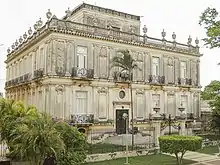
| House of Cámara | |
|---|---|
| Noble family | |
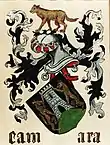 The Coat of arms of the House of Cámara as depicted in the Livro do Armeiro-Mor, the oldest and most important roll of arms of the Kingdom of Portugal, circa 1520. | |
| Place of origin | Alcalá de Henares, Spain (Kingdom of Castile) |
| Founded | 1227 (794 years ago) |
| Founder | Gonzalo de la Cámara (Spanish branch) João Gonçalves da Câmara (Zarco) (Portuguese branch) Juan de la Cámara (Yucatecan branch) |
| Titles |
|
A cadet branch of the family established itself in the Kingdom of Portugal. The Portuguese branch are direct descendants of João Gonçalves da Câmara (Zarco), who discovered and conquered the island of Madeira.[2] From the 15th century until the end of the donataries' regime, they maintained the hereditary title of Captain-Major (Capitães dos Donatários) on the island of São Miguel in the Azores. Serving the Portuguese Crown, the family received various noble titles,[3] including: Counts of Calheta (1576), Count of Vila Franca (1583 ), Count of Ribeira Grande (1662), Marquis of Castelo Melhor (1766), Count of Taipa (1823), Marquis of Ribeira Grande (1855), Count of Canavial (1880), among others.[4]
In the sixteenth century, Juan de la Cámara was one of the main Spanish conquistadores responsible for the Spanish conquest of Yucatán and was one of the founders of the city of Mérida.[5][6] His descendants live there to this day and are one of the principal families of the Mexican nobility.[7] For many years, the Cámara family were the owners of Cancún and its surroundings, the site of one of the most important tourist destinations in the Caribbean[8] At the end of the 19th century and the beginning of the 20th century, the family made a considerable fortune due to the boom of the Henequen industry in Yucatan.
See also
Bibliography
- Barreto, Maxcahrenas. Portuguese columbus : secret agent of King John II.. London, England: Palgrave Macmillan, 2014. OCLC 935190217 ISBN 978-968-16-5995-0[9]
- Melo, Carlos. História dos Açores: Da descoberta a 1934 . Ponta Delgada: Câmara Municipal de Ponta Delgada, 2008.
- Faria e Maia, Francisco de Athayde M. de.. Capitães dos donatários (1439-1766). Lisboa, Portugal: Núcleo Gráfico da Escola Preparatória de F. Arruda, 1972. OCLC 976699653[10]
- Valdés Acosta, José María. A Través de las Centurias (Vol. I). México DF: Talleres Litográficos de la Impresora Bravo, 1979. OCLC 6626094[11]
- García Bernal, Manuela Cristina. La Sociedad en Yucatán (1700-1750). Sevilla, España: Editorial CSIC, 1972. OCLC 1178651[12]
- González Muñoz, Victoria and Martínez-Ortega, Ana. Cabildos y élites capitulares en Yucatán (1700-1725). Sevilla, España: Escuela de Estudios Hispano-Americanos de Sevilla, 1989. OCLC 782343653[13]
- Ladd, Doris. The Mexican Nobility at Independence (1780-1826) . Austin, Texas: Institute of Latin American Studies, 1976. OCLC 491921643[14]
References
- Valdés Acosta (1979),p. 367
- Barreto (2014), p.314
- Melo Bento (2008), p.52
- "Câmara". Heraldry Institute of Rome.
- García Bernal (1972) p. 90
- González Muñoz and Martínez Ortega (1989),p. 169
- Ladd (1976) Appendix
- "Las 24 Familias Yucatecas con Hidalguía y Algunas Más". 9 December 2013.
- Bernal, Manuela Cristina García (1972). La sociedad de Yucatán, 1700-1750. OCLC 1178651.
- Muñoz, Victoria González (1989). Cabildos y élites capitulares en Yucatán: Dos estudios. OCLC 782343653.