Huangpu District, Guangzhou
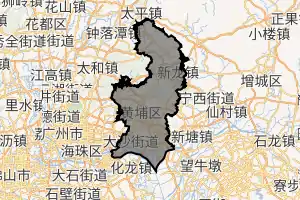
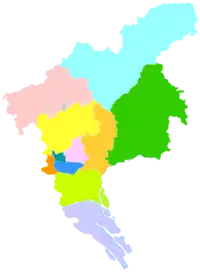
 Huangpu , alternately romanized as Whampoa, is one of 11 urban districts of the prefecture-level city of Guangzhou, the capital of Guangdong Province, China. Despite its name, it does not include Huangpu Island (now Pazhou) or its famous anchorage. Huangpu absorbed Guangzhou's former Luogang District in 2014. The district has been awarded the status of "Happiest District of China" in 2020.[2]
Huangpu
黄埔区 Whampoa; Whangpoa | |
|---|---|
.jpg.webp) Dasha Subdistrict | |
| |
 Huangpu in Guangzhou | |
| Country | People's Republic of China |
| Province | Guangdong |
| Sub-provincial city | Guangzhou |
| Area | |
| • Total | 484.17 km2 (186.94 sq mi) |
| Population (2014) | |
| • Total | 880,100[1] |
| • Density | 1,818/km2 (4,710/sq mi) |
| Time zone | UTC+8 (China Standard) |
| Postal code | 510700 |
| Area code(s) | 020 |
| Website | www |
| Huangpu District, Guangzhou | |||||||||||||||
|---|---|---|---|---|---|---|---|---|---|---|---|---|---|---|---|
| Simplified Chinese | 黄埔区 | ||||||||||||||
| Traditional Chinese | 黃埔區 | ||||||||||||||
| Guangdong Romanization | Wong4-bou3 Kêu1 | ||||||||||||||
| Hanyu Pinyin | Huángpǔ Qū | ||||||||||||||
| Literal meaning | Yellow Bank District | ||||||||||||||
| |||||||||||||||
| Alternative Chinese name | |||||||||||||||
| Simplified Chinese | 黄埔 | ||||||||||||||
| Traditional Chinese | 黃埔 | ||||||||||||||
| Guangdong Romanization | Wong4-bou3 | ||||||||||||||
| Hanyu Pinyin | Huángpǔ | ||||||||||||||
| |||||||||||||||
History
During the Canton trade, Changzhou was known as "Dane's Island" and used by Danish crews for repairs and burials. It lay on the eastern side of the Huangpu or "Whampoa" anchorage, named for Huangpu Island (now Pazhou in Haizhu District). The Whampoa Military Academy was founded on Changzhou in 1924.
Huangpu district played an important role in China's economic development. Originally called "Guangzhou Development District", it was one of the first economic and technological development districts in China.[2]
On 12 February 2014, Luogang District was dissolved by China's central government and its area added to Huangpu.[3]
Administrative divisions
| Name | Chinese (S) | Hanyu Pinyin | Canton Romanization | Population (2010)[4] | Area (km2) | |
|---|---|---|---|---|---|---|
| Dasha Subdistrict | 大沙街道 | Dàshā Jiēdào | dai6 sa1 gai1 dou6 | 44,641 | 13.10 | |
| Huangpu Subdistrict | 黄埔街道 | Huángpǔ Jiēdào | wong4 bou3 gai1 dou6 | 64,255 | 7.38 | |
| Hongshan Subdistrict | 红山街道 | Hóngshān Jiēdào | hung4 san1 gai1 dou6 | 42,127 | 7.30 | |
| Yuzhu Subdistrict | 鱼珠街道 | Yúzhū Jiēdào | jyu4 zyu1 gai1 dou6 | 59,529 | 9.11 | |
| Wenchong Subdistrict | 文冲街道 | Wénchōng Jiēdào | men4 cung1 gai1 dou6 | 46,877 | 10.07 | |
| Nangang Subdistrict | 南岗街道 | Nángǎng Jiēdào | nam4 gong1 gai1 dou6 | 76,747 | 13.74 | |
| Changzhou Subdistrict | 长洲街道 | Chángzhōu Jiēdào | cêng4 zeo1 gai1 dou6 | 36,478 | 11.5 | |
| Suidong Subdistrict | 穗东街道 | Suìdōng Jiēdào | sêu6 dung1 gai1 dou6 | 45,025 | 13.58 | |
| Lilian Subdistrict | 荔联街道 | Lìlián Jiēdào | lei6 lün4 gai1 dou6 | 42,251 | 6.58 | |
| Guangzhou Economic and Technological Development Zone | Luogang Subdistrict | 萝岗街道 | Luógǎng Jiēdào | lo4 gong1 gai1 dou6 | 45,717 | 80.10 |
| Changling Subdistrict | 长岭街道 | Chánglǐng Jiēdào | cêng4 léng5 gai1 dou6 | |||
| Xiagang Subdistrict | 夏港街道 | Xiàgǎng Jiēdào | ha6 gong2 gai1 dou6 | 44,528 | 14.54 | |
| Dongqu Subdistrict | 东区街道 | Dōngqū Jiēdào | dung1 kêu1 gai1 dou6 | 85,235 | 54.00 | |
| Yunpu Subdistrict | 云埔街道 | Yúnpǔ Jiēdào | wen4 bou3 gai1 dou6 | |||
| 49,867 | 51.76 | |||||
| Lianhe Subdistrict | 联和街道 | Liánhé Jiēdào | lün4 wo4 gai1 dou6 | |||
| Yonghe Subdistrict | 永和街道 | Yǒnghé Jiēdào | wing5 wo4 gai1 dou6 | 55,044 | 34.00 | |
| Jiufo Subdistrict | 九佛街道 | Jiǔfó Jiēdào | geo2 fed6 gai1 dou6 | 93,265 | 53.50 | |
| Longhu Subdistrict | 龙湖街道 | Lónghú Jiēdào | lung4 wu4 gai1 dou6 | 45.73 | ||
| Xinlong town | 新龙镇 | Xīnlóng Zhèn | sen1 lung4 zen3 | 75.87 | ||
Economy
Huangpu district is one of the developing industrial districts in Guangzhou. According to a 2020 study by Deloitte, the district is already especially competitive in the industries of automobiles, electronics, energy, high-end chemicals, food and beverage, and electrical machinery. Emerging industries in the district include ICT, intelligent equipment, biomedicine, new energy, new materials, and services.[2]
Huangpu district is at the heart of the Greater Bay Area (GBA) and is home to a large development area, which is considered one of China's most important economic centres. It is producing a regional GDP of 49.3 billion USD and the district received a fixed asset investment of 19.68 billion USD in 2019. The development district contributes 43% to Guangzhou's industrial output value and 70% of its high-tech product output value.[5]
Huangpu district is an important area for international trade and investment. In 2019, the district recorded the highest volumes in exports and imports among the districts of Guangzhou, with an export volume of 24.766 billion USD and an import volume of 19.878 billion USD. Foreign investment in actual use for Huangpu district was 2.28 billion USD the same year, prompting it to rank first among all development districts within China.[6]
Moreover, Huangpu is home to the Guangzhou IP Court, offering reliable and effective intellectual property (IP) right protection to every company and institution invested. It also provides newcomers and those looking for expansion with a fast approval and application process. Founding and registering a new company or branch is possible within one day. The rapid procedure is also referred to as Huangpu Speed.[7]
Industry Sectors
The division between primary, secondary and tertiary sectors has shifted since 2015. Back then, the tertiary sector accounted for 29.1% of Huangpu District’s GDP, while the secondary sector accounted for 70.6% and the primary sector for only 0.3%. In 2019, the tertiary sector accounted for 35.7% of Huangpu District’s GDP, with the secondary sector accounting for 64.1% and the primary sector having fallen to 0.2%. Thus, although the share of the tertiary sector has been growing, the dominating industry in Huangpu is still the secondary industry.[2]
The dominance of the secondary sector can also be seen from the growing industrial output. Between 2017 and 2019, total industrial output value above designated size rose from RMB 745.91 Billion to RMB 739.65 Billion. Sector-wise, the total industrial output is divided as follows:[2]
Automotive Industry
Huangpu district's automotive industry achieved a total industrial output value of RMB 167.88 billion in 2019. Companies present in Huangpu include Magna, Webasto, JATCO, Honda, Xpeng Motors, Stanley Electric, and Baoneng Motor.[2]
Electronics Industry
Huangpu district's electronics industry achieved a total industrial output value of RMB 162.41 billion in 2019. Companies present include LG, Jabil Circuit, and Skyworth. Another notable company is Guangzhou Shiyuan Electronic Technology Company Limited, an LCD controller board supplier headquartered in Huangpu. From its founding in 2005, the LCD controller board supplier has grown to occupy over 29% of global and 61% of China's domestic market share in 2019.[2]
Energy Industry
Huangpu district's energy industry achieved a total industrial output value of RMB 161.44 billion in 2019, drawing mainly from high-efficiency energy-saving equipment, the product considered most competitive in Huangpu district by Deloitte. Notable companies from the energy sector in Huangpu include China Southern Power Grid, Sinopec Group, Kinfa, Guangzhou Hengyun, Guangzhou Hirp Chemical, Guangdong Yuehua Power, and Guangzhou GCL Power.[2]
High-end Chemical Industry
Huangpu district's high-end chemical industry achieved a total industrial output value of RMB 62.21 billion in 2019. The industry centers mostly around cosmetics, home care, fragrances, flavours, and fine chemicals. Notable companies include P&G, Amway, Colgate, and Guangzhou NipponPaint.[2]
Food & Beverage Industry
Huangpu district's food and beverage industry achieved a total industrial output value of RMB 57.89 billion in 2019. It is composed of high-end food, functional food, green and organic food, urban leisure food, and health food. Notable companies include Mars, Pepsi, Coca-Cola, MeadJohnson, BiosTime, Uni-President, and Yantang Dairy.[2]
Electrical Machinery Industry
Huangpu district's electrical machinery industry achieved a total industrial output value of RMB 22.56 billion in 2019. The industry is, for instance, processing equipment, measurement and control devices. Notable companies include Panasonic, Hitachi, Siemens, Schneider, Guangzhou Nanyang Cable, and Guangzhou Zhiguang Electric.[2]
Industry Clusters
Huangpu district is home to four industry clusters. First, the China-Singapore Guangzhou Knowledge City focused on knowledge-intensive economy and future industries. Second, Huangpu Lingang Economic Zone focused on service industries. Third, Guangzhou Science City focused on innovation and research and development. Fourth, Guangzhou International Biotech Island focusing on biomedicine. [8]
China-Singapore Guangzhou Knowledge City
CSGKC, also known as "Sino-Singapore Guangzhou Knowledge City" or simply "Guangzhou Knowledge City" is focused on knowledge-intensive economy and future industries such as information technology, high-end equipment manufacturing, green economy, biomedicine, digital economy, new materials and artificial intelligence. It covers an area of 123 square kilometres.[8] The area combines industrial development with supporting facilities, research and development institutes, residential areas and cultural attractions.[9]
CSGKC is located around 35km northeast of Guangzhou city centre and around 25km from Guangzhou Baiyun International Airport. The area was started in 2010 as a greenfield master development by Sino-Singapore Guangzhou Knowledge City Investment and Development Co., Ltd., a joint venture between Singapore-based CapitaLand and the district government of Huangpu. In 2018, the initiative was elevated to a bilateral state-level cooperation project between Singapore and the People's Republic of China.[10] Since its inception, a total of 1,803 enterprises have registered in the area by 2020, with registered capital reaching 21.35 billion USD and fixed asset investment reaching around 20.35 billion USD.[11]
CSGKC is home to several companies and projects. Notable among those is for instance Guangzhou CanSemi Technology, which runs the only 12-inch wafer production line in Guangdong province in the CSGKC.[11] CSGKC is furthermore home to the Sino-Singapore International Joint Research Institute jointly set up by the CSGKC Administrative Committee, South China University of Technology, Nanyang Technological University, and Sino-Singapore Guangzhou Knowledge City Investment and Development Co., Ltd. The Institute is staffed with Singaporian and Chinese professionals and focuses on the key industries of CSGKC detailed above. It engages in the research and development of new products and processes. In doing so, it cooperates with local companies and investors and incubates enterprises.[12] Another notable project is Baidu's Apollo R&D Centre, where smart vehicles are researched and tested.[13]
Huangpu Lingang Economic Zone
Huangpu Lingang Economic Zone is situated in the southern part of Huangpu district.[14] It covers an area of 27 square kilometres of landmass and 15 square kilometres of water, and it focuses on modern service industries. Situated right at the Yangtze River, the cluster is home to coastline ports,[8] as well as the second Guangzhou Central Business District.[15] Its foci include port and shipping services, industrial finance, SciTech innovation, human resources, high-end and e-commerce, cultural tourism and cruise industry. It is envisioned to become an integrated service centre for international shipping and it is expected to become a key linking point for the Maritime Silk Road part of the Belt and Road Initiative. [14]
Guangzhou Science City
Guangzhou Science City (GSC) covers an area of 37.47 square kilometres. It focuses on high-tech industries, research and development institutions and human capital development.[8] It is home to ISA Science City International School,[16] as well as companies such as Samsung, LG, Sony, Hitachi, Cedar Center, Skyworth, Baoneng, Bio-Thera, Wondfo, and Xiangxue Pharmaceutical.[2]
Guangzhou International Biotech Island
Guangzhou International Biotech Island (GIBI), formally known as Guanzhou Island or Dove Island, is a biomedicine cluster within Huangpu district.[17] It forms the centre of the biotechnological industry base of Guangzhou. By 2020, around 130 pharmaceutical companies had settled on the island, among those KingMed Diagnostics or Riton-Biomaterial. In 2021, Geneseeq Technology Inc. and AstraZeneca announced their plans to establish a Bio-Diagnostic Innovation Center on the island.[18]
The island brings together domestic and international high-end biomedicine companies and research and development centres. Among those are biotechnological research and development institutions, as well as biological service providers. A study commissioned by the German Federal Ministry for Economic Affairs and Energy assumes that the island will develop into a multifunctional biotechnology centre of the GBA, as it is located within the city centre of Guangzhou and well-integrated into its trade- and business systems.[19]
Transportation
Metro
Huangpu is currently serviced by five lines on the Guangzhou Metro:
- Line 5 - Yuzhu 13 , Dashadi, Dashadong, Wenchong
- Line 6 - Huangbei, Jinfeng, Xiangang, Suyuan 21 , Luogang, Xiangxue
- Line 13 - Yuzhu 5 , Yufengwei, Shuanggang, Nanhai God Temple, Xiayuan, Nangang
- Line 14 - Hongwei, Xinnan, Fengxia, Sino-Singapore Guangzhou Knowledge City, Hetangxia, Wangcun, Tangcun, Zhenlongbei, Zhenlong 21
- Line 21 - Shenzhoulu, Science City, Suyuan 6 , Shuixi, Changping, Jinkeng, Zhenlongxi, Zhenlong 14
Education
Huangpu district is home to several international schools. First, the American International School of Guangzhou. Its middle and high school campus is located in the Guangzhou Science City (科学城; 科學城; Kēxuéchéng; fo1 hok6 sing4), in the former Luogang District.[20] Second, ISA Science City International School. An International Baccalaureate candidate school, It offers education from early childhood (starting from age two) to grade 12.[21] Third, SingChina Academy. This new international school opened at China-Singapore Guangzhou Knowledge City in September 2021. It is a cooperation project between Singapore and China, and it is affiliated with the Singaporean Hwa Chong family of schools.[9] It offers a 12-year bilingual, international curriculum covering primary, middle and high school levels, integrating both Chinese and western education.[22]
References
- "2014年广州市人口规模及分布情况" (in Chinese). Retrieved 13 February 2014.
- Deloitte (2020). Research Report on the Investment Environment of Huangpu District, Guangzhou (PDF).
- 黄埔萝岗合二为一 增城从化撤市改区 [Huangpu and Luogang Districts merge; Zengcheng becomes a District] (in Chinese). Nandu Online. Archived from the original on 22 February 2014. Retrieved 13 February 2014.
- shi, Guo wu yuan ren kou pu cha ban gong; council, Guo jia tong ji ju ren kou he jiu ye tong ji si bian = Tabulation on the 2010 population census of the people's republic of China by township / compiled by Population census office under the state; population, Department of; statistics, employment statistics national bureau of (2012). Zhongguo 2010 nian ren kou pu cha fen xiang, zhen, jie dao zi liao (Di 1 ban. ed.). Beijing Shi: Zhongguo tong ji chu ban she. ISBN 978-7-5037-6660-2.
- "Home". www.huangpu-europe.com. Retrieved 1 February 2021.
- "GDD economy in 2019". eng.gdd.gov.cn. Retrieved 25 September 2021.
- "Home". www.huangpu-europe.com. Retrieved 1 February 2021.
- "Introduction to Huangpu district / Guangzhou Development District". subsites.chinadaily.com.cn. Retrieved 25 September 2021.
- "China-Singapore Guangzhou Knowledge City opens new chapter of cooperative development - Regional - Chinadaily.com.cn". www.chinadaily.com.cn. 3 July 2021. Retrieved 25 September 2021.
- CapitaLand. "China-Singapore Guangzhou Knowledge City". Retrieved 25 September 2021.
- Li, You (3 July 2020). "Guangzhou Knowledge City lauds achievements in celebrating first decade - Regional - Chinadaily.com.cn". www.chinadaily.com.cn. Retrieved 25 September 2021.
- Li, You (3 July 2020). "Institute flourishes as cooperation increases - Regional - Chinadaily.com.cn". www.chinadaily.com.cn. Retrieved 25 September 2021.
- "Greater Bay Area: World's Innovation Lab (3/3)". Greater Bay Area: World’s Innovation Lab (3/3). Retrieved 28 September 2021.
- "Huangpu Lingang Economic Development Zone". subsites.chinadaily.com.cn. Retrieved 25 September 2021.
- "Guangzhou 2nd CBD (Huangpu District) Urban Design | OBERMEYER Engineering Consulting (Beijing) Co., Ltd". www.obermeyer-cn.com. Retrieved 25 September 2021.
- "Our Campus". ISA Science City. Retrieved 19 November 2021.
- "Guangzhou International Biotech Island". subsites.chinadaily.com.cn. Retrieved 25 September 2021.
- Inc, Geneseeq Technology. "Geneseeq and AstraZeneca Collaborate to Build Guangzhou Bio-Diagnostics Innovation Center". www.prnewswire.com. Retrieved 19 November 2021.
- trAIDe GmbH (2021). Zielmarktanalyse China: Gesundheitswirtschaft mit Fokus Biotechnologie [Analysis of the Target Market China: Healthcare Industry with Focus on Biotechnology] (PDF) (in German). trAIDe GmbH. pp. 28–37.
- "Contact Us Archived 15 September 2016 at the Wayback Machine." American International School of Guangzhou. Retrieved on September 16, 2016. "Science Park Campus (Gr.6-12): Address: 19, Kexiang Road Luogang District, Science Park, Guangzhou, PR China, 510663 广州市萝岗区科翔路19号" - Detailed map Archived 16 September 2016 at WebCite (Archive)
- "Early Childhood". ISA Science City. Retrieved 19 November 2021.
- "SingChin Academy". Retrieved 25 September 2021.
External links
 |
Wikimedia Commons has media related to Huangpu District, Guangzhou. |
- Official website of Huangpu District government
- Huangpu Dashadi
- Official English Website of Huangpu District Government
.JPG.webp)
| Sub-provincial cities |
| ||||||||||||||||||||||||||||||||||||||||||||||||||||||||||||||||||||
|---|---|---|---|---|---|---|---|---|---|---|---|---|---|---|---|---|---|---|---|---|---|---|---|---|---|---|---|---|---|---|---|---|---|---|---|---|---|---|---|---|---|---|---|---|---|---|---|---|---|---|---|---|---|---|---|---|---|---|---|---|---|---|---|---|---|---|---|---|---|
| Prefecture-level cities |
| ||||||||||||||||||||||||||||||||||||||||||||||||||||||||||||||||||||
