Human rights in Norway
Human rights in Norway protect the fundamental rights of all persons within the Kingdom of Norway. These rights are safeguarded by Chapter E of the Constitution of Norway, or Kongeriket Norges Grunnlov, as well as the ratification of various international treaties facilitated by the United Nations. The country maintains a dedicated commitment to human rights, and were the second country to ratify the European Convention on Human Rights.[1]
 |
|---|
| Constitution |

Although Norway is regarded as relatively proactive in human rights matters, ranking first in the UN Development Program's Human Development Index for 12 of the last 15 years, human rights issues still arise.[2] The most prevalent issue in recent history is the struggle for land rights by the Indigenous Sami people, under the threat of the Norwegian government exploiting the Sápmi region for natural resources[3].
Sources of human rights
The Constitution of Norway
Section E. of the Norwegian Constitution pertains specifically to the maintenance of human rights to all peoples within the state of Norway. Individual rights are granted by various articles, most notably:
- Article 92 assures authorities of the State respect and ensure the relevant human rights outlined in the Constitution
- Article 93 guarantees the right to life, and freedom from the death penalty and torture
- Article 95 states the right to a fair trial, and independence of the courts and judges
- Article 98 defines all people as equal
- Article 108 guarantees the preservation of Sami language, culture, and way of life
- Article 109 assures the right to an education[4]
Universal Declaration of Human Rights (1948)

After the barbarities of World War 2, an international declaration was constructed to guarantee rights to all humans on earth. Proclaimed by the newly constructed United Nations, at the General Assembly in Paris on the 10th of December, 1948, the declaration signposted 30 key human rights that should be universally granted to every human.[4] Although the Declaration is not legally binding in itself, subsequent international treaties, amendments to constitutions, and economic agreements affirm the declaration.
The Universal Declaration of Human Rights (UDHR) is seen as the precursor to the International Bill of Human Rights, which consists of the UDHR, as well as the International Covenant of Civil and Political Rights (ICCPR, 1966) and the International Covenant on Economic, Social, and Cultural Rights (ICESCR, 1996). This extension of the UDHR provided a legal reason for states to ensure maintenance of human rights, in addition to the moral obligation established by the initial proclamation of the UDHR in 1948.[5]
International Treaties
As well as the UDHR, and the International Bill of Human Rights, Norway have ratified a variety of other international treaties focused on the maintenance of human rights:, those include:[1]
- Convention of the Prevention and Punishment of the Crime of Genocide (1948)
- Convention Relating to the Status of Refugees (1951)
- Convention on the Political Rights of Women (1952)
- Convention Relating to the Status of Stateless Persons (1954)
- Supplementary Convention on the Abolition of Slavery (1956)
- Convention on the Nationality of Married Women (1957)
- Convention on the Reduction of Statelessness (1961)
- Convention on Consent to Marriage, Minimum Age for Marriage and Registration of Marriages (1962)
- International Convention on the Elimination of All Forms of Racial Discrimination (1965)
- International Covenant on Economic, Social and Cultural Rights (1966)
- International Covenant on Civil and Political Rights (1966)
- First Optional Protocol to the International Covenant on Civil and Political Rights (1967)
- Convention on the Elimination of All Forms of Discrimination Against Women (1979)
Civil and political rights
These liberties are granted by the Constitution of Norway:
Judicial rights
A variety of judicial rights are ensured under sections D and E of the Norwegian constitution.[6] The constitution prohibits arbitrary arrest, and supports the detainee should they desire to challenge the lawfulness of an arrest. All persons within the state of Norway are eligible for a fair and public trial, where publicly funded access to a legal counsel of their choice is ensured. An independent and impartial judiciary is required under Norwegian law.[7]
Capital punishment
Since 1979, there have been no instances of capital punishment in Norway. Any form of capital punishment was constitutionally abolished in 2014.[8] The death sentence ended during peacetime in 1905, with the last peacetime execution being carried out in 1876. The most recent execution was of a Nazi collaborator in 1948. Not only is the Norway's stance on capital punishment guarded by the constitution, but it is also ratified by the International Covenant on Civil and Political Rights (1972) and the Second Optional Protocol (1991).[8]
Prison conditions
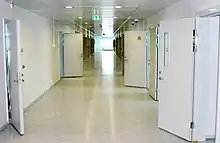
The Norwegian prison system is praised as an exceptional model with extraordinarily low re-offending rates.[9] The Norwegian model is focused on rehabilitation, rather than retribution, whereby the prison officers' main role is to mentor, not punish. Inside a Norwegian prison, human rights are guaranteed for the prisoners, with healthy food, exercise, and standard living conditions guaranteed. Guards and prisoners occupy the same spaces, eat the same meals, and participate in activities together, allowing personal bonds to develop to aid rehabilitation of the prisoners, this strategy is known as 'dynamic security'.[9]
Are Hodiel, the Governor of Halden Prison, the second largest prison in Norway, explains that "In Norway, the punishment is to take away someone's liberty. The other rights stay".[9] A spot at Halden Prison is approximately £98,000 per inmate per year, comparatively large in comparison to the UK, where places cost between £40,000 and £59,000.
Religious freedoms
The Norwegian Constitution states that "Our values will remain our Christian and humanistic heritage", and that "The King shall at all times profess the Evangelical-Lutheran religion". Yet, Norway maintains complete freedom of religion for all inhabitants, this fact is also enshrined within the Norwegian constitution, expressing that "All inhabitants of the realm shall have the right to free exercise of their religion."[6]
The State has, and continues to, support the Church of Norway, which is an Evangelical-Lutheran church that follows the religion professed by the King of Norway. The religious community of Norway primarily belongs to the Church of Norway, yet there remains small populations of Muslims and Catholics. The second largest religious group in Norway is unaffiliated.[7]
As well as funding the Church of Norway, the Norwegian government provides funding to over 800 religious groups, in an effort to maintain diversity and reduce religious discrimination. Religious persecution is punishable by law, through hefty fines and prison sentences of up to 6-months. Within Norway, complaints of religious discrimination are handled by the Equality and Anti-discrimination Ombudsman (LDO), who is chosen by the government to serve a six-year term.[7] Although the office is funded by the Norwegian government, it maintains its own autonomy and independence.
Protection of refugees
.jpg.webp)
The Norwegian Law facilitates permission of asylum and refuge to peoples displaced from their home countries. Whilst their refugee applications status is under review, asylum seekers are allowed to seek and obtain work, should they meet three main criteria. These criteria are that asylum seekers must; have proof of identity, have a document demonstrating that they will most likely receive asylum, be part of an "integration" program.[7] Norway has agreed to the EU's Dublin III regulation, which authorises the transfer of asylum seekers to other European countries whom are responsible for adjudicating the case.
There has been recent criticism of the Norwegian government's lack of dedication to accepting refugees. In comparison to other Scandinavian countries, Norway's 2017 intake of refugees was, at 30,000, whilst neighbouring country Sweden took in 160,000. Sylvi Listhaug, Norway's first immigration minister, cited the low acceptance of refugees as "a big challenge to integrate [...] to make sure they respect Norwegian values"[13]
Economic, social, and cultural rights
Women's rights
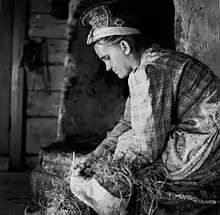
The prohibition of discrimination against women is guarded by law. Penalties can extend to up to 21 years' incarceration for crimes such as rape. Issues including domestic violence and sexual harassment continue to remain a problem in Norwegian society, with 27% of women experience physical and/or sexual violence from an intimate partner within their lifetime, and 6% in the last 12 months.[14] The conviction rate for domestic violence sits at 10%, causing criticisms by institutions such as the Oslo Crisis Centre that the government is not doing enough to reduce rates of gender-based violence.[7]
The National Coordination Unit of Victims of Human Trafficking (KOM) was initiated to reduce the number of women who fall victim to sex trafficking within Norway, in an effort by the Norwegian government to address the rising number of sex trafficking victims. Despite Norway's welcomed efforts by the UN, the number of victims of sex trafficking in Norway continues to rise, increasing from 203 to 292 victims from 2007 to 2009.[14]
The Norwegian Government launched a plan in 2016 to reduce violence against women, called the Action Plan for Women's Rights and Gender Equality in Foreign and Development Policy 2016–2020.[15] The plan has five main goals which Norway aims to promote to reduce discrimination and violence against women. The five aims are:
- Inclusive and equitable equality education for all girls and boys
- Women's equal participation in political life
- Full economic rights for women and equal opportunities for women to participate in the labor market
- The elimination of violence and harmful practices against girls and women
- Sexual and reproductive health and rights for girls and women[15]
In addition, government programs have been implemented to reduce rates of domestic violence, including the appointment for a dedicated domestic violence coordinator at all police districts. There are also over 47 publicly-funded shelters, and 5, 24-hour hotlines managed by the Norwegian government.[7]
Children's rights
Children of Norway are protected by the Convention on the Rights of the Child. Issues of child abuse and mistreatment are primarily investigated by the Ombudsman for Children in Norway.[16] Citizenship within Norway is granted through parents, children born in Norway do not automatically become citizens.[7] A recent Amnesty International report raises concern that unaccompanied minors arriving on Norwegian soil are taken into unaccompanied minor centres that have living conditions not on par with human rights standards.[16]
Assault against children in punishable under Norwegian law, yet 2017 ended with over 48,000 instances of documented child abuse.[7] A Norwegian survey registered that between 5 - 10% of children in Norway had experienced some form of physical and/or sexual violence in their lifetime. In 2018, a 26-year-old man was charged with the sexual assaults of over 300 underage boys. Police described the football-referee's crimes as "Norway's biggest ever sexual abuse case".[17]
Indigenous rights
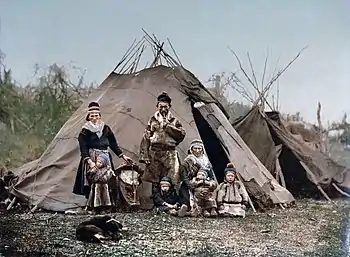
The Sami people are the inhabitants of the northernmost parts of Norway, Finland, Sweden, and the Kola Peninsula of Russia.[18] Despite the bureaucratic boundaries existing between the four states, the Sami people continue to operate as a single group, bonded through their rich cultural and linguistic connections.[3] Despite there being over 50000 people living and identifying as a Sami person, there is no official state registry defining the Sami people as Indigenous in Norway.
Various pieces of legislation have been enacted to protect the cultural and linguistic heritage of the Sami people. The Norwegian Sami Act (1987) provided a legal and verified definition of a Sami, as someone who 'has Sami as a first language, or whose father or mother or one of whose grandparents has or had Sami as a first language, and who considers themselves a Sami".[19] 1980 saw the creation of the Sami Rights Commission, which was enacted to address the economic and political issues of the Sami people. It was this that led to the creation of the Sameting, also known as the Norwegian Sami Assembly. This body mainly serves to ensure the rights of the Sami people, and sustain Norway's commitment to accomplish their international obligations[19]
In today's world, the Sami people hold a large amount of autonomy, and have their own parliament to which they elect, called the Samediggi.[7] After years of struggle, their autonomy is also protected by the Norwegian constitution, which states that "the authorities of the state shall create conditions enabling the Sami people to preserve and develop its language, culture and way of life"[6]
LGBT+ rights
Legislation exists that is designed to prohibit discrimination based on sexual orientation and gender identity, in the broad scope of housing, employment, citizenship, and access to services provided by the government. Despite this, targeted violence towards transgender peoples is still not considered a hate crime within Norwegian legislation. The Norwegian Association of Gender and Sexual Diversity reported repeated concern about the lack of disclosure of sexual orientation as a reason for hate crimes. The government is attempting to address these concerns through more thorough and consistent training and education for police on LGBT+ discrimination.[7]
Disability rights
The US Department of State reports that there was effective enforcement of laws which prohibit discrimination against the disabled community within Norway.[7]
Anti-semitism
There is only a very small Jewish population within Norway, about 1400, half of which belong to Jewish congregations. In an effort to reduce anti-semitism, the Norwegian government launched an 'Action Plan against Anti-semitism 2016 - 2020', of which the four main points are:
- Anti-semitism holds a separate category of hate crime in police statistics
- Education about anti-semitism is integrated into all schools
- Increased funding for Jewish museums and cultural institutions
- Research into anti-Semitism and Jewish life is also funded[7]
Human rights abuses
Current criticism
Norway has several human rights issues, although often not worse than in many other countries, Norway is by no means best in class in all sectors when it comes to human rights. And on some issues Norway is far behind other countries.
There still are many systemic human rights problems in Norway that are worse than in many other countries.
Many of these systemic human rights abuses have persisted with little to no change for decades despite of repeated international criticism and press focus. Many of these issues are mentioned in the UN Universal Periodic Review (UPR), and the report by the Council of Europe Commission for Human Rights although it's questionable if the UN, the Council of Europe and even the Norwegian Government is fully aware and understands the true magnitude of these human rights abuses in Norway.
Se this link for UN Universal Periodic Review (UPR) of Norway as one source written in English of official international (UN) complaints about most of the following issues.
Se this link for the 2015 report of the visit of the Council of Europe Commissioner for Human Rights which raises many of the same concerns as the UN.
- Norway's parliament has refused to sign the UN Declaration on the Rights of Disabled Persons, and there are several reports of the human rights of various groups of disabled people not being fully recognised.
- Norway's parliament has voted against including all economic and social rights in the constitution.
- Norway has been criticized for the very large state sovereign wealth fund investing internationally in companies with questionable ethical practices and unethical supply chains.
- The Norwegian state has been criticized for a serious lack of transparency by the state when the state uses force. For having a high degree of informal networks that make complaint processes difficult and for an almost total lack of transparency in complaint processes by third parties and the public.
- Repeated criticism over government actions and the situation for the Roma communities, especially in Oslo.
- Deportations of child refugees and asylum seekers with no parents to conflict and war zones has been criticized by the UN.
- Deportations of refugees and asylum seekers to conflict and war zones have been criticized by the UN.
- Reports of police entering the homes of asylum seeker and refugee families with dogs in the middle of the night for deportation.
- Repeated international criticisms of extensive use of torture in psychiatry, home invasions, forced treatments, coercion and forced drug treatments in public psychiatry is pervasive and all encompassing. Several psychiatric institutions have publicly refused to abide by a law change in 2017, and the law does not seem to have changed the practices in any meaningful way, mainly due to weak wording in the law being reinterpreted.
- Repeated international criticism of prolonged use of torture, permanent isolation and inhumane treatments in psychiatric treatments in prisons.
- Repeated international criticism of use of solitary confinement in bare minimum cells in jail over 24 hours, not unusually several days and up to seven days has been known to happen, by the police without due process.
- Repeated international criticisms of unusually long periods of incarceration before trial, many months and over half a year is not unusual.
- Repeated international criticisms of use of solitary confinement in bare minimum cells of children by the police in jail, especially in Oslo. The police have publicly refused to find alternative solutions citing practicality as the reason.
- Repeated criticisms of extensive inhumane harassment by police of drug addicts, and relatively high overdose numbers despite relatively low drug usage.
- Recently extensive decades long illegal use of body searches, blood and urine tests, forced communication controls of cellular phones and home invasions by the police reached mass public attention. This practice over simple suspected drug use has been criticized as illegal practices by the state attorney, but there is little evidence to suggest the police has or will change practices.
- Norway's methadone and Subutex programs have been criticised for demanding regular degrading urine samples and not allowing more than one dosage a day and thus effectively restricting the free movement of people in the programs.
- Norway has been convicted no less than 13 times recently in the European Court of Human Rights over human rights abuses by the state for the forced removal of contact between parents and children by state child protective services.
- The state privacy bureau, press organizations and lawyers organizations has criticized Norway over an ever expanding surveillance state and ever increasing laws that allow state invasions into privacy. Recently parlaiment allowed the military to store all metadata transfers crossing Norwegian borders.
- Religious propaganda in schools, no real separation of church and state. The constitution still emphasizes the Lutheran Church.
- Repeated civil society allegations of racism, racist profiling harassment by the police.
- Civil society allegations of treatment of minorities as B-patients in the health services.
- Repeated reports of racist discrimination of minorities in employment processes and even housing.
- The Norwegian state has also refused to treat paperless migrants, refugees and asylum seekers in the public health services.
- Many asylum seekers that can't be returned or deported because they come from a conflict or war-zone are being refused the right to work even after many years living in Norway.
- Public defunding of pacifist and peace movements to zero.
- Defunding of free lawyer help for lower income brackets.
- Sex wokers organisations have criticized that rights of sex workers as still limited. Although the sale of sex by private individuals is legal while purchases are not, sex workers are still being harassed by the police and often suffer uncertain living conditions and unsafe working conditions as a result.
Land rights of the Sami people
The increased demand for natural resources in recent times has led to social conflict between the Sami people and the local communities of Norway. The construction of infrastructure such as buildings, roads, mines, and dams, all preside primarily in areas inhabited by the Sami people. This has led to contention between the land rights of the Sami people, and the employment and development opportunities that would arise from these projects for local communities.[3]
The traditional landowner rights granted to the Sami people under the Norwegian legislation allow for their rejection of development proposals should it prohibit their ability to pursue their traditional livelihoods. As well as the Norwegian constitution, this right is guaranteed via various multilateral treaties, including the International Convention on the Elimination of All Forms of Racial Discrimination , the International Covenant on Civil and Political Rights, and the United Nations Declaration of the Rights of Indigenous Peoples. Standards established via institutions such as the International Labour Organisation (ILO) and the Tribal People's Convention explain that in order for development on Indigenous land, such as the creation of infrastructure on Sami territory, must have the 'free, prior, and informed consent' of the party involved.[3]
Response of the Norwegian government
In response to the land rights crisis in Northern Norway, the Norwegian government published the Land Rights Act of 2005, which provided partial protection of the Sami land in Finnmark Country. The act elucidated that ownership of land and natural resources would be changed from state ownership to local ownership, meaning that Finnmark Estate owned its own land. The Special Rapporteur of the United Nations provided a report praising the Norwegian response to the land rights crisis.[3]
Recent history
- Norway had up until late 1980's genocidal policies against Romani peoples with forced sterilization, psychiatry, criminal prosecutions and suppression of language, culture and religion. Romani people continue to experience discrimination in Norway. Not until 2010 did Norway officially apologize to the Romani people's. Also especially Sami peoples, but also Finnish-speaking minorities experienced forced suppression of language, culture and religion through forced "Norwegiansation" policies in schools and institution, and were also treated as second rate human beings.
- Norway had up until 1974 extensive usage of forced lobotomizations in psychiatry. Over 2500 people were lobotomized, the death rate was reported to be as high as 50%, possibly the highest in the world. Only second in the world to Denmark in the number of lobotomized pr. 100.000 inhabitants. Not until 1996 were the few still remaining surviving victims allowed to seek compensation from the state for the abuses. Norwegian psychiatry also forcefully experimented on humans with electrodes in the brain often with a fatal result.
- Male homosexuality was formally illegal until 1972. Psychiatry also experimented with drugs such as LSD and electroshocks conversion "therapy" of homosexuality.
- Norway had extensive use of legal forced and coerced sterilizations of "lower class" (poor) people from 1934 until 1977.
- Although the legality of secret police was officially dissolved and disbanded after the nazi occupation Norwegian secret police used extensive illegal surveillance of mostly socialist and communist organisations during the cold war. Also moderate socialists and people with no political interest were illegally put under surveillance. After the Lund Report in 1996 which disclosed the illegal surveillance, a law allowing for people to apply to view their surveillance files was passed, but with a limited time and it expired in 2002. A total of 12.764 people applied for insight and 38,4% of these the surveillance police had files on, of which again 82,8% of these were granted access to their files. A total of 774 persons also applied for economic compensation in the amount of 100.000 NOK, and 379 persons were granted economic restoration for a total combined sum of 11,23 million NOK.
- A large portion of Norwegian Jews were deported and exterminated by the nazis during world war II. A total 766 Norwegian Jews were deported for extermination, and Norwegian police was complicit in helping the Nazis in the arrests, only 34 Norwegian Jews returned alive from the deportations. 1100 Norwegian Jews escaped into Sweden, but in recent years the official resistance movement in Norway (MILORG) has been criticised for sometimes refusing to help, although this criticism was also been fiercely refuted and criticised. Norwegian Jews returning to Norway and Jewish refugees from Europe after the war experienced problems in being accepted into Norway and also in regard to having their Norwegian properties returned completely.
References
- Rosas, Allan (1986). "Nordic Human Rights Policies". Current Research on Peace and Violence. 9 (4): 167–192. JSTOR 40725044.
- Jones, Ann (2016-01-28). "After I Lived in Norway, America Felt Backward. Here's Why". ISSN 0027-8378. Retrieved 2020-01-30.
- Refugees, United Nations High Commissioner for. "Refworld | Report of the Special Rapporteur on the rights of indigenous peoples on the human rights situation of the Sami people in the Sápmi region of Norway, Sweden and Finland". Refworld. Retrieved 2020-01-30.
- "Universal Declaration of Human Rights". www.un.org. 2015-10-06. Retrieved 2020-02-06.
- General Assembly of the United Nations (1948). "Fact Sheet No.2 (Rev. 1), The International Bill of Human Rights" (PDF). United Nations.
- "The Constitution of the Kingdom of Norway - - Lovdata". lovdata.no. Retrieved 2020-01-30.
- United States Department of State, Bureau of Democracy, Human Rights, and Labor. "Norway 2018 Human Rights Report" (PDF).CS1 maint: multiple names: authors list (link)
- "Norway and the Death Penalty - Campaign for the Abolition of the Death Penalty (ADP)". www.pgaction.org. Retrieved 2020-02-05.
- "How Norway turns criminals into good neighbours". BBC News. 2019-07-07. Retrieved 2020-02-05.
- "Church of Norway".
- "Religious communities and life stance communities".
- "Religious communities and life stance communities".
- "Norway's tough-love approach to the refugee crisis". The Spectator. 2017-11-25. Retrieved 2020-02-06.
- "Norway". evaw-global-database.unwomen.org. Retrieved 2020-02-06.
- Affairs, Ministry of Foreign (2019-01-04). "Women's rights and gender equality". Government.no. Retrieved 2020-02-06.
- "Children of Norway". Humanium. Retrieved 2020-02-07.
- "Man held over sexual assaults on 300 boys". BBC News. 2018-11-21. Retrieved 2020-02-07.
- "Sami | People, History, & Lifestyle". Encyclopedia Britannica. Retrieved 2020-02-07.
- "Sami". Minority Rights Group. Retrieved 2020-02-07.
Norway articles | |||||||
|---|---|---|---|---|---|---|---|
| History | | ||||||
| Geography | |||||||
| Politics |
| ||||||
| Economy |
| ||||||
| Society |
| ||||||
| |||||||