Compagnie Maritime Belge
The Compagnie Maritime Belge (CMB) is one of the oldest Antwerp ship-owners. It is controlled by the Saverys family.
History
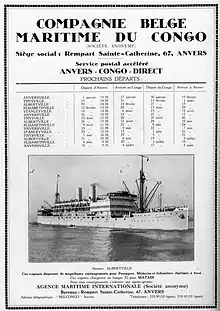
CMB was founded in 1895 under the name Compagnie Belge Maritime du Congo (CBMC). At the request of Leopold II of Belgium and with support from British investors, a maritime connection was opened with Congo Free State. On 6 February 1895 the CMBC ship Léopoldville was the first to leave port of Antwerp for Congo Free State. For sixty years the Congo boats (Kongoboten) were a constant presence in the port of Antwerp.
In 1930 CBMC acquired Lloyd Royal Belge, another Belgian shipowner. The name of the new company became Compagnie Maritime Belge (CMB), and new lines were opened towards America and the Far East.
In the Second World War, on the December 24th, 1944, CMB's 1928 Leopoldville while transporting the 66th Infantry Division, Leopoldville was torpedoed and sank in under 3 hours, losing 763 American soldiers and 56 crew.
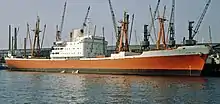
After the Second World War, the company introduced new ships, including the cargo passenger liners Jadotville (1956) and Baudouinville (1957). However, in 1961 it sold both these liners to P&O, who renamed them Chitral and Cathay and placed them in service in the Far East.
In 1960 the company Armement Deppe was acquired, and between 1975 and 1982 gradually also the tramp ship company Bocimar. The company entered the dry bulk trade in 1962 and continues to be a major dry bulk operator under its Bocimar banner. In 1975, the CMB group took a minority share in the dry bulk tramping company, Bocimar, which was increased to a majority share in 1982. In 1988, CMB bought Hessenatie, a large general cargo and container handling company in Antwerp.[1] In July 1991 the Société Générale de Belgique, until then the main shareholder of the CMB, sold its shares to the holding Almabo and his shipping society Exmar, led by Marc Saverys. In 1995, half of CMB Transport was sold to Safmarine, a South African shipping company. In 1999, with the sale of the African network of AMI, CMB group's participation in the liner sector ceased and they focussed on the bulk carrier sector. In the same year, CMB gained full control of Euronav, an operator of crude oil tankers.
On June 28, 2019, Ocean Yield ASA announced the acquisition of newcastlemax dry bulk vessel from CMB for 40 million (USD) net of a seller's credit, with 15-year bareboat charter to CMB.[2][3][4]
In 2020, it was announced that the HydroTug, the first hydrogen-powered tugboat will be deployed in the port of Antwerp.[5]
Companies and holdings
CMB owns and operates 139 sea-going ships in dry bulk (Bocimar), container transport (Delphis), chemical tankers (Bochem) & crew transfer vessels (Windcat Workboats). CMB is also involved in cleantech (CMB.TECH) and real estate (MCA facilities, Maritime Campus Antwerp). CMB has offices in Tokyo, Singapore, Hong Kong, Hamburg and London.
Bocimar - dry bulk
Bocimar is involved in every element of dry bulk shipping: new building, technical, operations and chartering. Bocimar’s in-house technical department collaborates with CMB.TECH to equip vessels with leading technology.
Bochem - Chemical tankers
Bochem is focused on the chemical tanker market and controls 9 full stainless steel, parcel chemical tankers. In 2019, Bochem ships carried 1,662,888 MT of cargo. Although part of the Bochem fleet is chartered, Bochem has vessels built to customised designs that respond to environmental factors as well as innovations developed by CMB.TECH.
Delphis - Container shipping
Founded in 2004, Delphis specializes in mid-size container ships (1.000 – 11.000 TEU). It is one of the world’s largest ice-classed container shipowners. The company was acquired by CMB in 2015 and was carrying a total of 11,350,000 MT of cargo a year later. The Delphis fleet focuses on the growing regional container trades. For this, the ships are adapted to specific trading environments, benefiting from the insight and innovations from CMB.TECH. Adaptations include:
- wide-beam shallow-draft hulls;
- higher reefer intakes;
- super-economical main engines;
- bow and stern thrusters, high-efficiency rudders and other features for better manoeuvrability.
CMB.TECH
CMB.TECH is an active developer and integrator of hydrogen solutions with the focus on engineering, hydrogen production, industry and marine applications.
- Engineering: A fast growing highly skilled engineering team with >15y of experience with hydrogen systems
- Industry: Design and retrofit of industrial applications to run on the clean fuel of hydrogen
- Marine: Design, building and operation of a future proof fleet powered by hydrogen and ammonia
- H2 infra: Technology and infrastructure to produce and distribute the clean fuels of the future
Windcat Workboats
Windcat Workboats owns and operates a growing fleet of over 45 offshore crew transfer vessels, mainly in the European offshore wind sector, but also in the oil and gas industry and outside Europe. The vessels are designed and built by ourselves and, as such, include over 19 years of experience in the field. The vessel’s layout and propulsion is optimised to transfer personnel offshore in a safe and comfortable environment.
Maritime Campus Antwerp
MCA is a "do" campus and community where business, technology and knowledge are linked to strengthen and develop the maritime sector.
The aim of MCA is to connect entrepreneurs who develop sustainable and water-related businesses. MCA Community is broad and focuses on joining forces between the various actors in the broad maritime sector at European level. In addition, the MCA Campus will become a lively new hotspot of Antwerp with cultural activities and catering establishments.
Shareholding
Its major shareholders are Saverco/Marc Saverys (49,43%), Victrix/Virginie Saverys (15,99%) with the balance owned by CMB and third parties[6]
Similar to other ship owners, CMB's earnings declined in the worldwide economic recession starting from 2007. However, they started to bounce back towards the end of 2012,[7] and started recording profits from 2013.[8]
See also
- SS Burgondier
- Léopoldville (1897 ship)
- Albertville (1928 ship)
- BeHydro
- CMB.TECH
- Maritime Campus Antwerp
References
- "History of the CMB Group". Official website, CMB Group. Retrieved 4 September 2013.
- "Acquisition of Newcastlemax dry Bulk Newbuilding With Long-term Charter". finance.yahoo.com. Retrieved 2019-06-28.
- "Acquisition of newcastlemax dry bulk newbuilding with long-term charter – Ocean Yield". www.oceanyield.no. Retrieved 2019-06-28.
- "Ocean Yield Announces Acquisition Of One Newcastlemax Dry Bulk Vessel From CMB". theoakreport.com. Retrieved 2019-06-28.
- CMB and Anglo Belgian Corporation launch latest hydrogen powered engine
- "Notification – Saverco" (PDF). 25 September 2008. Retrieved 4 September 2013. Cite journal requires
|journal=(help) - "Bocimar in the black". Tradewinds. Retrieved 4 September 2013.
- "Bocimar offloads newbuilds as rates tumble". Sea Trade Global. 19 April 2013. Retrieved 4 September 2013.
Other sources
- G. Devos, G. Elewaut, CMB 100. Een Eeuw Compagnie Maritime Belge, Tielt, Lannoo, 1995
- Lederer, André (1977). L'expansion belge outre-mer et la Compagnie Maritime Belge (PDF). Brussels: ARSOM.
