IBM Displaywriter System
The IBM 6580 Displaywriter System is a microcomputer that was marketed and sold by IBM's Office Products Division primarily as a word processor. Announced in June 1980[1][2] and withdrawn from marketing in July 1986[3], the system was sold with of a 5MHz Intel 8086, 128K to 448K of RAM, a top-mounted monochrome CRT monitor, a detached keyboard, a detached dual disk drive that used 8-inch floppy disks, and a detached daisy wheel printer. The primary operating system for the Displaywriter was IBM's internally developed word processing software named "Textpack", but UCSD p-System[4][5], CP/M-86[6] and MS-DOS were also offered by IBM, Digital Research and CompuSystems, respectively.
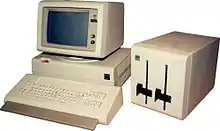 IBM Displaywriter with keyboard, monitor and dual 8-inch floppy disk drive | |
| Developer | IBM |
|---|---|
| Manufacturer | IBM |
| Type | microcomputer |
| Release date | June 1980[1] |
| Introductory price | US$7,895 (equivalent to $24,800 in 2020) / leased for US$275 (equivalent to $860 in 2020) a month. |
| Related articles | IBM System/23 Datamaster |
The Textpack operating system came in 6 variants (E, 1, 2, 3, 4, & 6) which sported progressively more features, with E having the fewest and 6 having the most. The features varied from basic text editing with the lowest Textpacks, E and 1, to being able to spell check, mail merge, automatically create headers, footers and footnotes, customize and bypass menus, save and recall macros, process light arithmetic and simultaneously run additional programs with Textpack 6. This tiered approach, according to IBM, was an attempt to make the Displaywriter more economical for smaller businesses, who could choose a cheaper software package and then upgrade as their needs required. The operator stored their data files on diskettes 8" in the typical manner that data would be stored on a microcomputer, however the format the diskettes used was proprietary.
Several supplemental programs were also offered by IBM to be used in conjunction with the Textpack software. These programs included Bisynchronous and Asynchronous communications; 3277 terminal emulation; 3276 terminal emulation, including terminal overstrike and underscoring; "Chartpack", a program to create business charts that could be inserted into typed documents; "Reportpack", a program to create and manage lists of data, such as customer lists or revenue reports; mag card conversion software; "Financial Planning and Report Generating System"[7], which was an advanced version of Reportpack that included financial modeling and easier report generation; "Language pack", to provide spell checking in 11 additional languages; electronic document distribution, to share Displaywriter documents with a S/370 mainframe; "Extended Spelling Dictionary", which provided spell checking for United States legal terminology; a "PC attach program"[8], which allowed file sharing and fixed disk sharing with an IBM PC/jr/XT; and several tailored templates for specialized data processing including "Administrative Support", "Applicant Processing" and "Personnel Report".
CP/M-86 and MS-DOS work as they do on other microcomputers, however, the software selection is limited by the display card in the Displaywriter, which only supports limited graphics outside of text characters. As a result, many DOS games are not playable on the Displaywriter. However an array of CP/M 86 software is compatible, and many programs, such as VEDIT, and Turbo Pascal were released with the Displaywriter explicitly in mind.
UCSD p-System was the official data processing operating system for the Displaywriter released by IBM, but it saw limited use and limited program support. It was most notably used by the USDA Rural Development as the operating system for the "Farmer Program Servicing Action System"[9], which was a custom software suite written by the Rural Development agency.
The Displaywriter hardware was meant to be configurable and offered multiple configuration options and additional feature cards. Feature cards included: a 3277 emulation card, a 3274/3276 emulation card, a printer sharing card, a single external EIA modem card, a dual external EIA modem card, a X.21 communications card, a local device communications card, an enhanced Chartpack display card and a memory expansion card. Additional configuration options included a 25 or 66 line display, one or two disk drives, 1 sided or 2 sided disk drives, a beamspring (Type A) or Model F (Type B) keyboard, and RAM configurations between 128 and 448 KB.
"A basic system — consisting of a display with a typewriter-like keyboard and a logic unit, a printer and a device to record and read diskettes capable of storing more than 100 pages of average text — cost $7,895 and leased for $275 a month."[1] The basic word-processing software was Textpack E, with simple mail merge; Textpack 2 added support for double-sided disks, networking, spellchecking, and print spooling; Textpack 4 added automatic hyphenation, columns, and more sophisticated merging; and Textpack 6 added automatic footnoting and outlining. Other options included multilingual dictionaries, graphics, and reports.[5]
The Displaywriter's features were comparable to other word processors of its era. The features included mail-merge, with fields designated as a01, a02, a03, etc. Elementary arithmetic could be applied to the fields.
The basic Displaywriter was a standalone system. An optional central storage and management unit was available, which permitted multiple Displaywriters to share storage and a printer. Connections to other IBM systems included:
- IBM 3278 emulation program[5] to attach to IBM 3274/3276 controllers, IBM 4321/4331, or IBM 4701.
- IBM 3277 emulation program to attach to IBM 3271, 3272 or 3274 controllers.
- Connection to IBM 8100 systems which use DPCX/DOSF.
- IBM Displaywriter/PC Attachment program on 8 inch floppies and cable connecting the Magnetic card port of the Displaywriter to the asynchronous communications port of an IBM PC XT allowing the user to transfer data.
Because of Displaywriter's popularity, IBM later produced DisplayWrite software for the IBM Personal Computer, with a similar user interface and equivalent to Textpack 4.[2]
References
- "IBM Displaywriter". IBM Archive. Retrieved 2009-01-31.
- Dickinson, John (1984-09-18). "IBM's Displaywriter Begets a Family of PC Software". PC. p. 238. Retrieved 29 January 2015.
- "IBM 6580 DISPLAYWRITER SYSTEM LICENSED PROGRAMS WITHDRAWAL FROM MARKETING". www.ibm.com. 1986-04-02. Retrieved 2021-12-17.
- SofTech's new products extend p-System's versatility. Info World. 1982-09-20. Retrieved 2010-02-25.
- Dickinson, John (1984-09-18). "The Prototype: Displaywriter". PC Magazine. pp. 242–243. Retrieved 9 March 2016.
- Libes, Sol (December 1981). "Bytelines". BYTE. pp. 314–318. Retrieved 29 January 2015.
- "PROGRAM OFFERINGS". www.ibm.com. 1984-03-06. Retrieved 2021-12-18.
- "IBM DISPLAYWRITER/PERSONAL COMPUTER ATTACH CONVENIENCE KIT". www.ibm.com. 1984-04-03. Retrieved 2021-12-18.
- "FARMER PROGRAM SERVICING ACTION SYSTEM" (PDF).
External links
 Media related to IBM Displaywriter System at Wikimedia Commons

Authority control: National libraries  |
|---|