Ian Fishback
Ian Fishback (January 19, 1979 – November 19, 2021) was a United States Army officer, who became known after he sent a letter to Senator John McCain of Arizona on September 16, 2005, in which Fishback stated his concerns about the continued abuse of prisoners held under the auspices of the Global War on Terror.
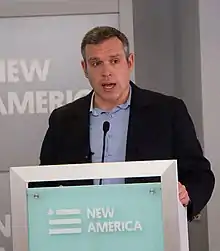

After receipt of his letter, McCain, along with Republican Senators John Warner and Lindsey Graham, wrote an amendment to a Senate bill that would make illegal previous Bush administration claims for the use of extreme methods of abuse.
Fishback earned a bachelor of science degree in middle eastern studies from the United States Military Academy at West Point, New York in 2001, two master of arts degrees, one in political science and one in philosophy, from the University of Michigan in 2012, and a Ph.D. in philosophy from the University of Michigan in 2021.
Major Fishback died at a care facility in Bangor, Michigan, on November 19, 2021, aged 42.[1][2][3]
Biography
Fishback was born in Detroit on January 19, 1979.[1] He was a 1997 graduate of Newberry High School in Newberry, Michigan.[4]
He was admitted to West Point and achieved the rank of major in the United States Army Special Forces.[5]
He served four combat tours in the U.S. Army, two with the 82nd Airborne and two with the Fifth Special Forces Group.[1]
In May 2012, Fishback was awarded an M.A. in political science from the University of Michigan, writing his master thesis on just war theory.[6]
From 2012 to 2015, he served as an instructor at West Point.[6][1]
He was a Ph.D. student in philosophy at the University of Michigan, Ann Arbor researching the interplay of morality and law regarding relative proportionality and necessity.[7] In 2021, Fishback submitted his Ph.D. dissertation that was entitled, Method and the Morality of War (adviser Elizabeth S. Anderson).[8]
Letter to McCain
In 2005, Fishback expressed concern about what he perceived as a military culture that was permissive toward the abuse of prisoners.[9][10][11][12]
Dear Senator McCain:
While I served in the Global War on Terror, the actions and statements of my leadership led me to believe that United States policy did not require application of the Geneva Conventions in Afghanistan or Iraq. On 7 May 2004, Secretary of Defense Rumsfeld's testimony that the United States followed the Geneva Conventions in Iraq and the "spirit" of the Geneva Conventions in Afghanistan prompted me to begin an approach for clarification. For 17 months, I tried to determine what specific standards governed the treatment of detainees by consulting my chain of command through battalion commander, multiple JAG lawyers, multiple Democrat and Republican Congressmen and their aides, the Ft. Bragg Inspector General's office, multiple government reports, the Secretary of the Army and multiple general officers, a professional interrogator at Guantanamo Bay, the deputy head of the department at West Point responsible for teaching Just War Theory and Law of Land Warfare, and numerous peers who I regard as honorable and intelligent men.
Instead of resolving my concerns, the approach for clarification process leaves me deeply troubled. Despite my efforts, I have been unable to get clear, consistent answers from my leadership about what constitutes lawful and humane treatment of detainees. I am certain that this confusion contributed to a wide range of abuses including death threats, beatings, broken bones, murder, exposure to elements, extreme forced physical exertion, hostage-taking, stripping, sleep deprivation and degrading treatment. I and troops under my command witnessed some of these abuses in both Afghanistan and Iraq.
This is a tragedy. I can remember, as a cadet at West Point, resolving to ensure that my men would never commit a dishonorable act; that I would protect them from that type of burden. It absolutely breaks my heart that I have failed some of them in this regard.
That is in the past and there is nothing we can do about it now. But, we can learn from our mistakes and ensure that this does not happen again. Take a major step in that direction; eliminate the confusion. My approach for clarification provides clear evidence that confusion over standards was a major contributor to the prisoner abuse. We owe our soldiers better than this. Give them a clear standard that is in accordance with the bedrock principles of our nation.
Some do not see the need for this work. Some argue that since our actions are not as horrifying as Al Qaeda's, we should not be concerned. When did Al Qaeda become any type of standard by which we measure the morality of the United States? We are America, and our actions should be held to a higher standard, the ideals expressed in documents such as the Declaration of Independence and the Constitution.
Others argue that clear standards will limit the President's ability to wage the War on Terror. Since clear standards only limit interrogation techniques, it is reasonable for me to assume that supporters of this argument desire to use coercion to acquire information from detainees. This is morally inconsistent with the Constitution and justice in war. It is unacceptable.
Both of these arguments stem from the larger question, the most important question that this generation will answer. Do we sacrifice our ideals in order to preserve security? Terrorism inspires fear and suppresses ideals like freedom and individual rights. Overcoming the fear posed by terrorist threats is a tremendous test of our courage. Will we confront danger and adversity in order to preserve our ideals, or will our courage and commitment to individual rights wither at the prospect of sacrifice? My response is simple. If we abandon our ideals in the face of adversity and aggression, then those ideals were never really in our possession. I would rather die fighting than give up even the smallest part of the idea that is "America."
Once again, I strongly urge you to do justice to your men and women in uniform. Give them clear standards of conduct that reflect the ideals they risk their lives for.
With the Utmost Respect,—Capt. Ian Fishback
1st Battalion,
504th Parachute Infantry Regiment,
82nd Airborne Division,
Fort Bragg, North Carolina[13]
The letter resulted in the creation of a anti-torture legislation, the Detainee Treatment Act, "sponsored by Senator McCain and passed by the Senate in an overwhelming show of bipartisan support with a vote of 90-9."[14]
Recognition
During debates over his amendment, Senator McCain said:
I thank God every day that we have men and women the caliber of Captain Fishback serving in our military. I believe the Congress has a responsibility to answer this call.[15]
On May 8, 2006, Fishback was chosen by Time magazine as one of the 100 most influential people in the world for taking his stand against torture.[16]
Matthew Harwood, an associate editor at Security Management magazine, wrote in Attitudes Aren't Free: Thinking Deeply About Diversity in the US Armed Forces (2012) that Fishback's letter to Senator McCain "is a testament that inside the US military lies redemption".[17]
References
- Roberts, Sam (November 23, 2021). "Maj. Ian Fishback, Who Exposed Abuse of Detainees, Dies at 42". The New York Times.
- Stiffler, Carol (November 24, 2021). "Major Ian Fishback Has Died at Age 42". The Newberry News.
- Steinhauer, Jennifer (November 25, 2021). "Army Whistle-Blower's Lonely Death Highlights Toll of Mental Illness". The New York Times.
Ian Fishback revealed abuse of detainees during the Iraq war, but struggled after leaving the service. He died awaiting a bed at the V.A.
- Stiffler, Carol (January 29, 2020). "A Modern Hero Says Goodbye: Ian Fishback Is Leaving the Country". The Newberry News. Archived from the original on June 12, 2020.
- Fishback, Ian. "Statement for the Record of Ian Fishback, Former Major, U.S. Army Before the Senate Judiciary Committee January 10, 2017" (PDF). Archived from the original (PDF) on June 11, 2021.
- "Ian Fishback". U-M LSA Philosophy. Retrieved October 27, 2020.
- "Ian Fishback: Graduate Student". University of Michigan. Archived from the original on June 13, 2020.
- Fishback, Ian (2021). Method and the Morality of War (PDF) (Dissertation). University of Michigan. Archived from the original (PDF) on November 24, 2021.
- "Leadership Failure: Firsthand Accounts of Torture of Iraqi Detainees by the U.S. Army's 82nd Airborne Division". Human Rights Watch. Vol. 17 no. 3(G). September 2005.
- Schmitt, Eric (September 24, 2005). "3 in 82nd Airborne Say Beating Iraqi Prisoners Was Routine". The New York Times.
- Richardson, John H. (September 21, 2009). "Acts of Conscience". Esquire. Archived from the original on March 3, 2020.
- Serrano, Richard A. (September 25, 2005). "Officer's Road Led Him Outside Army". Los Angeles Times. Retrieved October 27, 2020.
- Fishback, Ian (September 28, 2005). "A Matter of Honor". The Washington Post. Archived from the original on June 12, 2020.
- "Soldier Who Wrote of Detainee Abuse Submits Statement on Senator Sessions". Human Rights First. Retrieved October 27, 2020.
- "Department of Defense Appropriations Act, 2006". Congressional Record. October 5, 2005. pp. S11061–S11120. Archived from the original on June 13, 2020.
- Rowley, Coleen (May 8, 2006). "Heroes and Pioneers: Ian Fishback". Time. Archived from the original on June 13, 2020.
- Harwood, Matthew (2012). "Enjoining an American Nightmare" (PDF). In Parco, James E.; Levy, David A. (eds.). Attitudes Aren't Free: Thinking Deeply About Diversity in the US Armed Forces. Enso. ISBN 978-0982018569. Archived from the original (PDF) on June 13, 2020.CS1 maint: ignored ISBN errors (link)
External links
 |
Wikimedia Commons has media related to Ian Fishback. |