Ian Urbina
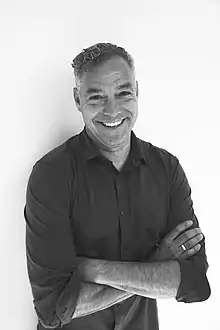
Ian Urbina (born March 29, 1972) is an American investigative reporter who has written for a variety of outlets, including The New York Times, The New Yorker, and The Atlantic.[1] Urbina is the author of The New York Times bestseller[2] The Outlaw Ocean (2019),[3] based on more than five years of reporting, much of it offshore, exploring lawlessness on the high seas.[4][5][6] As a journalist, his investigations typically focus on human rights, worker safety and the environment, and he has received a George Polk Award, and has been nominated for an Emmy. In 2008, Urbina was a member of the team of reporters that broke the story about the New York governor, Eliot Spitzer, and his use of prostitutes, a series of stories for which the Times staff won a Pulitzer in 2009 for breaking news.[7]
Ian Urbina | |
|---|---|
 | |
| Born | March 29, 1972 |
| Alma mater | Georgetown University |
| Occupation | Investigative reporter |
| Organization | The New York Times, The Atlantic |
| Website | theoutlawocean |
Early life and education
As a student at St Albans[8] and Georgetown, Urbina was an accomplished long-distance runner.[9][10] His father, Judge Ricardo M. Urbina, who was also a highly accomplished collegiate runner, was the first Latino on the federal bench in DC.[11][12][13][14]
Urbina has a degree in history from Georgetown University. Urbina was in a doctoral program in history and anthropology at the University of Chicago, where he specialized on Cuba.[15] As a Fulbright scholar, he did his doctoral dissertation research in Havana.[16]
Career
Joining The New York Times in 2003, Urbina was initially a reporter on the Metro desk. In 2005, Urbina moved to the Times' national desk to become its Mid-Atlantic Bureau chief. A 2007 Times investigation by Urbina about "mag crews" — traveling groups of teenagers, many of them runaways or from broken homes, who sell magazine subscriptions — was optioned for a 2016 movie, American Honey, directed by Andrea Arnold and starring Shia LaBeouf.[17]
Urbina became a senior investigative reporter for the National Desk in 2010, where he wrote a series in 2011, "Drilling Down", about the oil and gas industry and fracking.[18][19][20] John Krasinski said that the 2012 film Promised Land was partly inspired by the series.[21]
On worker safety, in 2013, he wrote a story about longterm exposure to hazardous chemicals and the federal agency, O.S.H.A., which is responsible for protecting against these workplace threats.[22] For the New York Times Magazine, he wrote in 2014, a piece called "The Secret Life of Passwords" about the anecdotes and emotions hidden in everyday web-users' "secure" passwords.[23]
He left The New York Times on May 30, 2019.[24]
Based at a think tank in Washington DC called The Middle East Research and Information Project (MERIP),[25] he spent two years writing about the Middle East[26] and published in The International Herald Tribune, Harper's Magazine, The Los Angeles Times and The Christian Science Monitor. He is a regular contributor to NPR[27] and C-SPAN.[28] In 2016, National Geographic designated Urbina as one of its resident Nat Geo Explorers and in 2020 he was awarded a National Geographic Storytelling Fellowship to make a podcast about The Outlaw Ocean Music Project and the use of music to convert and amplify journalism.[29] In 2017, he became a Resident Fellow at The Safina Center, a research and creative collective focused on environmental conservation, which was founded by the naturalist writer and scholar, Dr. Carl Safina.[30] In 2019, he was brought on staff as an investigator for the United Nations in affiliation with the UN's World Maritime University in Malmö, Sweden.
The Outlaw Ocean
In 2015, Urbina wrote a series called "The Outlaw Ocean" about lawlessness on the high seas.[31][32][33][34] To report the stories, Urbina traveled through Africa, Asia, Europe, and the Middle East, much of that time spent on fishing ships, chronicling a diversity of crimes offshore, including the killing of stowaways, sea slavery, intentional dumping, illegal fishing, the stealing of ships, gun-running, stranding of crews, and murder with impunity.[35] This series served as the basis of the 2019 book, The Outlaw Ocean, which has since been published in various countries and languages.[5][36] In 2015, Leonardo DiCaprio, Netflix, and Kevin Misher bought the scripted and non-scripted rights for The Outlaw Ocean.[37]
In 2019, Urbina created Synesthesia Media, which specializes in mixing mediums. In its first project, the firm functioned as a music label and recruited hundreds of musicians from more than 80 countries.[38] As part of The Outlaw Ocean Music Project,[39] these artists ranged in genre from classical and ambient to electronic and hip hop.[40] Each musician made their own album, inspired by the book and using field recordings that Urbina collected while reporting the book. The project's stated goal is to serve as an experiment in translation, converting journalism into music, while also disseminating the reporting more broadly, especially to younger demographics globally. The project has been widely reviewed by NPR, Billboard magazine, GQ, San Francisco Classical Voice, The Pulitzer Center and elsewhere.[41][42] Among the musicians participating in the project, is the Italian composer and pianist Alessandra Celletti with the album entitled Heroes.[43]
In 2019, Urbina also founded a non-profit organization[44] called The Outlaw Ocean Project, dedicated to producing journalism about the environmental, human rights and labor concerns that exist offshore around the world.
Urbina went on tour with Pop-Up Magazine, a theatre company, in 2021 to put on stage a multimedia rendering of The Outlaw Ocean Project's reporting from Libya about the brutal and EU-funded effort to prevent migrants from crossing the Mediterranean Sea and reaching European shores.[45]
In 2021, Urbina was accused by musicians of exploiting recording artists through the Outlaw Ocean Music Project, keeping most of the revenue from streaming for himself and his company Synesthesia Media. Urbina was listed on streaming services as co-author of more than 2,000 songs by more than 400 artists in the project. Urbina said that he has not made a cent in profit on the project. The New York Times said it was investigating the claims.[46][47]
Awards and fellowships
- In 2001, Urbina was awarded a Fulbright-Hays Fellowship to be based for a year in Havana, Cuba on behalf of The University of Chicago for anthropology and history doctoral research.[48]
- In 2006, Urbina was a member of the team of reporters that wrote a series about diabetes, which received a public service award from the Society of Professional Journalists' New York City chapter and a Society of Silurians award for science health reporting. The series was a finalist[49] for the Pulitzer Prize.
- In 2010, Urbina wrote a series called, "Running in the Shadows" which focused on the sexual trafficking of minors and the growing number of young runaways in the United States. This series received the New York Press Club's award for feature reporting.
- In 2011, Urbina delivered the annual Kops Freedom of the Press lecture at Cornell University titled, "Investigating the Natural Gas Drilling Boom" (video).[50] "Drilling Down" also received a Society of American Business Editors and Writers (SABEW), "Best in Business" award.
- In 2014, his story about OSHA and worker exposure to hazardous chemicals was a finalist in the Explanatory category for the Gerald Loeb Award. He was also on the Times team covering the death of thousands of garment workers in Bangladesh that was also a finalist for a Loeb Award that year in the international reporting category.[51]
- In 2015, Urbina's, "The Secret Life of Passwords" was nominated for an Emmy.[52]
- In 2016, Urbina's series, "The Outlaw Ocean" won various journalism awards, including the George Polk Awards for Foreign Reporting,[53] The Maritime Foundation's Desmond Wettern Media Award for Best Journalistic Contribution,[54][55] The Sigma Delta Chi Award[56] for Foreign Correspondence from the Society of Professional Journalists, The Peter Benchley Ocean Award for Media Excellence,[57] The Best in Business Award for Feature Writing[58] from the Society of Business Editors and Writers, and The Human Rights Press Award Online English Merit Award.[59] The Society of Publishers in Asia (SOPA) also awarded the series a prize in the Excellence in Digital News category and an honorable mention in the Human Rights Reporting category.[60] Photos from the series won The National Press Photographers Association's 2016 Award for Best Of Photojournalism Multimedia[61] and The Photojournalism/Documentary Award from Photo District News (PDN).[62] The series' videos won the National Edward R. Murrow Award for News Series.[63] The series was also a finalist for The Scripps Howard Award in Public Service Reporting,[64] The Gerald Loeb Award in International reporting,[65] and The Michael Kelly Award.[66] The series won an honorable mention for TRACE International's Prize for Investigative Reporting for "Maritime 'Repo Men': A last resort for stolen ships,"[67] and won an honorable mention for The Anthony Lewis Prize for Exceptional Rule of Law Journalism, given by the World Justice Project.
- In 2019, The Outlaw Ocean was placed on Amazon's List of Best Books of 2019[68] and The New York Times Best Seller List for Non-Fiction.[69]
- In 2021, The Outlaw Ocean Project won a Sigma Delta Chi Award for data reporting presented by the Society of Professional Journalists. The award was granted for a story published with NBC News that revealed the world's largest illegal fishing fleet (more than 900 Chinese squid ships in North Korean waters in violation of UN sanctions).[70]
- In 2021, FilmAid International gave Ian Urbina the Christopher Dickey Award for Journalism Excellence[71] for accomplishment in international reporting and telling stories rarely told. The award was presented by Mark Ruffalo in a ceremony in the New York City.[72]
Bibliography
- 2019: The Outlaw Ocean: Journeys Across the Last Untamed Frontier. Knopf Doubleday, New York 2019, ISBN 978-0451492944.
- 2005: Life's Little Annoyances: True Tales of People Who Just Can't Take It Anymore. Reprint, Henry Holt and Company, New York 2010, ISBN 978-0805083033.
References
- "Ian Urbina Joins The Atlantic as Contributing Writer". The Atlantic. The Atlantic. August 15, 2019. Retrieved August 15, 2019.
- "The New York Times Hardcover Non-Fiction Bestsellers". The New York Times. Retrieved August 31, 2019.
- "The Outlaw Ocean". The Outlaw Ocean. Retrieved June 24, 2019.
- "Kirkus Review". The Kirkus Review. Retrieved August 31, 2019. "Urbina's book ranks alongside those by Mark Bowden and Sebastian Junger."
- Iglesias, Gabino (August 21, 2019). "'The Outlaw Ocean': A Forgotten Frontier Where Slavery And Illegal Activities Abound". NPR. NPR. Retrieved August 31, 2019. "The Outlaw Ocean is an engrossing and immersive book that shows the ocean is the last frontier: a vast place where the laws don't apply. The narratives have a cinematic quality to them that is intensified by the many photos and drawings that accompany most each story. That he has condensed all that into 560 pages is a testament to his reporting skills and proof that outstanding writing is still one of the best tools we have to get to know the world we live in."
- Braverman, Blair (August 19, 2019). "Pirates, Slavers and Poachers: Violence on the High Seas". The New York Times. Retrieved August 31, 2019."These chapters are vibrant as individual stories, but as a collection they're transcendent, rendering a complex portrait of an unseen and disturbing world. Urbina pursues a depth of reportage that's rare because of the guts and diligence it requires — not to mention the budget, which must have been enormous. The result is not just a fascinating read, but a truly important document."
- "The 2009 Pulitzer Prize Winner in Breaking News Reporting". www.pulitzer.org. Retrieved December 6, 2021.
- Sonner, Tim (September 28, 1989). "Free from pain, St. Albans' Urbina regains momentum". The Washington Post. Retrieved September 27, 2015.
- Graber, Michael (November 24, 1994). "Hoyas men chase 1st National Championship". The Washington Post. Retrieved September 27, 2015.
- Niewiaroski, Donna (October 11, 1993). "Running". The Washington Post. Retrieved March 23, 2020.
- Hoyas, Georgetown (September 28, 1989). "Athletic Hall Of Fame Members". Georgetown University Athletics. Retrieved March 31, 2020. Judge Urbina held the NCAA indoor national 1000-yard collegiate record in 1966 and that same year he won the indoor NCAA Div. I title in 880 yd. run.
- Hall of Fame (March 15, 2019). "Ricardo Urbina '63". Monsignor McClancy Memorial High School. Retrieved March 31, 2020.
- Wilber, Del Quentin (June 1, 2011). "Judge who had "no passion for punishment" retires after 31 years". The Washington Post. Retrieved March 4, 2016.
- Gonzalez, Charlie. "Tribute to Honorable Ricardo M. Urbina". Scout - Sunlight Foundation. Congressional Record Online through the Government Publishing Office. Retrieved July 12, 2011.
- "Author Biography". Macmillan. Macmillan Publishers. Retrieved October 1, 2015.
- "The University of Chicago". National Geographic Society Newsroom. The University of Chicago. Retrieved October 1, 2015.
- O'Sullivan, Michael. "'American Honey': Travels with a youthful subculture, fleeing crushed dreams". The Hollywood Reporter. Retrieved October 6, 2016.
- McKibben, Bill (March 8, 2012). "Why Not Frack?". The New York Review of Books. Retrieved September 27, 2015. McKibben wrote: "In fact, the most remarkable work on the subject has been done by Ian Urbina, a New York Times journalist, and by the rebel filmmaker Josh Fox. Urbina's stories, which seem likely to win a Pulitzer, demonstrate why we can't do without serious newspapers. Beginning last spring, he documented the health risks, lax regulation, industry overstatement, and general corruption that have surrounded the boom."
- Petit, Charlie. "New York Times Science Times". Knight Science Journalism at MIT. MIT. Archived from the original on June 2, 2012. Retrieved September 27, 2015.CS1 maint: unfit URL (link) Petit wrote: "From here, it appears that the Times and Mr. Urbina are calmly saying we should learn a lesson from the dot-com bubble and the housing bubble, suggesting investors and regulators and gov't planners step with care and not be blinkered by all the money that's pouring in."
- Kennedy, Robert F. (October 20, 2011). "The Fracking Industry's War on The New York Times and the Truth". The Huffington Post. Retrieved September 27, 2015.
- Karpel, Ari (January 2, 2013). "Matt Damon and John Krasinski on making "Promised Land," A Non-Message Message Movie". Fast Company. Retrieved September 27, 2015. Karpel wrote: "After a moment considering the salmon industry, the pair settled on making a movie about hydraulic fracturing, known as fracking. Krasinski was inspired in part by a series of stories in The New York Times, called Drilling Down. Thus, Promised Land, written by and starring Damon and Krasinski, and directed by Gus Van Sant, was born."
- Starkman, Dean. "Three things to like about the Times OSHA exposé". Columbia Journalism Review. Columbia Journalism Review. Retrieved September 27, 2015. The Columbia Journalism Review called the story a "magisterial probe", and "without doubt a great example of agenda-setting public-interest reporting of a kind that, sad to say, is becoming increasingly scarce among mainstream business news outlets."
- Urbina, Ian (November 23, 2014). "The Secret Life of Passwords". The New York Times Magazine. Retrieved September 22, 2018.
- "A Former 'New York Times' Reporter Allegedly Exploited Artists". UPROXX. December 5, 2021. Retrieved December 7, 2021.
- "Ian Urbina - MERIP". MERIP. Retrieved July 5, 2003.
- Urbina, Ian; Tutu, Archbishop Desmond (June 27, 2002). "Against Israeli Apartheid". The Nation. The Nation. Retrieved June 27, 2002.
- "WNYC - People - Ian Urbina". WNYC. WNYC.org. Retrieved October 1, 2015.
- "Natural Gas Drilling and the Environment". CSPAN. CSPAN. March 4, 2011. Retrieved October 1, 2015.
- "National Geographic Storytelling Fellows". National Geographic Society Newsroom. National Geographic. July 23, 2020. Retrieved July 23, 2020.
- "Ian Urbina Fellow". The Safina Center. Retrieved November 21, 2019.
- Murphy, Tim. "Deep Dive". The University of Chicago Magazine. The University of Chicago. Retrieved March 2, 2016.
- Torrence, Marc (February 17, 2016). "Murder, Slavery, A Harrowing Chase: Behind the Journalism Series That's Changing the Oceans". Patch.com. Patch Media. Retrieved February 18, 2016.
- Damanski, Maria. "Quick Take: Growing Momentum to Fight Illegal, Unreported and Unregulated Fishing". Talk. Nature.org. Retrieved September 27, 2015. Damanski wrote: "If you haven't read it, it's a dramatic exposé about the chronic and widespread violence, oppression and lawlessness that exists out on the open ocean. In the series, Urbina shines an important spotlight on the magnitude of challenges facing ocean management and the need for governments to work together. The last in the series, The Longest Chase, gives us a glimpse into the $10 billion-per-year illegal fishing trade "that is thriving as improved technology has enabled fishing vessels to plunder the oceans with greater efficiency."
- Ryan, Chris (July 20, 2015). "'True Detective,' Season 2, Episode 5: 'Other Lives'". Grantland. Retrieved September 27, 2015. Ryan writes, in reference to "The Outlaw Ocean": "The web of holding companies and money; the apathetic, complicit, or handcuffed law-enforcement agencies and bodies of government; and the powerful men who escape any kind of justice — Urbina's story has all the makings of a True Detective season."
- "Long Island University Announces 67th Annual George Polk Awards In Journalism". PR Newswire. PR Newswire. Retrieved March 19, 2016.
- "The Outlaw Ocean Book". The Outlaw Ocean. Ian Urbina. Retrieved April 6, 2020.
- "The Tracking Board". The Tracking Board. June 20, 2016. Retrieved November 10, 2016.
- Colin, Molly. "Art and Advocacy Combine in The Outlaw Ocean Music Project". www.sfcv.org. The San Francisco Classical Voice. Retrieved December 8, 2020.
- "The Outlaw Ocean Music Project". The Outlaw Ocean Music Project. Retrieved January 31, 2020.
- "Behind the Story: The Outlaw Ocean Music Project". Youtube. The Pulitzer Center. Retrieved October 9, 2020.
- "The Outlaw Ocean Music Project Press". The Outlaw Ocean Music Project. Retrieved January 31, 2020.
- "Artists | The Outlaw Ocean Music Project". www.theoutlawoceanmusic.com. Retrieved July 23, 2020.
- "Alessandra Celletti: "Heroes" recensione". Rockit.it (in Italian). Retrieved July 10, 2021.
- "Non-Profit The Outlaw Ocean Home Page". Retrieved January 30, 2020.
- "Pop-Up Magazine 2021 Fall Tour". Retrieved October 28, 2021.
- Leight, Elias (December 6, 2021). "A Pulitzer Prize-Winning Reporter Has Been Accused of 'Scamming' Musicians". Rolling Stone. Retrieved December 7, 2021.
- Stokel-Walker, Chris. "Did a former 'NYT' reporter exploit musicians for his personal gain?". Input. Retrieved December 5, 2021.
- "Fulbright-Hays Doctoral Dissertation Research Abroad Fellows". The University of Chicago. Retrieved October 6, 2016.
- Shafir, Doree (April 17, 2007). "Bill Keller: Why is this Pulitzer different from all other prizes?". Gawker. Archived from the original on July 2, 2015. Retrieved September 27, 2015. "This year we had three Pulitzer finalists — two of them emanating from that engine of excellence known as the Metro Desk. In the explanatory category, The NYT Staff was a finalist for our national wake-up call on the epidemic of diabetes. Sonny Kleinfield, Richard Perez-Pena, Marc Santora and Ian Urbina kicked off the year with an eye-opening series, and throughout the year we had contributions from other departments, accompanied by great video narratives and slide shows that brought the problem vividly to life."
- "Cornellcast". American Studies Program, College of Arts and Sciences. Cornell University. Retrieved October 1, 2015.
- "Gerald Loeb Awards, 2014 Finalists". Retrieved September 27, 2015.
- "The New York Times Nominated For Eight News and Documentary Emmy Awards". NYTCO. The New York Times. July 22, 2015. Retrieved September 27, 2015.
- "Long Island University Announces 67th Annual George Polk Awards In Journalism". Long Island University. February 14, 2016. Retrieved May 24, 2016. "The reporting also took readers aboard a ship operated by environmental activists in the culmination of a 10,000-mile chase leading to the sinking of a notorious pirate trawler that had eluded Interpol and other authorities for a decade. The series spurred Congressional hearings and testimony, class-action litigation against the seafood industry, and, abroad, a criminal investigation and convictions."
- "New York Times reporter Ian Urbina lands 'best maritime journalism contribution in 2016'". Maritime Foundation. October 27, 2016. Retrieved October 28, 2016.
- "Maritime Media Awards 2016: Ian Urbina, The New York Times". Maritime Foundation. October 27, 2016. Retrieved November 10, 2016.
- "2015 SIGMA DELTA CHI AWARD HONOREES". www.spj.org. Society of Professional Journalists. Retrieved May 24, 2016.
- "Ian Urbina | Peter Benchley Ocean Awards". peterbenchleyoceanawards.org. Retrieved May 24, 2016. "Urbina's riveting series has generated a high-level of public interest, a NYTimes editorial call for action, and opened the doors for discussion of new regulatory and law-enforcement approaches at the national and international policy-making levels."
- "2015 Best in Business Honoree List « SABEW". sabew.org. Retrieved May 24, 2016.
- "2015 HRPA winners – English version | Human Rights Press Awards". humanrightspressawards.org. May 6, 2016. Retrieved May 24, 2016.
- "SOPA 2016 Award Winners" (PDF).
- "NPPA Best Of Photojournalism Multimedia Category Winners Announced | NPPA". nppa.org. March 23, 2016. Retrieved May 24, 2016.
- "PDN Photo Annual 2016". CTV News. Retrieved May 24, 2016.
- "2016 National Edward R. Murrow Award Winners". www.rtdna.org.
- Company, The E.W. Scripps. "Scripps Howard Foundation announces winners of 2015 Scripps Howard Awards". www.prnewswire.com. Retrieved May 24, 2016.
- "2016 Gerald Loeb Award Finalists". May 19, 2016. Retrieved July 9, 2016.
- "Alissa J. Rubin Wins Atlantic Media's 2016 Michael Kelly Award". www.theatlantic.com. April 18, 2016. Retrieved April 18, 2016.
- "TRACE International Prizes for Investigative Reporting". Retrieved July 21, 2016.
- "Amazon's picks for best books of 2019 are out and on sale". CNN. November 12, 2019. Retrieved November 14, 2019.
- "The New York Times Best Seller List For Hardcover Nonfiction". The New York Times. Retrieved January 31, 2020.
- "The Outlaw Ocean Project won a Sigma Delta Chi Award for data reporting". Retrieved July 22, 2020.
- "The Christopher Dickey Award". The Hollywood Reporter. Retrieved October 4, 2021.
- "The Christopher Dickey Award presented by Mark Ruffalo". YouTube. Retrieved October 28, 2021.
External links
 |
Wikiquote has quotations related to: Ian Urbina |
Authority control  | |
|---|---|
| General | |
| National libraries | |