Ife Empire
The Ife Empire was the first empire in Yoruba history. It was found primarily in what is now southwestern Nigeria and eastern Benin. The Ife Empire lasted from 1200 to 1420. The empire was founded by Odùduwà, and became well known for its sophisticated art pieces. Yoruba was mainly spoken, though it was multi-ethnic. It rose to power through trade with Sahelian states and nearby forest states. Its capital city Ilé-Ife was one of the largest urban centers, the biggest emporium, and the wealthiest polity in West Africa during the mid-14th-century.
Empire of Ife | |||||||||
|---|---|---|---|---|---|---|---|---|---|
| c. 1200 - 1420 AD | |||||||||
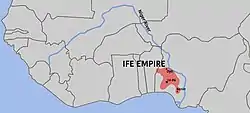 Ife Empire during mid 14th century | |||||||||
| Status | Empire | ||||||||
| Capital | |||||||||
| Common languages | Yoruba, Edo | ||||||||
| Religion | Yoruba religion, Islam.[1] | ||||||||
| Government | Elective Monarchy | ||||||||
| Oba | |||||||||
| Historical era | Postclassical Era | ||||||||
| |||||||||
| Today part of | Nigeria Benin | ||||||||

History
Formation and early history
The Ife region began as a small collection of house societies, which over time grew to become “mega houses” or mini-states, due to competition for resources. Over time, as managing the resources, population, and conflicts presented opportunities for new organizational structures, several of the mega-Houses started forming themselves into confederacy-like associations. The most prominent of these was the Ife “confederacy”. Conflicts over resources continued, exacerbated by drying and an increasing population.
Out of fighting emerged a group of people led by Odùduwà, who built a large perimeter wall between the 10th to 11th centuries, measuring about 7 km (4.3 mi) in circumference and 2.3 km (1.4 mi) in diameter. The wall would soon become the core urban center of Ilé-Ifè. The building of the wall led to a very large conflict between the Odùduwà group and another mega house called the Obatálá group. The Odùduwà group won the conflict.
According to oral traditions a conference was held at Ìta Ìjerò in Ilé-Ifè. following the triumph of the Odùduwà group in the Obatálá-Odùduwà conflict. At the end of the conference, each prince went away to establish his kingdom such as Benin and oyo, with the promise that they would all keep in touch as brothers and support one another in times of trouble.
Ife made up a story to place it at the center of a system of social networks and hierarchically linked polities. They created Ìta Ìjerò legend to give it a coherent framework. And It was gained region-wide (yoruba-edo region) recognition by the thirteenth century.[2]
Classical Period (1000–1420 AD)
Once the war ended a new era began, the Classical period. The sociopolitical outcome of the instability was qualitatively different from that of the preceding era. The hallmarks of the Classical period include the development of an urban capital with concentric embankments. There were also life-size terracotta and copper or brass sculptures with detailed, idealized naturalism.
Craft specialization defined everyday economic life, in which the production of high-value crafts such as glass-bead production featured prominently. Ife grew to have very iron production which they made high-quality iron and even steel.[3]
As the population grew, the capital city Ilé-Ife, built a second wall during the thirteenth century. They also began paving several of its major roads. The occurrence of potsherd pavements in virtually every part of the area within the Inner and Outer Walls and beyond indicate that the city was densely populated. It's estimated that the city of Ilé-Ifè had a population of 70,000–105,000 during the mid-fourteenth century.
Ife's promince grew so much that it was even possibly mentioned on A 1375 Spanish trade map known as the Catalan Atlas under the name Rey de Organa. The name Organa alludes to the title of first dynasty Ife rulers, i.e. Ógáne (Óghéné, Ógéne̩). The same name is referenced to in a Portuguese account from the 1480s about an inland ruler who played a central role in Benin royal enthronements.[4]
At its zenith in the 14th century, Ife reached around three hundred kilometers and encompassed Owu, Jebba, Tada, and Oyo in the north and Benin and Ijebu in the south.
Ife was very culturally diverse, the northern parts of ife around the Niger river included the Nupe, Ìbàrìbá, and various Songhai peoples of which the Djerma were post prominent.They all came to the area because of its opportunities as a commercial entrepôt and its abundant resources for agriculture and fishing.[2]
Trade

The Ife Empire was one of the oldest trading empires in west Africa and an early partner in the trans-saharan trade. One of Ife's earliest trade routes was up the Niger to gao, the route became active as early as the ninth century.[5]
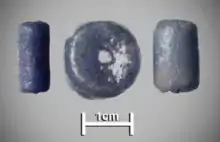
Glass beads were one of the most sought after items in west Africa during this time and Ife had almost all control of this market. Ife was likely the third place in the world glass bead technology was indigenously invented.[4] Dichroic glass beads from Ilé-Ifè Have been found at Kissi in Burkina Faso, Diouboye in Senegal, Gao Ancien, Essouk in Mali, and Koumbi Saleh in Mauritania, all in twelfth- to fourteenth-century contexts. Ilé-Ifè, was the only known industrial center for HLHA glass production.
Ife's fame spread far and wide, Ibn Battuta was informed during his visit to Mali about a powerful kingdom to the south called Yufı which he described as “one of the biggest countries of the Sudan, and their sultan, one of the greatest sultans [2] He goes on further calling Yufi as a country that “no white man can enter . . . because the negros will kill him before he arrives”.[4] Ife was most likely Yufi, Akinwumi Ogundiran writes "Ilé-Ifè was the largest urban center, the biggest emporium, and the wealthiest polity in West Africa’s rain forest belt south of the Niger River during the mid-fourteenth century, with more than two centuries of trading contact with the Western Sudan. On account of these facts alone, it is the best match for Ibn Battuta’s Yufi. Moreover, on linguistic grounds, Yufı is a Mandé or an Arabic transliteration of “Ufè.,” the proper name for “Ifè.” in central Yorùbá dialect."[2]
The Bead Road is the name given by akinwumi ogundiran of the trade route, which stretched from Ilé-Ifè to the Moshi-Niger area and as far as the Niger Bend in present-day Mali.[2] Another possible mention of Ife are the Records of 11th to 14th century Arab scholars that reveal trade in blue dichroic West African glass beads.[6] Ife was receiving Mediterranean and Chinese silks from trade with the western Sudan by the 12th century.
Ife was also likely a part of the silk trade east–west silk road between the twelfth through fifteenth centuries, with long-distance trade routes going up all the way to nubia during 1300s. Evidence for this are coptic cross motifs found on objects, burial sites, and statues in the Ife Empire region Historic Ife ritual contexts also suggest possible early Coptic Christian contact. there is also Ife regalia likely modeled on an ancient Nubian shield ring that probably reached the area between the twelfth through fourteenth Century era through trade.[4]
Evidence also shows that yorubaland during Ife's times period, was involved in trade with southwestern Cameroon.[7]
Architecture
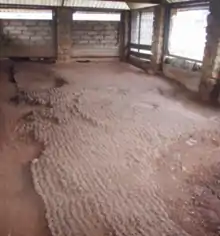
Houses dwellings had a sort of clay terrace and used wooden posts to hold the roof. Elite buildings walls and floors were paved with potsherd tiles, ceramic tiles, and cobblestone. Most of the potsherd tiles were arranged linearly in herringbone patterns, and black and red sherds were arranged in geometric mosaics.[2] Leo Frobenius also noted that the foundations of ancient buildings at Ile-Ife were built of burnt bricks.[8] By the early 19th century, he said Ife's architecture has greatly regressed from what it reached in antiquity.
Conflicts
One of Ife's northernmost provinces, Owu, controlled the trade connecting the rest of Ife and the western Sudan where Ifè glass beads passed into the Middle Niger valley. With control of the trade and profit they began buying horses from the Wasangari, Mossi, Mandé, and Songhai in the early 14th century and became the first cavalry state in Ife. with Owu new found power the becam to expand rapidly with the use of calvary and Òwu began to undermine the commercial and political interests of Ifè, eventually declared war on ife starting a civil war.[2]
Evidence also shows Ife was likely dealing with Islamic expansions during the 14th century. A group of rock carvings found around nine miles south of Ife show carved images including hands holding a sword, bound arms, a decapitated man, another sword, two clusters of spears, a tortoise, a snake, what seems to be a leopard, and a Muslim prayer board. The carving seems to depict a battle. Since the carving shows obatala linked animals and a Muslim prayer board it likely implies that the battle that took place involved people from local and foreign religions(Islam). The battle seems all the more significant considering the interest shown in providing evidence of it. The Muslim prayer board offers evidence that the wars that were taking place in the Ife area as with regions to the north and east in this era (from modern Chad to Mali) involved local populations in contestation with Islamic troops.[4]
Decline
Many factors led to Ife's ultimate demise by 1420. These included long spells of drought that kicked off around 1380 across West and East Africa, political disturbances in Western Sudan like, the collapse of the Mali Empire, internal crisis within the Ife Empire, and an epidemic that was most likely smallpox[2] or even possibly the black death.[9]
References
- Kalilu, Razaq Olatunde Rom (1997). "BEARDED FIGURE WITH LEATHER SANDALS: ISLAM, HISTORICAL COGNITION, AND THE VISUAL ARTS OF THE YORÙBÁ". Africa: Quarterly magazine of studies and documentation of the Italian Institute for Africa and the East. 52 (4): 579–591.
- akinwumi, ogundiran (2020). The Yoruba: A New History. Indiana University Press. ISBN 9780253051509.
- Ige, Akin; Rehren, Thilo. "Black sand and iron stone:iron smelting in Modakeke, Ife, south western Nigeria". Institute for Archaeo-Metallurgical Studies.
- blier, suzanne (2014). art and risk in ancient yoruba: ife history, power, and identity, c. 1300. Cambridge University Press. ISBN 9781107021662.
- HORTON, ROBIN (1979). "Ancient Ife: A reassessment". Journal of the Historical Society of Nigeria. 9 (4): 35–36.
- Babalola, Abidemi Babatunde (May 2, 2017). "Ancient History of Technology in West Africa: The Indigenous Glass/Glass Bead Industry and the Society in Early Ile-Ife, Southwest Nigeria". journal of black studies. 48 (5): 19–20.
- Mercader, Julio; Marti, Raquel (2006). "The Eastern Periphery of the Yoruba Cultural Sphere: Ceramics from the Lowland Rain Forests of Southwestern Cameroon". Current Anthropology. 4 (1): 173–184.
- Frobenius, Leo (1913). The Voice of Africa, Vol. 1 of 2: Being an Account of the Travels of the German Inner African Exploration Expedition in the Years 1910-1912. Smithsonian Libraries. ISBN 9780405085369.
- Chouin, Gérard (2018). "Penser la peste dans l'histoire de l'Afrique (XIVe-XIXe s.)" [Reflections on plague in African history (14th–19th c.)]. OpenEdition Journals (in French and English).