The Incredible Hulk: Ultimate Destruction
The Incredible Hulk: Ultimate Destruction is an open world action-adventure video game developed by Radical Entertainment, published by Vivendi Universal Games (VU Games), and based on Marvel Comics' Hulk. The game was released on August 24, 2005 in the United States and on September 9, 2005 in Europe.
| The Incredible Hulk: Ultimate Destruction | |
|---|---|
.jpg.webp) Cover art by Bryan Hitch | |
| Developer(s) | Radical Entertainment |
| Publisher(s) | Vivendi Universal Games[lower-alpha 1] |
| Director(s) | Mark James |
| Producer(s) | Tim Bennison Vlad Ceraldi |
| Designer(s) | Eric Holmes |
| Programmer(s) | Chris Cudahy |
| Artist(s) | Martin Bae |
| Writer(s) | Paul Jenkins |
| Composer(s) | Bill Brown |
| Platform(s) | PlayStation 2, Xbox, GameCube |
| Release | |
| Genre(s) | Action-adventure |
| Mode(s) | Single-player |
Gameplay
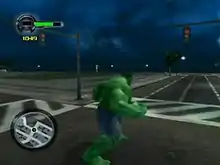
The Incredible Hulk: Ultimate Destruction is a third-person action-adventure game in which the player controls the Hulk, the super-powered alter-ego of scientist Bruce Banner. Influenced by hypnotic suggestions from Banner's psychotherapist Leonard Samson, the Hulk is tasked with gathering resources for a machine that will cure Banner of the infliction that causes his transformations into the Hulk.[1] Between each story-based mission, the Hulk can freely explore the game's world as well as engage in side missions such as playing rounds of golf with giant balls and clubs or carrying an ambulance to a hospital.[1][2] His location in the world is tracked by a radar on the bottom-left corner of the screen,[3] and a variety of icons on the radar indicate mission objectives; for example, a red fist indicates something that must be destroyed, while a blue shield indicates something that must be protected. Samson's base is indicated by a green house icon.[1]
The Hulk is capable of jumping great distances, running up and along walls, and climbing, as well as a series of basic attacks and grapples to use against enemy characters. The Hulk can grab several objects and use them as weapons, such as using a wielding a lamppost as a club. Larger objects such as cars and tanks can be picked up and thrown to dispatch groups of enemies from a distance. The Hulk's health is represented by a bar on the upper-left corner of the screen, while a second bar below it increases whenever the Hulk takes damage or destroys property. When this bar is filled, the Hulk enters a "critical mass" state in which he is capable of his most powerful and devastating moves. However, using these moves depletes the bar, causing the Hulk to drop out of critical mass. When his health drops to a certain level, the Hulk will enter an "adrenaline surge" state similar to critical mass, in which he can use the same moves without depleting the critical mass bar.[1]
If the Hulk causes wanton destruction during the free-roaming gameplay, the spokes of an "emergency response meter" on the upper-right corner of the screen will extend. When the meter's center lights up, a military strike team will be dispatched to combat the Hulk.[3] Accomplishing missions, destroying property, and defeating enemies earn the Hulk "smash points", which can be used to purchase new moves at Samson's base. Such moves include new ways to weaponize objects, such as using two halves of a car as steel gloves, or using a flattened car as a shield. Each mission that is completed unlocks additional moves to purchase. Some moves have dependencies, and will not be available until the moves they are based on have been purchased. Hidden throughout the world are sixty collectible comic book covers from the Incredible Hulk series, which unlock a variety of rewards.[1]
Plot
Scientist Bruce Banner has spent years in semi-isolation researching a potential cure for an affliction that transforms him into the Hulk when he is angered or stressed. He has created an experimental device intended to modify his subconscious and repair psychological damage inflicted upon him by childhood trauma, thus subduing the Hulk as well as another more menacing personality that is emerging within him. Working alongside psychotherapist Doctor Leonard Samson, Banner nearly completes the device, but military forces led by Emil Blonsky destroy his forest hideout. As Banner escapes in the form of the Hulk, Blonsky takes the device from the hideout's remains and receives a dose of gamma rays. Banner regroups with Samson, who equips Banner with a device that implants post-hypnotic suggestions and artificially induces episodes of rage, allowing them a degree of control over the Hulk. Samson sends the Hulk on various errands into the city and the badlands, either to help construct the machine or to hinder Blonsky's ever-growing presence.
Meanwhile, the mutual animosity between Blonsky and his superior General Thunderbolt Ross grows into open hostility due to Blonsky overstepping his authority to secure a mysterious prisoner, "Mission Directive", in a secret military research facility known as the Vault. After an argument with Ross, Blonsky loses control and transforms into a massive reptilian-like creature known as the Abomination. He goes on a rampage until the Hulk arrives and defeats him. As the Hulk escapes, Blonsky returns to normal and claims to his men that the wreckage is the Hulk's doing. The Hulk is sent to a nuclear power plant to obtain fuel rods, and he confronts Blonsky's bodyguard Mercy. Upon her defeat, Mercy attempts to divulge the true nature of Mission Directive, but is killed when Blonsky orders an air strike on the plant. Although Banner escapes with his life, the stress of the situation takes its toll and his evil alter ego, the Devil Hulk, begins to emerge.
Under the Devil Hulk's influence, the Hulk destroys civilian buildings, killing many innocents, under the illusion that Samson is ordering him to destroy military locations. When Samson sends Hulk on a mission to retrieve a package from a military test site, he is lured into an ambush; Samson has sided with Ross, fearing the threat of an out-of-control Hulk. Ross faces the Hulk in a gigantic Hulkbuster mech, which the Hulk destroys. Having no choice, Samson puts the Hulk to sleep with his hypnotic device. Banner is taken to the Vault, where Blonsky prepares to peel open Banner's mind in search of the secret to controlling gamma-based transformations. The agony of Banner's interrogation draws out the Devil Hulk's power, and the Hulk breaks free. Blonsky transforms into the Abomination when the Hulk corners him, exposing his identity to the military. Blaming the Hulk for ruining his life, the Abomination flees the Vault, as does the Hulk. Banner confronts Samson for betraying him, but forgives him when Samson reveals that he used Banner's captivity as a diversion to secure a vital component of the machine. Before the machine can be completed, however, Ross discovers Samson's base and orders it destroyed. The Hulk defends the church as Samson makes the final adjustments. Using the finished machine to venture into his own psyche, Banner defeats and banishes the Devil Hulk.
Meanwhile, the Abomination breaks into the Vault to retrieve Mission Directive. The Hulk follows him, but discovers that Mission Directive is Blonsky's now-deceased wife Nadia and their unborn child; following Nadia's diagnosis of ovarian cancer, Blonsky exposed her to gamma radiation as part of a government program influenced by Banner's previous research. Blaming Banner for Nadia's death, the Abomination departs from the Vault and heads for the local dam, planning to destroy it and the city below. The Hulk and the military pursue the Abomination, but fail to prevent him from breaking the dam. As the Abomination disappears under the rushing current, the Hulk causes a landslide to stop the water and save the city. Despite this heroic act, Ross publicly blames the Hulk for the dam's destruction. Samson, lamenting this turn of events, offers his help again, but Banner turns him down, believing the world will never trust the Hulk, and he sets off on his own.
Development and release
On February 10, 2004, Vivendi Universal Games and Radical Entertainment jointly announced a partnership under which Radical would create six license-based multi-platform games published by VU Games, including a sequel to Hulk tentatively titled The Hulk 2. Michael Pole, executive vice president of worldwide product development for VU Games, confirmed that The Hulk 2 would not be based on any theatrical production, and was slated for a mid-2005 release.[4] Another working title, The Incredible Hulk, was revealed in December, as was its status as a free-roaming title.[5] The final title was revealed by Marvel Studios in a webcast conference on March 7, 2005.[6]
The game's direction was based on reactions to the previous Hulk game; the development team built upon the game's feeling of controlling the Hulk's power, combat style, and environmental interaction, drawing from the tutorial level as a particular influence. The free-roaming element and the omission of Bruce Banner from the gameplay were based on negative responses to the previous game's limited corridor-based level design and stealth levels respectively. To achieve an authentic comic book experience, Radical collaborated with Marvel Comics veterans Paul Jenkins and Bryan Hitch, who were heavily involved in the game's development: Jenkins wrote the story, script, and in-game dialogue, and also provided suggestions for the gameplay, while Hitch provided visual design for the main characters, high-resolution concept art, and the box art.[7]
Martin Bae, Eric Holmes, Mark James, and Chris Cudahy reprised their respective roles as art director, game designer, director, and lead programmer from Hulk.[8] For the game's visuals, the team opted for a "hyper realistic" style rather than the cel shaded graphics of the previous game. According to Holmes, the game's irreverent side missions were created to break up the pace and intensity of the story, which Holmes described as "quite dark".[2] The voice cast features Neal McDonough as Bruce Banner (reprising his role from the 1996 TV series), Ron Perlman as Emil Blonsky and the Abomination, and Richard Moll as the Devil Hulk.[9] Other cast members include Daniel Riordan as Samson, Vanessa Marshall as Mercy, Dave Thomas as General Ross, and Michael Donovan as the Grey Hulk.[10] The score was composed by Bill Brown and performed by the Los Angeles Orchestra. The game supports Dolby 5.1 for the Xbox and Dolby Pro Logic II and I for the PlayStation 2 and GameCube respectively. Additionally, the Xbox version supports 720p widescreen, and the PlayStation 2 version supports progressive scan.[11] The latter feature was initially omitted from the GameCube version after Nintendo removed component video support from newly manufactured GameCube consoles in 2004.[12] However, based on an overwhelming response by the gaming public to an article by IGN covering the decision, Radical later added both progressive scan and widescreen support to the GameCube version.[13]
The Incredible Hulk: Ultimate Destruction went gold on August 5, 2005, and was released in North America on August 23.[14] Those who pre-ordered the game received a limited edition reprint of The Incredible Hulk #1, with an exclusive cover by Jimmy Palmiotti, Amanda Conner, and Paul Mounts.[15] The game was released in Europe on September 9.[7]
Reception
| Aggregator | Score | ||
|---|---|---|---|
| GC | PS2 | Xbox | |
| Metacritic | 84/100[16] | 83/100[17] | 84/100[18] |
| Publication | Score | ||
|---|---|---|---|
| GC | PS2 | Xbox | |
| 1Up.com | 8.5/10[19] | 8.5/10[20] | 8.5/10[21] |
| EGM | 25.5/30[22] | 25.5/30[22] | 25.5/30[22] |
| EP Daily | N/A | N/A | 9/10[23] |
| Eurogamer | N/A | N/A | 8/10[24] |
| G4 |   [25] [25] | [25] | [25] |
| Game Informer | 8.25/10[26] | 8.25/10[26] | 8.25/10[26] |
| GamePro | N/A | 4/5[27] | N/A |
| GameRevolution | B+[28] | B+[28] | B+[28] |
| GameSpot | 8.2/10[29] | 8.2/10[30] | 8.2/10[31] |
| GameSpy |  [32] [32] | [33] | [34] |
| GameZone | 8.8/10[35] | 8.5/10[36] | 8.9/10[37] |
| IGN | 8.4/10[38] | 8.4/10[39] | 8.4/10[40] |
| Nintendo World Report | 9/10[41] | N/A | N/A |
| OPM (US) | N/A | 8.6/10[42] | N/A |
| PALGN | N/A | N/A | 7.5/10[43] |
The Incredible Hulk: Ultimate Destruction received "generally favorable" reviews on all platforms according to the review aggregation website Metacritic.[16][17][18] Jeremy Dunham of IGN proclaimed it to be "the deepest, most accurate recreation of the Jade Giant that anybody could ever hope for",[39] and Tom Byron – writing for Electronic Gaming Monthly – considered it to be "quite possibly the best superhero game to date".[22]
Reviewers interpreted the game's free-roaming format as being influenced by Spider-Man 2,[lower-alpha 2] and enjoyed the visceral feeling of the combat and rampaging through the city.[22][35][41] John Davison of 1Up.com and Steven Hopper of GameZone respectively compared the feeling of the gameplay's destructive aspect to War of the Monsters and Rampage.[20][37] Jonathan Metts of Nintendo World Report noted that a few missions were complex, lengthy, and in some cases lacked checkpoints.[41] Contrariwise, Michael Lafferty of GameZone regarded the missions as "pretty short", and additionally dismissed the side missions as "too simplistic and detract[ing] from the story".[36] Eduardo Vasconcellos of GameSpy cited the frequency of load times as a drawback.[33]
While Justin Leeper of G4 was content with the challenge provided by the enemies' artificial intelligence,[25] Alex Navarro of GameSpot claimed that it can "sometimes act up". He elaborated that "some enemies, like the smaller Hulkbuster mechs, can be beaten extremely easily by a couple of specific attacks via a fairly cheap exploit. Other times, the enemies will be locked into specific attack patterns that cause them to get hung up on pieces of the scenery, or they otherwise become incapacitated".[30] The boss fights were considered a highlight, with Dunham regarding them as "[his] favorite end-stage nemeses since God of War and DMC3"; he as well as Matt Keller of PALGN singled out the fight against General Ross's Hulkbuster for its scale.[30][33][39][43] Critics were satisfied with the game's challenge level, with Byron – writing for Official U.S. PlayStation Magazine – comparing the intensity of the game's later missions to God of War, though Navarro warned of "some annoying sections" caused by large and inopportune swarms of enemies.[30][39][42]
Critics praised the controls as tight and intuitive,[lower-alpha 3] and lauded the expansive move set for providing a satisfactory amount of depth.[lower-alpha 4] However, Metts wished for a customizable button layout, as he felt that the default assignment for the jumping and punching buttons created an "unnecessary" learning curve.[41] Joe Juba of Game Informer also remarked that the mechanics for scaling buildings "needs some serious work".[26] Ouroboros of GamePro observed that the same controls that give the Hulk a "bulky yet responsive" feel during the main gameplay felt "sluggish and unwieldy" during many of the side missions.[27] The camera was criticized as being somewhat obstinate.[30][36][37][41]
Assessments of the visuals were somewhat positive. The model and animation for the Hulk were commended,[lower-alpha 5] as were those of the enemy characters.[35][41][43] The destruction effects were admired,[lower-alpha 6] though the lack of variety and detail in the environments was a source of disappointment;[22][27][35][39] Keller added that "many parts of the game look bland, the city is a ghost town when you're not fighting Division forces, and many of the smaller components of the game - namely cars and civilians, look rather crap".[43] The frame rate, while considered solid and consistent, was found to experience occasional slowdown during more chaotic moments, particularly on the GameCube version.[23][30][39][43] Byron and Dunham criticized the dialogue screens that preface the missions as "overly bland" and "lackluster", and while Dunham felt the cutscenes were "occasionally cool", Byron determined that they "throw CG back to the 1990s".[39][42] Navarro and Davison were unimpressed by the game's simplistic and flat presentation.[20][30]
The audio was commended for its sound design,[lower-alpha 7] music,[lower-alpha 8] and voice-acting.[lower-alpha 9] Duke Ferris of GameRevolution singled out the "all-drum riff" as his favorite track.[28] Metts, however, regarded the soundtrack as predictable and the voice acting for the villains as "a bit cheesy but still quite adequate".[41] Leeper felt that the music "doesn't quite reach the level of intensity of the gameplay".[25] Ouroboros, while surprised by the liveliness of the voice-acting, was perplexed by the Hulk's lack of verbal expression, elaborating that "There's a grunt here and there, sure, but there's no sense of exertion when he hammer-throws a tank half a mile down the street, nor nary a "hulk smash!" to be heard".[27] Keller wished that some of the film and television series actors provided voice work for the game.[43]
Reactions to the narrative were mixed. David Chapman of the Electric PlayGround was surprised by its depth,[23] and Metts regarded the story as intelligently crafted.[41] Lafferty and Juba respectively considered it "somewhat predictable" and "paper-thin",[26][36] and Navarro remarked that the writing "gets a little goofy in spots".[30] Leeper's assessment was especially dismissive, deeming the story "laughable even by fan-fiction standards".[25]
References
Notes
Citations
- Vivendi Universal Games 2005, pp. 7–8.
- Reed, Kristan (May 11, 2005). "Interview – Incredible Hulk: Ultimate Destruction". Eurogamer. Eurogamer Network. Archived from the original on March 9, 2006. Retrieved October 22, 2021.
- Vivendi Universal Games 2005, p. 9.
- Perry, Douglass C. (February 10, 2004). "PlayStation 2: VU Executive's Radical Talk". IGN. IGN Entertainment. Archived from the original on June 4, 2004. Retrieved October 17, 2021.
- Adams, David (December 17, 2004). "PlayStation 2: The Hulk is Back". IGN. IGN Entertainment. Archived from the original on April 7, 2005. Retrieved October 17, 2021.
- Goldstein, Hilary (March 8, 2005). "IGN: Marvelous Games in 2005". IGN. IGN Entertainment. Archived from the original on January 9, 2006. Retrieved October 21, 2021.
- Bramwell, Tom (September 5, 2005). "The Destructor Interview". Eurogamer. Eurogamer Network. Archived from the original on July 2, 2009. Retrieved October 22, 2021.
- Vivendi Universal Games 2005, pp. 10–11.
- Adams, David (June 22, 2005). "IGN: Hulk Voice Cast Revealed". IGN. IGN Entertainment. Archived from the original on June 15, 2006. Retrieved October 21, 2021.
- Radical Entertainment (August 23, 2005). The Incredible Hulk: Ultimate Destruction (Multiplatform). Vivendi Universal Games. Level/area: Credits.
- Perry, Douglass C. (March 8, 2005). "PlayStation 2: The Incredible Hulk: Ultimate Destruction". IGN. IGN Entertainment. Archived from the original on March 11, 2005. Retrieved October 21, 2021.
- Casamassina, Matt (March 16, 2005). "The Hulk Drops Progressive Scan". IGN. IGN Entertainment. Archived from the original on August 30, 2005. Retrieved October 22, 2021.
- Castro, Juan (June 14, 2005). "GameCube: Hulk Regains Progressive Scan". IGN. IGN ENtertainment. Archived from the original on June 17, 2005. Retrieved October 22, 2021.
- "IGN: The Incredible Hulk: Ultimate Destruction is Gold". IGN. IGN Entertainment. August 5, 2005. Archived from the original on April 20, 2006. Retrieved October 22, 2021.
- Adams, David (August 2, 2005). "IGN: The Hulk: Ultimate Pre-Order Bonus". IGN. IGN Entertainment. Archived from the original on June 15, 2006. Retrieved October 22, 2021.
- "The Incredible Hulk: Ultimate Destruction Critic Reviews for GameCube". Metacritic. CBS Interactive. Archived from the original on May 5, 2012. Retrieved February 13, 2014.
- "The Incredible Hulk: Ultimate Destruction Critic Reviews for PlayStation 2". Metacritic. CBS Interactive. Archived from the original on February 29, 2012. Retrieved February 13, 2014.
- "The Incredible Hulk: Ultimate Destruction Critic Reviews for Xbox". Metacritic. CBS Interactive. Archived from the original on June 25, 2013. Retrieved February 13, 2014.
- Davison, John (August 22, 2005). "The Incredible Hulk: Ultimate Destruction GC Review". 1Up.com. Ziff Davis. Archived from the original on November 13, 2005. Retrieved October 20, 2021.
- Davison, John (August 22, 2005). "The Incredible Hulk: Ultimate Destruction PS2 Review". 1Up.com. Ziff Davis. Archived from the original on November 2, 2005. Retrieved October 20, 2021.
- Davison, John (August 22, 2005). "The Incredible Hulk: Ultimate Destruction Xbox Review". 1Up.com. Ziff Davis. Archived from the original on November 1, 2005. Retrieved October 20, 2021.
- Leeper, Justin; Boyer, Crispin; Byron, Tom (September 2005). "Review Crew: The Incredible Hulk: Ultimate Destruction". Electronic Gaming Monthly. No. 195. Ziff Davis. p. 108.
- Chapman, David. "The Incredible Hulk: Ultimate Destruction". Electric Playground. Greedy Productions. Archived from the original on June 21, 2006. Retrieved November 2, 2021.
- Reed, Kirstan (September 9, 2005). "The Incredible Hulk: Ultimate Destruction Review (Xbox)". Eurogamer. Retrieved February 14, 2014.
- Leeper, Justin (September 19, 2005). "The Incredible Hulk: Ultimate Destruction Review". G4. G4 Media. Archived from the original on December 11, 2005. Retrieved November 1, 2021.
- Juba, Joe (September 2005). "The Incredible Hulk: Ultimate Destruction". Game Informer (149): 97. Archived from the original on September 28, 2008. Retrieved February 14, 2014.
- Ouroboros (August 22, 2005). "The Incredible Hulk: Ultimate Destruction Review for PS2". GamePro. IDG Entertainment. Archived from the original on March 19, 2006. Retrieved February 14, 2014.
- Ferris, Duke (September 14, 2005). "The Incredible Hulk: Ultimate Destruction Review". GameRevolution. CraveOnline. Archived from the original on February 27, 2014. Retrieved February 14, 2014.
- Navarro, Alex (August 23, 2005). "The Incredible Hulk: Ultimate Destruction for GameCube Review". GameSpot. CNET Networks. Archived from the original on January 11, 2006. Retrieved November 1, 2021.
- Navarro, Alex (August 23, 2005). "The Incredible Hulk: Ultimate Destruction for PlayStation 2 Review". GameSpot. CNET Networks. Archived from the original on October 25, 2005. Retrieved November 1, 2021.
- Navarro, Alex (August 23, 2005). "The Incredible Hulk: Ultimate Destruction for Xbox Review". GameSpot. CNET Networks. Archived from the original on November 7, 2005. Retrieved November 1, 2021.
- Vasconcellos, Eduardo (August 22, 2005). "GameSpy: The Incredible Hulk: Ultimate Destruction Review". GameSpy. IGN Entertainment. Archived from the original on December 1, 2005. Retrieved February 14, 2014.
- Vasconcellos, Eduardo (August 22, 2005). "GameSpy: The Incredible Hulk: Ultimate Destruction Review". GameSpy. IGN Entertainment. Archived from the original on October 1, 2005. Retrieved October 27, 2021.
- Vasconcellos, Eduardo (August 22, 2005). "GameSpy: The Incredible Hulk: Ultimate Destruction". GameSpy. IGN Entertainment. Archived from the original on September 23, 2005. Retrieved October 27, 2021.
- Knutson, Michael (September 14, 2005). "The Incredible Hulk: Ultimate Destruction Review – GameCube". GameZone. GameZone Online. Archived from the original on December 10, 2005. Retrieved October 27, 2021.
- Lafferty, Michael (August 24, 2005). "The Incredible Hulk: Ultimate Destruction Review". GameZone. GameZone Online. Archived from the original on September 24, 2005. Retrieved October 27, 2021.
- Hopper, Steven (August 31, 2005). "The Incredible Hulk: Ultimate Destruction Review - Xbox". GameZone. GameZone Online. Archived from the original on December 10, 2005. Retrieved October 27, 2021.
- Dunham, Jeremy (August 16, 2005). "IGN: The Incredible Hulk: Ultimate Destruction Review". IGN. IGN Entertainment. Archived from the original on November 1, 2005. Retrieved November 1, 2021.
- Dunham, Jeremy (August 16, 2005). "IGN: The Incredible Hulk: Ultimate Destruction Review". IGN. IGN Entertainment. Archived from the original on November 4, 2005. Retrieved November 1, 2021.
- Dunham, Jeremy (August 16, 2005). "IGN: The Incredible Hulk: Ultimate Destruction Review". IGN. IGN Entertainment. Archived from the original on October 4, 2005. Retrieved November 1, 2021.
- Metts, Jonathan (August 22, 2005). "The Incredible Hulk: Ultimate Destruction Review". Nintendo World Report. NINWR, LLC. Retrieved November 2, 2021.
- Byron, Tom (August 19, 2005). "The Incredible Hulk: Ultimate Destruction PS2 Review". Official U.S. PlayStation Magazine. Ziff Davis. p. 88. Archived from the original on November 18, 2005. Retrieved October 27, 2021.
- Keller, Matt (September 26, 2005). "Incredible Hulk: Ultimate Destruction Review – Xbox Review". PALGN. PAL Gaming Network. Archived from the original on December 25, 2007. Retrieved November 2, 2021.
