Inri Cristo
Álvaro Thais (Portuguese pronunciation: [ˈawvɐɾu ˈtajs]; March 22, 1948) is a Brazilian astrologer,[1] better known as Inri Cristo (pronounced [ˈĩʁi ˈkɾistu]) who claims to be the reincarnation of Jesus.[2] He later moved to Curitiba, where he became famous as a persona in comedy television programs, getting to participate in a widely circulated advertising campaign.[3][4][5]
Inri Cristo | |
|---|---|
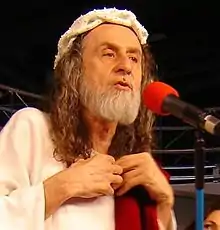 Inri Cristo on TV | |
| Born | Álvaro Thais March 22, 1948 Indaial, Santa Catarina, Brazil |
| Occupation | Cult leader |
| Website | www.inricristo.org.br |
Inri Cristo regularly participates in lively debates with religious figures, such as priest Óscar González-Quevedo (whom Álvaro claims to have been the reincarnation of the Spanish Inquisitor Tomás de Torquemada), and also appears in interviews and comedy shows. His provocative statements about evolutionism, vegetarianism,[6] overpopulation, birth control, abortion, atheism, socialism, and capitalism, and a potential World War Z have stirred much commentary and controversy.
Early life
Inri Cristo was raised by two Roman Catholic farmers of German ancestry: Wilhelm and Magdalena Theiss.[7] Inri had a humble childhood and studied for about three years at the Adolfo Konder School. He quit studying so he could help his mother with domestic supplies, since his father was retired due to a work accident.
Since childhood, Inri has claimed to obey a "powerful voice" that speaks inside his head. Obedient to this voice, he left home at thirteen to live independently. In adolescence, he worked as a greengrocer, baker, delivery boy, peddler, and waiter. Eventually, Inri severed all ties with Christianity, becoming an atheist, until he received what he calls the "revelation of his identity".
Public speaking and religious activities
In 1969, at the age of 21, Inri began his public life as a self-professed prophet and astrologer, introducing himself as "Iuri de Nostradamus".[8]
In 1971, he began speaking on television, with TV Morena (an affiliate of Brazilian Rede Globo), and this opportunity introduced him to a wider audience. In 1976, claiming to blaze the trail of spiritual transcendence, Inri became vegetarian. In 1977, he lived for some time in Copacabana Palace hotel, in Rio de Janeiro, a part of high society. In 1978, he left Brazil on a tour through Latin America, speaking on radio.
In 1979, obeying the powerful voice that he claims to have heard since childhood, he underwent a fast in Santiago, Chile. On this occasion, he says, the voice said in a rasping voice, "I am your Father," and revealed itself to be the "God of Abraham, of Isaac, and of Jacob".
This voice, he says, said that he was the same Christ crucified two thousand years ago under Pontius Pilate. It also said that the second letter of his name (the "u" in "Iuri") would henceforth be upside down, making his name "Inri", the acronym for Iesus Nazarenus Rex Iudaeorum.[9] Inri launched a pilgrimage over many countries, dressed in a white tunic and sandals, announcing that his mission would be accomplished in the dawn of a New Age of peace.
Inri wandered over 27 countries, spreading his message. In 1980, Inri was expelled from the United States, from Venezuela, and from England. France sheltered him for nine months and even announced in Antenne 2: "Le Christ est revenu sur la terre" ("Christ is back on Earth"). On this occasion, Inri was invited to speak in the Grande École Polytechnique de Paris. Back in Brazil, on 28 February 1982, Inri performed what he called a "libertarian act." He broke into the cathedral in Belém in Pará state. Accused of profanation and vandalism by the clergy, he was sent to jail for fifteen days.[10][11] On this occasion, he established a new mystical order, SOUST (Suprema Ordem Universal da Santissima Trindade), which he called "the formalization of the promised Kingdom of God on Earth." On April 20, 1982, Inri Cristo officially established SOUST in Curitiba, where he remained for 24 years in a "provisional" headquarters.
He has been detained by police more than forty times, owing to his statements and unusual way of dressing.[12][13]
He is often invited to give lectures in many colleges and universities throughout Brazil, and he is usually well received by students.[14]
SOUST
SOUST (Acronym in Portuguese for "Supreme Universal Order of the Holy Trinity") refers to the residence of Álvaro Thais. Located on the outskirts of Brasília, DF, the property is protected by weaponts, barbed wire, electric fence, dogs and an observation tower, where Álvaro lives with nine other women, also with characterized garments. He has lived there since 2006, before spending two decades in Curitiba, in southern Brazil..[15][16][17]
See also
References
- Bazi, Daniela (2020-10-16). ""Eu não faço milagres. Inri Cristo muito menos": o conturbado debate entre Inri Cristo e Padre Quevedo". Aventuras na História (in Portuguese). Retrieved 2021-10-15.
- "Por que INRI Cristo, personagem ícone de Curitiba, trocou a cidade por Brasília?". Gazeta do Povo. 2017-10-26.
- Severo, Antunes (2011-12-27). "INRI CRISTO, a história real de um catarinense fantástico". Caros Ouvintes (in Portuguese). Retrieved 2019-01-24.
- "Inri Cristo deu o que falar nesta semana; como ele se mantém na mídia? | Tribuna PR - Paraná Online". A fama é sua (in Portuguese). 2017-07-28. Retrieved 2019-01-24.
- "Por que INRI Cristo trocou Curitiba por Brasília". Viver Bem (in Portuguese). 2017-10-26. Retrieved 2019-01-24.
- "Inri Cristo fala ao Vida Vegetariana sobre sua alimentação, vegetarianismo na bíblia e o que come diariamente" (in Portuguese). Vida Vegeteriana. September 6, 2009. Archived from the original on July 21, 2010. Retrieved June 28, 2016.
- Declaration of Wilhelm and Magdalena Theiss, Awakener, page 130.
- "As previsões de Iuri de Nostradamus" (in Portuguese). Almanaque Estado do Paraná. December 25, 1977. p. 1. Archived from the original on July 27, 2011. Retrieved June 28, 2016.
- Yug Yoga Yoguismo, Serge Reynaud de la Ferrière, page 92.
- "No presidio, aclamado: "Cristo, Cristo"" (in Portuguese). A Província do Pará. March 1, 1982. p. 7. Retrieved June 28, 2016.
- "A Província do Pará, Advogado vai pedir soltura de Inri". Archived from the original on 2011-07-05. Retrieved 2009-09-09.
- "INRI Cristo é preso pelaa vez" [INRI Cristo is arrested for the 48th time] (in Portuguese). Jornal do Brasil. July 4, 1984. p. 7. Retrieved June 28, 2016.
- "A Província do Pará, Advogado vai pedir soltura de Inri". Archived from the original on 2011-07-05. Retrieved 2009-09-09.
- "Com a palavra, o novo Messias". Campus. Universidade de Brasília. December 20, 2007. pp. 9–10. Retrieved June 28, 2016.
- Menezes, Leilane (2017-08-20). "A misteriosa história por trás das seguidoras de Inri Cristo". Metrópoles. Retrieved 2021-10-16.
- "Inri não está só: conheça os homens que dizem ser o messias". National Geographic (in Portuguese). 2017-08-30. Retrieved 2021-10-16.
- Werneck, Carolina. "Por que INRI Cristo trocou Curitiba por Brasília". Gazeta do Povo (in Portuguese). Retrieved 2021-10-16.


External links
Authority control  | |
|---|---|
| General | |
| National libraries | |