International Anti-Corruption Court
The International Anti-Corruption Court (IACC) is a proposed international court that would strengthen the enforcement of criminal laws against corrupt leaders.[1] The effort to establish the court is being led by Judge Mark L. Wolf, a Senior Judge of the United States District Court for the District of Massachusetts, who first proposed the concept at the 2012 St. Petersburg International Legal Forum, the 2014 World Forum on Global Governance, and in articles for the Brookings Institution and The Washington Post in 2014.[2][3][4]
The IACC continues to be advocated for by Integrity Initiatives International (III) (pronounced "Triple I"), an NGO that Mark L. Wolf founded in 2016 with Judge Richard Goldstone, former Justice on the Supreme Court of South Africa and chief prosecutor of the International Criminal Tribunal for the Former Yugoslavia and the International Criminal Tribunal for Rwanda. III's mission is to "strengthen the enforcement of criminal laws in order to punish and deter leaders who are corrupt and regularly violate human rights, and to create opportunities for the democratic process to replace them with leaders dedicated to serving their citizens."[5] Establishing the IACC, supporting national anti-corruption measures, and forging a network of young people committed to fighting grand corruption in their own countries are some of its main priorities.
Structure
Grand corruption does not endure because of a lack of laws. 187 Countries are party to the United Nations Convention Against Corruption (UNCAC), which requires the criminalization of corruption. However, these laws are rarely enforced because kleptocrats also control the police, the prosecutors, and the administration of justice in the countries they rule.
The IACC would fill a crucial gap in the international framework for combatting grand corruption. The proposed IACC would enforce existing national anti-corruption laws, or a new international counterpart to them, against kleptocrats and their conspirators.[6] The IACC would be a court of last resort. Operating on the principle of complementarity, it would only prosecute if a member state were unwilling or unable to prosecute a case itself. Prosecution in the IACC would, in many cases, result in the incarceration of convicted kleptocrats and thus create the opportunity for the democratic process to replace them with honest leaders. However, it is also foreseeable that some kleptocrats will not permit the countries they rule to join a court that would prosecute them. In order to be effective, the IACC would need 20 to 25 representative countries to be effective as long as they include some major financial centers through which kleptocrats often launder the proceeds of corruption, and attractive countries in which kleptocrats invest and spend their wealth. In this way, the IACC may act as incentive for domestic governments to establish adequate anti-corruption processes while ensuring that corrupt leaders are held accountable where the effective processes do not yet exist.
The IACC would also have the potential to recover, repurpose, and repatriate stolen assets through sentences that include orders of restitution in criminal cases and judgments in civil cases brought by whistleblowers, a small portion of which would be used to fund the Court itself. Not only would successful prosecution of a kleptocrat result in his or her incarceration, but it would also result in an order of restitution or disgorgement of illicit assets or gains for the benefit of victims.
The IACC's expert investigators, prosecutors, and judges would be valuable resources for strengthening their counterparts in countries striving to improve their capacity, and it would provide a forum for evidence raised by whistleblowers. In these respects, the IACC is similar to, but distinct from, the International Criminal Court (ICC), and may be designed in a way that draws on the strengths of the ICC model while avoiding some of its weaknesses.
Support
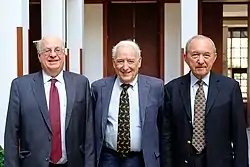
The proposed International Anti-Corruption Court gained the support of the Office of the United Nations High Commissioner for Human Rights, Global Witness and Human Rights Watch.[9][10] In 2018, Wolf informed the public of his idea in an article in Daedalus, titled "The World Needs an International Anti-Corruption Court."[11] In June 2019, Colombian Foreign Minister Carlos Holmes Trujillo delivered opening remarks, including calling for support of the IACC, to the United Nations Office on Drugs and Crime Expert Group Meeting in Oslo, Norway. The outcome statement of the Expert Group Meeting further endorsed consideration of the IACC.[12] In September 2019, leaders from Malaysia, Norway, Peru and Colombia expressed the importance of international cooperation in efforts to combat grand corruption and called for the establishment of an International Anti-Corruption Court.[13] In May 2020, Wolf discussed the IACC with the United Nations High-Level Panel on Financial Accountability, Transparency, and Integrity for Achieving the 2030 Agenda. Wolf pointed out that "the IACC would have inherent advantages compared to the ICC. Evidence of genocide, war crimes, and other crimes against humanity typically remains within the country controlled by the perpetrators and, therefore, is difficult to obtain… In contrast, kleptocrats do not keep their illicit assets in their own countries. Rather, they regularly launder the proceeds of their crimes through major financial centers."[14]
The governments of Colombia, Peru, and Nigeria formally endorsed a General Assembly session on corruption at the United Nations Headquarters in New York which occurred on 26–28 April 2021.[15] President Iván Duque Márquez of Colombia and President Martín Vizcarra of Peru issued a joint declaration calling for further study and action to establish the IACC.[16][17] In June 2021, Integrity Initiatives International and Transparency International made submissions to the UN General Assembly Special Session Against Corruption, proposing an International Anti-Corruption Court as an "innovative idea to end impunity" and a "reform to international justice institutions."[18][19]
In June 2021, over 100 world leaders, including Nobel laureates, former presidents, high court justices, and prominent business people from over 40 countries signed a Declaration in support of establishing the IACC.[6] With the active support of the Colombian government, momentum is growing to convene an international conference for countries to negotiate and adopt a treaty statute that would establish the International Anti-Corruption Court.
There is bipartisan support for the IACC in Canada, including from Lloyd Axworthy, Peter MacKay, and Allan Rock. Former Minister Axworthy and Minister Rock wrote about the IACC in articles for The Globe and Mail and the Diplomat & International Canada.[20][21] Former Minister MacKay also advocated for the creation of the IACC in the Diplomat & International Canada.[22]
Criticisms
In a report published by the Heritage Foundation in October 2014, titled "Why the U.S. Should Oppose the Creation of an International Anti-Corruption Court," Brett D. Schaefer, Steven Groves, and James M. Roberts outlined a number of arguments against the establishment of an International Anti-Corruption Court.[23] In a post for the Global Anticorruption Blog titled, "Is an International Anti-Corruption Court a Dream or a Distraction?" Matthew Stephenson argued that the IACC was idealistic.[24] In a U4 Brief, he and Sofie Arjon Schütte also argued that the IACC would divert resources away from other, more effective, ways of combatting grand corruption.[25]
Select Speeches and Publications
- Wolf, Mark L. (2014). "The Case for an International Anti-Corruption Court". The Brookings Institution.
- Wolf, Mark L. (2014). "We need an international court to stamp out corruption". The Washington Post.
- Ganesan, Arvind (2014). Oral Testimony of Arvind Ganesan, Business and Human Rights Director, Human Rights Watch, Tom Lantos Human Rights Commission Briefing: An International Anti-Corruption Court (IACC) to Mitigate Grand Corruption and Human Rights Abuses (Speech). Human Rights Watch.
- Wolf, Mark L. (2015). Roundtable Discussion on the Proposal for an International Anti-Corruption Court (Speech). Columbia School of International and Public Affairs.
- Wolf, Mark L. (2015). An International Court to Fight Corruption: A Federal Judge Makes the Case (Speech). Brandeis University International Center for Ethics, Justice and Public Life.
- Tom Lantos Human Rights Commission (2015). An International Anti-Corruption Court (IACC) to Mitigate Grand Corruption and Human Rights Abuses (Speech). Lantos Commission Hearing.
- Wolf, Mark L. (2016). Rule of Law Initiative Inaugural Lecture (Speech). Woodrow Wilson Center.
- Wolf, Mark L. (2016). An International Anti-Corruption Court for Grad Corruption (Speech). International Anti-Corruption Summit in London.
- Aspen Institute (2017). Combatting Kleptocracy: Is an International Anti-Corruption Court the Answer? (Speech).
- Wolf, Mark L. (2017). Lunch Seminar with Judge Mark Wolf: Grand Corruption, Violations of Human Rights, and the Need for an International Anti-Corruption Court (Speech). Harvard Kennedy School Carr Center for Human Rights.
- Wolf, Mark L. (2018). How do you stop prime ministers and presidents lining their own pockets with the country's wealth? An International Anti-Corruption Court (Speech). BBC Hardtalk.
- Wolf, Mark L. (2018). "The World Needs an International Anti-Corruption Court". Daedalus. 147 (3): 144–156. doi:10.1162/daed_a_00507. S2CID 57571237.
- Carnegie Mellon University, Australia (2018). Roundtable Forum on Ending Impunity for Kleptocrats and Accomplices: Do we need an International Anti-Corruption Court? (Speech). Nigerian Coalition for the International Criminal Court.
- Wolf, Mark L. (2019). 30th Raytheon Lecture in Business Ethics. American Business Needs an International Anti-Corruption Court (Speech). Bentley University.
- Roach, Brendan (2019). An International Anti-Corruption Court (Speech). American Academy of Arts and Sciences.
- Antony, Joseph (2020). Anti-Graft War: Stakeholders at UNGA 74 Call for Establishment of International Anti-Corruption Court (Speech). Herald Nigeria.
- Glavin, Terry (2021). "Canadians are leading the push for a global anti-corruption court". MacLean's Magazine.
- Rohani, Farid (2021). "World needs Canada to champion an international anti-corruption court". Toronto Star.
- Escobar Mejia, Claudia (2021). "The Case for an International Anti-Corruption Court". Americas Society Council of Americas.
- Dezenski, Elaine (2021). "An international anti-corruption court is needed to deter kleptocrats". Financial Times.
- Green, Ruth (2021). "Covid-19: Pandemic heightens calls for international court to tackle grand corruption." International Bar Association.
- Malcorra, Susan, and Ian J. Lynch (2021). "Deterring Kleptocracy Demands an International Anti-Corruption Court." Global Governance Forum.
- Axworthy, Lloyd, and Fen Osler Hampson (2021). "Canada should lead in creating an international court to fight corruption." Toronto Star.
References
- Mark L. Wolf, The Case for an International Anti-Corruption Court, Brookings Institution, Governance Studies at Brookings, July 2014.
- Recknagel, Charles (April 10, 2014). "Prague Forum Provides Anti-Corruption Platform". Radio Free Europe/Radio Liberty.
- "The Case for an International Anti-Corruption Court" (PDF). Brookings. Retrieved 2021-06-18.
- "We need an international court to stamp out corruption". Washington Post. Retrieved 2021-06-18.
- "Richard Goldstone". Integrity Initiatives International.
- "Declaration in Support of the Creation of an International Anti-Corruption Court". Integrity Initiatives International.
- "An International Anti-Corruption Court". American Academy of Arts and Sciences. Retrieved 2021-06-18.
- Robert Rotberg. It's time for Canada to back an International Anti-Corruption Court, The Global and Mail, 25 April 2016. Retrieved 29 September 2016.
- Nick, Donavan (December 19, 2016). "THE 1MDB SCANDAL SHOULD BE ADDRESSED BY AN INTERNATIONAL CRIMINAL TRIBUNAL - AN IMPORTANT FIRST IN THE FIGHT AGAINST GRAND CORRUPTION". Global Witness.
- "Global Expert Group Meeting on Corruption involving Vast Quantities of Assets". UNODC. June 12–14, 2019.
- Wolf, Mark L. (2018). "The World Needs an International Anti-Corruption Court". Daedalus. 147 (3): 144–156. doi:10.1162/daed_a_00507. S2CID 57571237.
- "Joint statement Colombia – Peru on anticorruption". JD Supra. June 19, 2019.
- Nigeria, Herald. "Anti-Graft War: Stakeholders at UNGA 74 Call for Establishment of International Anti-Corruption Court". Herald Nigeria. Retrieved 2020-06-22.
- "Strengthening the Enforcement of Criminal Laws to Combat Grand Corruption" (PDF). Integrity Initiatives International.
- "A/RES/74/276 - E - A/RES/74/276". undocs.org. Retrieved 2020-06-22.
- "An International Anti-Corruption Court". American Academy of Arts and Sciences.
- "Joint statement Colombia – Peru on anticorruption". JDSUPRA. June 19, 2019.
- "Integrity Initiatives International Submission to the UNGASS against Corruption 2021" (PDF). United Nations Office on Drugs and Crime.
- "Transparency International Submission to the UNGASS against Corruption" (PDF). United Nations Office on Drugs and Crime.
- "Let's hold the kleptocrats to account". The Globe and Mail. June 22, 2020.
- "It's time for an IACC". Diplomat & International Canada. January 20, 2021.
- "Canada and the corruption court". Diplomat & International Canada. January 20, 2021.
- Brett D. Schaefer, Steven Groves, and James M. Roberts, Why the U.S. Should Oppose the Creation of an International Anti-Corruption Court, The Heritage Foundation, Backgrounder No. 2958, October 2014.
- Stephenson, Matthew (October 4, 2018). "Guest Post: Is an International Anti-Corruption Court a Dream or a Distraction?". The Global Anticorruption Blog.
- Stephenson, Matthew (December 2019). "An International Anti-Corruption Court? A Synopsis of the debate". U4 Anti-Corruption Center.