International intervention in Somalia
UN Security Council Resolution 733 and UN Security Council Resolution 746 led to the creation of UNOSOM I, the first mission to provide humanitarian relief and help restore order in Somalia after the dissolution of its central government in 1992.
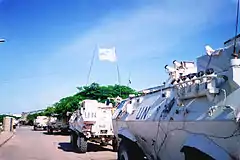
United Nations Security Council Resolution 794 was unanimously passed on 3 December 1992, which approved a coalition of United Nations peacekeepers led by the United States. Forming the Unified Task Force (UNITAF), the alliance was tasked with assuring security until humanitarian efforts aimed at stabilizing the situation in the country were transferred to the UN.
Landing in 1993, the UN peacekeeping coalition started the two-year United Nations Operation in Somalia II (UNOSOM II) primarily in the south.[1] UNITAF's original mandate was to use "all necessary means" to guarantee the delivery of humanitarian aid in accordance to Chapter VII of the United Nations Charter,[2] and is regarded as a success.[3]
Aidid saw UNOSOM II as a threat to his power and in June 1993 his militia attacked Pakistan Army troops, attached to UNOSOM II, (see Somalia (March 1992 to February 1996)) in Mogadishu inflicting over 80 casualties. Fighting escalated until 19 American troops and more than 1,000 civilians and militia were killed in a raid in Mogadishu during October 1993.[4][5] The UN withdrew Operation United Shield on 3 March 1995, having suffered significant casualties, and with the rule of government still not restored. In August 1996, Aidid was killed in Mogadishu. Former UN Secretary General Boutros Boutros Ghali and Ahmedou Ould Abdallah, UN special envoy to Somalia have referred to the killing of civilians during the conflict as a "genocide".[6][7]
Under the auspices of the UN, AU, Arab League and IGAD, a series of additional national reconciliation conferences were subsequently held as part of the peace process. Among these summits were the 1997 National Salvation Council in Sodere, Ethiopia, the 1997 Cairo Peace Conference / Cairo Declaration, the 2000 Somalia National Peace Conference in Arta, Djibouti under the newly established Transitional National Government, the 2002 Somali Reconciliation Conference in Eldoret, Kenya, the 2003 National Reconciliation Conference in Nairobi, Kenya when the Transitional Federal Government was established and the Transitional Federal Charter was adopted, the 2004 Nairobi Conference, and the 2007 National Reconciliation Conference in Mogadishu.[8]
Refugees and IDPs
Following the outbreak of the civil war, many of Somalia's residents left in search of asylum. According to the UNHCR, there were around 975,951 registered refugees from the country in neighboring states as of 2016.[9] Additionally, 1.1 million people were internally displaced persons (IDPs).[10] An estimated 60% of the IDPs were children.[11] Causes of the displacement included armed violence, periodic droughts, and other natural disasters, which, along with diverted aid flows, hindered the IDPs' access to safe shelter and resources.[12][13] IDP settlements were concentrated in south-central Somalia (893,000), followed by the northern Puntland (129,000) and Somaliland (84,000) regions.[11] Additionally, there were around 9,356 registered refugees and 11,157 registered asylum seekers in Somalia.[9] Most of these foreign nationals emigrated from Yemen to Berbera after the Houthi insurgency in 2015.[14] However, the majority of emigrants to Somalia consist of Somali expatriates, who have returned to Mogadishu and other urban areas for investment opportunities and to take part in the ongoing post-conflict reconstruction process.[15]
Piracy
A consequence of the collapse of governmental authority that accompanied the civil war was the emergence of piracy in the unpatrolled Indian Ocean waters off of the coast of Somalia. The phenomenon partly arose as an attempt by local fishermen to protect their livelihood from illegal fishing by foreigners.[16] In August 2008, a multinational coalition, Combined Task Force 150, took on the task of combating the piracy by establishing a Maritime Security Patrol Area (MSPA) within the Gulf of Aden.[17] Many ship owners have also hired private armed guards.[18] By October 2012, pirate attacks had dropped to a six-year low, with only one ship attacked in the third quarter compared to 36 during the same period in 2011.[19]
References
- Ken Rutherford, Humanitarianism Under Fire: The US and UN Intervention in Somalia, Kumarian Press, July 2008 ISBN 1-56549-260-9
- "United Nations Operation In Somalia I – (Unosom I)". United Nations. Retrieved 29 January 2012.
- "Operation Restore Hope". Retrieved 15 January 2008.
- Atkinson, Rick (31 January 1994). The Washington Post.
- Red Cross (18 October 1993). "Anatomy of a Disaster". Time. Archived from the original on 18 January 2008. Retrieved 19 January 2008.
- Boutros Boutros Ghali (1999) Unvanquished: A U.S.-U.N. Saga, London: I.B. Tauris & Co., p. 140 ISBN 1-86064-497-X
- "Troubled Somalia Mission Extended", BBC News, 22 December 2008. Retrieved 25 January 2011
- "Somali Peace Process". AMISOM. Retrieved 15 May 2015.
- "Registered Somali Refugee Population". UNHCR. Retrieved 19 June 2016.
- "Refugees in the Horn of Africa: Somali Displacement Crisis". UNHCR. Retrieved 19 June 2016.
- "Somalia IDP Figures Analysis". IDMC. Archived from the original on 26 June 2016. Retrieved 19 June 2016.
- "Over a million IDPs need support for local solutions" (PDF). IDMC. Archived from the original (PDF) on 2 August 2016. Retrieved 19 June 2016.
- "Drought set to worsen in parts of Greater Horn of Africa". World Meteorological Organization. Retrieved 3 April 2017.
- "Refugees from Yemen Landed In Berabera Town". Goobjoog. 31 March 2015. Retrieved 24 April 2015.
- Mulupi, Dinfin (21 June 2012). "Mogadishu: East Africa's newest business destination?". How We Made It in Africa. Retrieved 24 April 2014.
- Eliza Ronalds-Hannon. "Behind The Demise Of Somali Pirates". Archived from the original on 27 December 2013. Retrieved 9 January 2013.
- Combined Maritime Forces Public Commander Affairs (29 September 2008). "Combined Task Force 150 Thwarts Criminal Activities". United States Navy. Retrieved 17 November 2008.
- "Armed Guards Now Deployed on 80% of Container Ships, Tankers". The Maritime Executive.
- Alaric Nightingale; Michelle Wiese Bockmann (22 October 2012). "Somalia Piracy Falls to Six-Year Low as Guards Defend Ships". Bloomberg News. Archived from the original on 2 June 2013. Retrieved 25 October 2012.