Telecommunications in Lebanon
This article concerns the systems of communication in Lebanon. Lebanon possesses a number of systems of telecommunication. The country code and top-level domain for Lebanon is ".lb".
Telephone
The first mention of a telephone network in Lebanon (then known as Syria) dates from 1910 and, surprisingly, concerns the secondary town of Zahle in Mount Lebanon, which was also applying at the time for a concession to set up an electric plant--another first in this part of the region.[1] Writing in 1914, the Daily Consular and Trade Reports of the U.S. Department of Commerce and Labor announced that the government of Lebanon was making plans to connect its seat in Baabda, above Beirut, to major cities across the country, thanks to a 150 miles of cables on metal posts.[2] In Decembre 1921, the French mandate authorities granted the concession for radio-electric communication to the Compagnie Générale de Télégraphie sans Fil (CSF), authorized to build in Khalde a transmission station connected to Radio France.[3] The following year, in December 1922, the CSF established Radio-Orient to run said concession in Lebanon and Syria.[4] Radio-Orient would later become the Organisme de Gestion et d'Exploitation de Radio Orient,[5] then OGERO.
Starting in the 1950s, an economically affluent Lebanon started investing in developing its telephone network by installing automatic exchanges, not least in partnership with Ericsson, which assumed a key role in the following decades.[6] (Ericsson had long been a pioneer in telecommunications in the Arab world, setting up the first telephone lines in Istanbul and Cairo in the 1890s.)[7] By 1957, demand massively outpaced supply, as seen in the contracts signed with Ericsson and Siemens, respectively to expand the network with 25,000 new lines in the country's main cities and build a state-of-the-art radio transmission station.[8] At the end of the 1960s, Lebanon was planning to extend the telephone network to all rural regions across the country.[9]
Radio-Orient continued to assume a central position: It hosted the first international telephone services in Lebanon, in 1952, and the first telex services, as of 1961.[10]
The telephone system was severely damaged during the civil war, which lasted from 1975 to 1990, but was subsequently rebuilt and revamped. Rehabilitating and expanding the infrastructure befell Ericsson along with Siemens and Alcatel, each of which was allotted a certain part of the country.[11] The contract, signed in March 1994, cost Lebanon $431 million.[12] Cellular phones using the GSM communication standard were introduced as an alternative to cabled telephone. LibanCell claims to have placed the very first GSM call in Lebanon, on 23 December 1994, from the Alexandre Hotel in Beirut.[13]
By 2009, there were 1,816,262 landlines along with 4,890,534 mobile telephones in use in Lebanon, a relatively high penetration rate for both fixed lines and mobiles.[14]
The systems that provide the infrastructure for the telephone network are, domestically, microwave radio relay stations and cables, and internationally, two Intelsat satellite-earth stations, a microwave radio relay station to Syria, and three international undersea fiber optic cables: I-ME-WE, CADMOS (to Cyprus), and BERYTAR (to Syria).
Free radio and television broadcasting
Radio-Orient started broadcasting in 1937. In 1946, three years after Lebanon's independence, it became Radio Liban, the country's first radio channel.
According to Media Landscape, there were 2.85 million radios is Lebanon around 2016.[15] In 1998 Lebanon's radio penetration rate was 906 radios per 1000 people.
Lebanon possesses one AM radio broadcast station and 32 FM radio broadcast stations. In 2005, there were 28 privately owned FM radio stations. One FM station, which shifts between French, English, and Armenian, and the sole AM radio station, which broadcasts solely in Arabic, are owned by the state-owned Radio Lebanon, which is under the jurisdiction of the Ministry of Information. Radio Lebanon also relays Radio France International at 13:00 (UTC) daily. Among private broadcasters are Mix FM, PAX Radio, the Lebanese Broadcasting Corporation, National Broadcasting Network, Radio One, and the Voice of Tomorrow.[16]
There are 1.18 million television sets in Lebanon.
There are 28 television broadcast stations in Lebanon, although the application of the audiovisual law has caused the closure of a number of TV stations. The PAL television standard is used in Lebanon. Other than the state-owned Télé Liban, most broadcasters are privately owned and earn revenues from advertising. Some of the most important television networks are the LBC, Murr TV, Al Jadeed, Future TV, Orange TV (OTV), Al-Manar, NBN, Télé Lumière, and Télé Liban (State-owned).
Paid radio and television broadcasting
There are five cable TV companies in Lebanon:
Internet services
In 2009, Lebanon had 2,000,000 internet users, or 48% of the population. By mid-2011, Lebanon had 2,500,820, for a 59% penetration rate.[20] As of 31 December 2011, Lebanon had 3,367,220 Internet users (87% penetration rate).[21] As of 30 June 2012, Lebanon had 3,722,950 Internet users (92% penetration rate).[21] The number of Internet users in Lebanon continued to grow rapidly in 2013 after the Ministry of Telecommunications and state-run Ogero introduced fast DSL and 3G and 4G service.[22] Actual data, however, is patchy at best: The graph below shows the rare years since 2000 for which Lebanese authorities provided figures to the International Telecommunication Union (ITU), which is the relevant agency of the UN. Characteristically, these numbers conflict with other sources, making them difficult to validate.
| Year | % | Source |
|---|---|---|
| 2001 | 6.8 | Lebanese Broadcasting International |
| 2007 | 18.7 | Ministry of Telecommunications |
| 2008 | 22.5 | Ministry of Telecommunications |
| 2011 | 52.0 | Presidency of the Council of Ministers |
The development and growth of the internet infrastructure has been relatively slow in Lebanon due to corruption and allegations of a sector monopoly.[24]
Internet services are administered in Lebanon by the Ministry of Telecommunications and the state-owned company Ogero. Lebanon provides four types of services: dialup services, wireless Internet service, ADSL, and fiber-optic. On 1 February 2019. Lebanon ranked 161 on Net Index, which rated internet speeds worldwide and has since been replaced by Speedtest. On 23 November 2021, Speedtest ranked Lebanon 160 for broadband and 82 for mobile services.
Submarine cables and international bandwidth
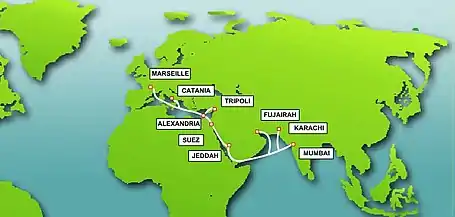
Lebanon is connected to the internet through three submarine fiber-optic cables, which provide the bulk of its "international bandwidth", meaning the maximum quantity of data it can transmit to or receive from the rest of the world. The three main landing points of these cables, called international exchanges or gateways, are all operated by Ogero. They are in Beirut, Jdeideh, and Tripoli.
- CADMOS, which started operating in September 1995, is a 230km cable connecting landing points in Ras Beirut and Jdeideh to Pentaskhinos in Cyprus, and owned by a consortium including the Lebanese Ministry of Telecommunications.[25] It reportedly had a capacity as low as 622Mbps.[26]
- BERYTAR, which started operating in April 1997, is a 134km cable connecting Lebanese landing points in Saida, Ras Beirut, and Tripoli with Tartous in Syria. It is owned jointly by the Lebanese Ministry of Telecommunications and the Syrian Establishment for Telecommunications, and officially has a capacity of 5Gbps,[27] although in 2010 Lebanon's international bandwidth was reported to be less than half of that.[28] The Tartous landing point then connects to Pentaskhinos via the UGARIT cable (1995) and to Egypt's Alexandria via the Aletar cable (1997).
- I-ME-WE, which started operating in December 2010, is a 12,000km cable with an overall capacity approaching 4Tbps, and connecting Southern Asia with Southern Europe via the Red Sea. It is owned by a large consortium including the Lebanese operator Ogero. Its landing point in Lebanon is Tripoli, which links via I-ME-WE to Alexandria, Catania in the Italian island of Sicily, and Marseille on the French coast. When the project was launched, Lebanon was expecting to derive from it around 40Gbps, multiplying its international capacity by 20.[29] In 2011, Global Information Society Watch estimated in its annual country report that Lebanon had access to 120Gbps via I-ME-WE.[30]
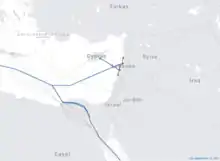 CADMOS, BERYTAR, AND I-ME-WE
| External image | |
|---|---|
 Map of sea cables (zoom over Lebanon to see all cables coming to the country) Map of sea cables (zoom over Lebanon to see all cables coming to the country) |
Several other cables have been in discussion since 2010. In 2011, an official at the Lebanese Ministry of Telecommunications mentioned the need to replace the aging CADMOS with a new cable dubbed EUROPA, which was meant to bridge to an international cable at the bottom of the Mediterranean called Alexandros (2010).[31] In June 2019, the Ministry of Telecommunications again announced plans for a new Internet submarine cable to link the country to Europe, to boost the Internet service locally, and to turn Lebanon into a hub for Internet distribution to countries in the region.[32] This project involved a partnership with the Cyprus Telecommunications Authority (CYTA). Neither scheme materialized.
Lebanon's efforts to increase its international bandwidth are reflected in the figures local authorities have reported over the years to the International Telecommunications Union or ITU. The leap in capacity enabled by I-ME-WE in 2011 appears clearly in the data. However, the claims made in subsequent years are sufficiently inconsistent to warrant verification. Indeed, the Ministry of Telecommunications has published data in its official documents that contradicts the information it submitted in parallel to the ITU. For example, in its "Daring progress" vision of 2015, the Ministry put the country's international bandwidth in 2012 and 2013 at 12.2 and 26.8 Gbps respectively.[33]
| Year | Bandwidth | Source |
|---|---|---|
| 2007 | 0.93 | Ministry of Postal Services and Telecommunications |
| 2009 | 1.82 | Ministry of Telecommunications |
| 2010 | 2.5 | Telecommunications Regulatory Authority |
| 2011 | 12.5 | Ministry of Telecommunications |
| 2012 | 52.5 | Ministry of Telecommunications |
| 2013 | 52.5 | Ministry of Telecommunications |
| 2014 | 89 | Ogero |
| 2015 | 153 | Ministry of Telecommunications |
| 2016 | 85 | Ministry of Telecommunications |
| 2017 | 130 | Ministry of Telecommunications |
| 2018 | 190 | Ministry of Telecommunications |
| 2019 | 220 | Ministry of Telecommunications |
| 2020 | 320 | Ministry of Telecommunications |
Even as officially reported, Lebanon's increase in international bandwidth has not helped the country significantly improve its ranking on a global scale, despite the government's repeated pledges to "catch up" with the rest of the world.
Lebanon's internet backbone
Through its network of central offices, the state-owned company Ogero provides the "backbone" telecommunication infrastructure which distributes internet capacity throughout the country. The actual distribution occurs via Data Service Providers (DSPs) and Internet Service Providers (ISPs). Ogero also doubles up as an ISP.
Up to 2010, Lebanon's backbone relied on fixed lines in a traditional "public switched telephone network" (PSTN). By late 2010, the Ministry of Telecommunications started setting up a fiber-optic transmission network connecting central stations around the country, through two super-rings and 30 sub-rings representing 4,400km of cables,[35] at a cost of $166 million. It was officially completed in April 2013.[36] But two years later, in April 2015, only one sub-ring had actually been turned on.[37] By 2017, fiber-optic cables connected together Ogero approximately 300 central offices,[38] from which the internet would reach end-users.
Ogero central offices have long suffered from a weak capacity to provide satisfying internet services to end-users. For example, in 2015, only 78 such centrals were equipped with very high-speed digital subscriber lines (VDSL).[39]
Dial-up internet
Dial-up internet was introduced in 1997.[40] 33Kbps dial-up services cost around $7 a month but users would also have to pay for the cost of phone communication.
ADSL internet
Asymmetric digital subscriber lines (ADSL) was offered for the first time in April 2007, and was partially upgrade high-bit-rate digital subscriber lines (HDSL) in 2009.[41] There were, as of July 2011, 1,284,361 subscribers. The prices for ADSL varied slightly depending on the DSP, but typically cost from $16/month (4 Mbps) to $65/month (open speed) on unlimited data plans.
Broadband wireless internet
Wireless Internet services were offered for the first time in 2005 to palliate for the absence of an ADSL infrastructure at the time. WISP and ISP fees revolve around $45 per month. Wireless internet is portable: Users can connect nearly anywhere through a receiver (connected to the client via USB or Ethernet), and it provides download rates between 2 Mbit/s and 9 Mbit/s depending on the chosen plan. Coverage weakens in densely built areas or remote locations.
Starting in May 2013, Alfa and MTC Touch introduced 3.9G & 4G LTE data services in many regions in Lebanon (mostly dense urban regions).[42] As part of the Lebanon Broadband 2020 plan, Full LTE 4G coverage was expected by 2018.
Fiber-optic internet
In March 2007, Solidere, the Lebanese company for the development and reconstruction of the Beirut Central District, deployed a Broadband Network in partnership with Orange Business Services. Orange operates this IP network using a fiber-optic backbone with dual connection to each building in the city center. Under its unified communication network, Solidere provides IPTV services to all its residents operated and monitored from the network main operation center.[43]
The Beirut Digital District (BDD) was launched in September 2012 as a government-facilitated project with broadband internet and telephone infrastructure facilities.[44] The BBD was designed to become a hub for creative companies and talents. The project aimed to improve the digital industry in Lebanon by providing, at competitive rates, state-of-the-art infrastructure, superior support services for businesses, and a living environment suited to a young and dynamic workforce.
In 2013, the Minister of Telecommunications Nicolas Sehnaoui claimed that 4,700km of fiber optic network were being deployed across Lebanon, linking 300 fixed central offices with thousands of Active Cabinets being installed with the last mile using copper connections, allowing subscribers to reach a connection speed of 4 Mbit/s and more at home. The backbone FO network consist of 13 rings and was reportedly almost complete.[45] At the time, experts said that Lebanon should have much faster Internet thanks to the international capacity cables, only a small fraction of which was being used in Lebanon.[22]
On 1 July 2015, the Ministry of Telecommunications, then under Boutrous Harb, launched a five-year plan called "2020 Digital Telecom Vision".[46] The plan aimed both to ramp up the country's 4G capacity and to replace Lebanon's aging copper network with fiber-optic cables.[47][48] By 2020, it was expected to present users with VDSL2+ plans capable of offering speeds reaching 150Mbit/s, and ensure that the majority of Lebanese population would have access to a full range of services (FTTH, IPTV, video conferencing).
The Fiber to the Home/Fiber to the Office scheme is being deployed in a phased approach in Lebanon under the management of the Ministry of Telecommunications[49] and Ogero (the fixed network owner & maintainer).[50] The four FTTx- phases are as follows:[51]
– 2015–2017: FTTO Organizations SME/SM
– 2015–2020: FTTC (+VDSL) cabinets (& Houses)
– 2016–2020: FTTH1 (Houses)
– 2019–2022: FTTH2 (Houses)
In February 2018, Ogero attributed three contracts worth $283 million to three local companies (out of four bidders) to distribute fiber optics from central stations to end users: SERTA Channels, BMB, and Powertech, respectively paired with international equipment vendors Huawei, Calix, and Nokia.[52]
Upgraded Central Offices with fibre optics GPON or P2P access technology & FTTx deployment phasing can be found on Ogero's website.[53] Also updates are found on the Fibre Optics Lebanon Forum.[54]
Providers
There are at least 18 licensed ISPs (Internet Services Providers) and some 9 licensed DSPs (Data Service Providers) operating in Lebanon.
Note: Ogero distributes internet to all providers.
ISPs include:
- WiMax SARL (www.wimax-lb.com)
- SME[56]
- Broadband Plus
- ComNet
- Cyberia[57]
- Data Consult (Managed Services Provider)[58]
- Farah Net
- Fiberlink Networks[59]
- IDM[60]
- Keblon
- Lebanon OnLine
- Masco Group
- Mobi[61]
- Moscanet (Wise)[62]
- Onet Plus
- Pro Services
- Sodetel[63]
- Solidere
- Terranet[64]
- Transmog (Cyberia)
- Tri Network Consultants
- Virtual ISP (VISP)
DSPs include:
- Cable One
- Cedarcom,[65]
- GlobalCom Data Services
- Pesco, Sodetel
- Solidere, LCNC S.A.L.
- TRISAT S.A.R.L.
- Waves S.A.L.
Fair play between Ogero and Internet providers
On July 5, 2012 Ogero and ISP met with the Ministry of Telecommunications (MoT), who describes to us that the IMEWI cable was cut underwater in Egypt. The repair time was delayed up to 7 days.
However, the Ministry tool is activated with the Cypriot operator Cyta and will have a 10Gbps link activated tonight or tomorrow at the latest.
The Minister wants to implement "FAIR PLAY" between Ogero and private ISPs. Ogero took all the "redundant" capacity for itself and did not allocate any capacity from the ISPs which is why the Ogero DSL is on while the ISP's DSL is off. Again, "legal" ISPs buy international bandwidth from one provider: MoT.
Timeline
1993-5-13: The mobile phone company LibanCell is established by Lebanese businessman Nizar Dalloul and Telecom Finland International, "with the vision of bringing GSM communications to every Lebanese household".[66]
2002-7-23: Lebanon issues law 431, creating the governance framework needed to organize the telecommunications sector. In particular, the law established the Telecommunications Regulatory Authority (TRA), meant to liberalize the sector and oversee a more competitive environment.[67] The TRA only started its work five years later, when its board members were finally appointed in February 2007.[68] Law 431 also established Ogero as an entity independent from the Ministry of Telecommunications, and reporting directly to the cabinet of ministers.[69]
2007-12: The Beirut Internet Exchange is launched, and is the first Internet Exchange Point (IXP) in the country.[70] An IXP enables ISPs to carry each other's packets to their destination, to improve the overall quality of service. The Beirut Internet Exchange was joined on inception by ten Lebanese ISPs,[71] although not the main provider, namely Ogero.
2009-4: The so-called Barouk affair exposes the practice among ISPs of illegally acquiring international bandwidth, in this case through micro-wave transmission from Cyprus and Israel.[72] This illegal station reportedly also relied on equipment smuggled in from Israel.[73]
2011-3: The uprisings spreading across the Arab world trigger in Lebanon a wave of activism documenting and denouncing the country's laggard internet services.[74] The most notable groups involved were Flip the Switch, Lebanese Want Fast Internet, and Ontornet, which translates as "in-waiting-net".[75]
2011-8-23: The cabinet of ministers passes a decree to set the minimum speed acceptable for Internet services to 2 Mbps, in addition to lowering the prices.
References
- Commerce, United States Bureau of Foreign and Domestic (1910). Commerce Reports. Bureau of Foreign and Domestic Commerce, United States Department of Commerce.
- Daily Consular and Trade Reports. Department of Commerce and Labor, Bureau of Manufactures. 1914.
- "الجامعة اللبنانية - مركز الابحاث والدراسات في المعلوماتية القانونية ::الأتفاقيات :: Convention entre le haut-Commissaire de la Republique Francaise en Syrie et au Liban et la Compagnie Generale de Telegraphie sans fil". legallaw.ul.edu.lb. Retrieved 15 December 2021.
- "Les Entreprises coloniales françaises : Proche-Orient". www.entreprises-coloniales.fr. Retrieved 15 December 2021.
- Dajani, Nabil H. (1979). Lebanon. International Institute of Communications. ISBN 978-0-904776-09-6.
- "Lebanon". www.ericsson.com. 30 August 2016. Retrieved 14 December 2021.
- "Ericsson looks ahead as it celebrates 140 years of innovation". tradearabia.com. Retrieved 14 December 2021.
- World Trade Information Service. U.S. Department of Commerce, Bureau of Foreign Commerce. 1958.
- Commerce, United States Bureau of International (1969). Overseas Business Reports. U.S. Department of Commerce, Bureau of International Commerce.
- Who's who in Lebanon. Les Editions Publitec. 1980.
- "Lebanon". www.ericsson.com. 30 August 2016. Retrieved 14 December 2021.
- Najem, Tom (2000). Lebanon's renaissance : the political economy of reconstruction. Reading: Ithaca Press. ISBN 0-86372-252-0. OCLC 47822842.
- "LIBANCELL". www.libancell.com.lb. Retrieved 14 December 2021.
- CIA World Factbook, 2009.
- "Lebanon". Media Landscapes. Retrieved 23 November 2021.
- World Radio Television Handbook (WRTH), 2005.
- "Cable Vision website".
- "Eco Net website".
- "City TV website".
- Internet World Stats, 2011.
- Internet World Stats, 2012.
- "Lebanon ranks fourth in Arab world in bandwidth penetration". The Daily Star. 4 December 2013.
- "Statistics". ITU. Retrieved 23 November 2021.
- Johnson, Howard (13 October 2011). "Lag leaving Lebanon's web lacking". BBC News.
- "Submarine Cable Map". www.submarinecablemap.com. Retrieved 30 November 2021.
- "New submarine broadband cable for Lebanon in 2010?". Armigatus. 20 August 2010. Retrieved 30 November 2021.
- "Submarine Cable Map". www.submarinecablemap.com. Retrieved 30 November 2021.
- Daoud, Marie-José (1 January 2010). "IMEWE : la capacité de la bande passante internationale du Liban va être multipliée par vingt". Commerce du Levant (in French). Retrieved 30 November 2021.
- Daoud, Marie-Jose (1 January 2010). "IMEWE : la capacité de la bande passante internationale du Liban va être multipliée par vingt". Commerce du Levant (in French). Retrieved 30 November 2021.
- "Lebanon | Global Information Society Watch". giswatch.org. Retrieved 2 December 2021.
- "Submarine cable to speed up Internet in Lebanon". Al Bawaba. Retrieved 30 November 2021.
- O'Grady, Vaughan (19 June 2019). "Lebanon plans to enhance cable links to Europe". Developing Telecoms. Retrieved 30 November 2021.
- "Daring progress" (PDF).
- "Statistics". ITU. Retrieved 1 December 2021.
- "The Internet Situation in Lebanon". web.archive.org. 4 October 2011. Retrieved 9 December 2021.
- Gelvanovska, Natalija (2014). Broadband networks in the Middle East and North Africa : accelerating high-speed internet access. Michel Rogy, Carlo Maria Rossotto. Washington, DC. ISBN 978-1-4648-0113-6. OCLC 867284264.
- Murray, Livia (8 April 2015). "Four reasons Lebanon's internet is so slow". Executive Magazine. Retrieved 9 December 2021.
- News·, Grace Hovsepian·Latest (7 June 2017). "It's Official, Lebanon Is Getting Faster And Cheaper Internet!". 961. Retrieved 9 December 2021.
- "Lebanon's fibre-optic network installation back on track". Al Bawaba. Retrieved 9 December 2021.
- "Will Lebanon Get High-Speed Internet?". Techie Dad - Creative Technologist. 22 January 2017. Retrieved 9 December 2021.
- "Will Lebanon Get High-Speed Internet?". Techie Dad - Creative Technologist. 22 January 2017. Retrieved 9 December 2021.
- "Limited 4G network arrives in Beirut". The Daily Star. 16 May 2013.
- "Infrastructure".
- "Beirut Digital District website".
- http://mpt.gov.lb/documents/AnnualReports/MOT_brochure_en-corr.pdf
- "MPT - Lebanon 2020 Digital Telecom Vision". 12 November 2016. Archived from the original on 12 November 2016. Retrieved 23 November 2021.
- Merehbi, Ibrahim El (15 July 2015). "Lebanon's 2020 Digital Telecom Vision". Ibrahim El Merehbi. Retrieved 23 November 2021.
- http://www.mpt.gov.lb/lebtelecom2020/index.html
- "Ministry of Post & Telecoms website".
- "Ogero website".
- "Fiber Optics Finally Coming to Lebanon in 6 Months, Full LTE 4G Coverage Expected in 2 Years". July 2015.
- "fttx-to-be-distributed-by-three-companies-ogero-head". The Daily Star. 13 February 2018.
- "FTTx Deployment from Ogero's website".
- "Fibre Optics Lebanon Forum". Facebook.
- "public-wifi-and-5g-fixed-wireless-services-are-now-available-in-beirut-international-airport". Telecom Review.
- "SME SARL (ISP) WEBSITE".
- "Cyberia (ISP) website".
- "Data Consult (Managed Services Provider) website".
- "Fiberlink Networks website".
- "IDM (ISP) website".
- "Mobi website".
- "Moscanet (Wise) website".
- "Sodetel website".
- "Terranet website".
- "Cedarcom website".
- "LIBANCELL". www.libancell.com.lb. Retrieved 14 December 2021.
- "Law No. 431 of 2002 - Telecommunication Law • Page 8 • CYRILLA: Global Digital Rights Law". cyrilla.org. Retrieved 3 December 2021.
- "TRA - Telecommunications Regulatory Authority". web.archive.org. 26 April 2009. Retrieved 3 December 2021.
- "The Internet Situation in Lebanon". web.archive.org. 4 October 2011. Retrieved 9 December 2021.
- www.beirutix.net https://www.beirutix.net/index.htm. Retrieved 3 December 2021. Missing or empty
|title=(help) - www.beirutix.net https://www.beirutix.net/members-list.htm. Retrieved 3 December 2021. Missing or empty
|title=(help) - "IMEWE : la capacité de la bande passante internationale du Liban va être multipliée par vingt - Marie-José Daoud". Commerce du Levant (in French). 1 January 2010. Retrieved 10 December 2021.
- "La station de Barouk et l'affaire Ezzeddine au menu de la rencontre Siniora-Mirza". L'Orient-Le Jour. 11 September 2009. Retrieved 10 December 2021.
- "Ontornet: Lebanese Campaign Against Snail-Paced Internet Service". HuffPost. 28 March 2011. Retrieved 9 December 2021.
- "Lebanon | Global Information Society Watch". giswatch.org. Retrieved 10 December 2021.
External links
Telecommunications in Asia | |
|---|---|
| Sovereign states |
|
| States with limited recognition |
|
| Dependencies and other territories | |
| |


