Isaac Backus
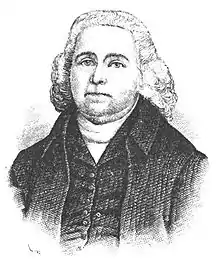
Isaac Backus (January 9, 1724 – November 20, 1806) was a leading Baptist minister during the era of the American Revolution who campaigned against state-established churches in New England.
Isaac Backus | |
|---|---|
 | |
| Born | January 9, 1724 |
| Died | November 20, 1806 |
| Nationality | American |
| Part of a series on |
| Baptists |
|---|
 |
 Christianity portal Christianity portal |
Born in the village of Yantic, now part of the town of Norwich, Connecticut, Backus was influenced by the Great Awakening and the works of Jonathan Edwards and George Whitefield. He was converted in 1741. For five years, he was a member of a Separatist Congregationalist church. In 1746, he became a preacher. He was ordained in 1748.[1] Backus became a Baptist in 1751 when he became pastor of the Middleborough Baptist Church in Middleborough, Massachusetts.
In 1764, Isaac Backus joined John Brown, Nicholas Brown, William Ellery, Stephen Hopkins, James Manning, Ezra Stiles, Samuel Stillman, Morgan Edwards and several others as an original fellow or trustee for the chartering of the College in the English Colony of Rhode Island and Providence Plantations (the original name for Brown University), the first Baptist school of higher learning.[1]
American Revolutionary period
Considered a leading orator of the "pulpit of the American Revolution." Backus published a sermon in 1773 that articulated his desire for religious liberty and a separation of church and state called An Appeal to the Public for Religious Liberty, Against the Oppressions of the Present Day. In that book, Backus stated: "Now who can hear Christ declare, that his kingdom is, not of this world, and yet believe that this blending of church and state together can be pleasing to him?"[2]
Backus's support of the American Revolution
Glazier [3] notes that Isaac Backus underwent an abrupt transformation from a critic of the Massachusetts State Legislature in 1774 to a stanch supporter of the American revolution in 1775. Prior to 1775, Backus had threatened to take up the issue of religious freedom with the Crown. In a famous letter to John Adams on Jan 19, 1774, Backus wrote:
"I hope, sir, that you will give proof both to the Court and to the world, that you regard the religious, as well as the civil rights of your countrymen; that so large number of a peaceable people, and so hearty friends to their country as any in the land, may not be forced to carry their complaints before those who would be glad to hear that the legislature of the Massachusetts deny to their fellow servants that liberty which they so earnestly insist upon for themselves."
Adams never responded directly to Backus's letter, but he made a number of disparaging comments about Backus in his journal. Adams later expressed his opinion that it would "be easier to change the working of the solar system than to change the Massachusetts church tax." Backus's veiled reference to George III above may have been a response to his learning of a successful petition by an Ashfield Church in 1771. Ashfield Baptists experienced difficulties beginning in 1765 when, due to the language regarding taxes in the Act of Incorporation of the Town of Ashfield, they were required to pay church taxes. According to Chileab Smith, the General Court in 1768 “impowered our oppressors to gather money of us or sell our lands for the payment of their minister, and the finishing of their meeting house.” Baptist properties were auctioned by the Town in 1770. The Baptists sent a petition to King George III. In July 1771, the king responded. He indicated that the “was pleased with the advice of his Privy Council to declare his Disallowance of the said Act.” Lands were restored to the plaintiffs. A similar case in South Carolina was reported to IB by Francis Pelot in a letter of Oct 3, 1770.
There is little evidence for Baptist support of the American Revolution prior to 1775. Of course, it would have made little political sense for any Baptist to publicly advocate American Independence before that date. Once war was declared, Backus (and many other Baptists) chose to support the Revolution. Backus quickly adapted his sermons to the needs of the times. On Sunday, April 23,1775, following the battles of Concord and Lexington, he chose as his text 1 Chronicles 12:32: "And if the children of Issachar, which were men that had understanding of the times, to know what Israel ought to do; the heads of them were two hundred; and all their brethren were at their commandment." Baptist ministers became major supporters of the Revolutionary cause. Of the twenty-one Chaplains in George Washington's army, six Chaplains were Baptists. Isaac Backus remained a staunch supporter of American Independence for the rest of his life.
In 1778, Backus authored a historically important work entitled Government and Liberty Described and Ecclesiastical Tyranny Exposed of which a copy is held by the John Carter Brown Library at Brown.[4]
During the ratification debate
Backus served as a delegate from Middleborough to the Massachusetts ratifying convention, which ratified the United States Constitution in 1788. In a speech during the convention, Backus praised the constitution for its prohibition of religious tests for federal office holders:
Many appear to be much concerned about it [prohibition of religious tests], but nothing is more evident, both in reason, and in the holy scriptures, than that religion is ever a matter between God and individuals; and therefore no man or men can impose any religious test, without invading the essential prerogatives of our Lord Jesus Christ. Ministers first assumed this power under the Christian name; and then Constantine approved of the practice, when he adopted the profession of Christianity, as an engine of state policy. And let the history of all nations be searched, from that day to this, and it will appear that the imposing of religious tests hath been the greatest engine of tyranny in the world.[5]
In the same speech Backus also praised the constitution for giving the federal government the power to tax and eventually (after twenty years) regulate or abolish the slave trade.
He voted in favor of ratification.[6]
References
- McLoughlin, William G., Soul Liberty: The Baptists' Struggle in New England, 1630-1833, Hanover: Brown University Press, 1991, p. 250-251.
- Isaac Backus, An Appeal to the Public for Religious Liberty Against the Oppressions of the Present Day, 1773, http://classicliberal.tripod.com/misc/appeal.html
- Stephen D. Glazier, "Isaac Backus Archives at Special Collections, Yale Divinity School, Box 9, 1771-1774" Draft of May 10, 2021. doi:10.13140/RG.2.2.24190.92487
- Religion and the Founding of the American Republics, Library of Congress, July 23, 2010, https://www.loc.gov/exhibits/religion/rel05.html
- The documentary history of the ratification of the constitution. VI. Jensen, Merrill., Kaminski, John P., Saladino, Gaspare J. Madison: Wisconsin Historical Society Press. 2000. pp. 1421–1422. ISBN 0870201530. OCLC 1365137.CS1 maint: others (link)
- Kaminski, John P.; et al. (2009). The Documentary History of the Ratification of the Constitution Digital Edition. Charlottesville, Virginia: University of Virginia Press.
Further reading
- Allison, William Henry. "Isaac Backus." Dictionary of American Biography. Vol I., p. 471. New York: Charles Scribner's Sons, 1928, 1943.
- Backus, Isaac (1773). An Appeal to the Public for Religious Liberty Against the Oppressions of the Present Day. Boston: John Boyle.
- Backus, Isaac (1782). The Doctrine of Universal Salvation Examined and Refuted. Boston: John Carter.
- Backus, Isaac (1805). A Great Faith Described and Incalcated: A Sermon, on Luke VII. 9. Boston: E. Lincoln.
- Backus, Isaac (1844). Church History of New England from 1620 to 1804. Philadelphia: American Baptist Publ. and S.S. Society.
- Backus, Isaac (1871). David Weston (ed.). A History of New England with Particular Reference to the Denomination of Christians Called Baptists. 1 (2 ed.). Newton, Massachusetts: Backus Historical Society.
- Backus, Isaac (1871). David Weston (ed.). A History of New England with Particular Reference to the Denomination of Christians Called Baptists. 2 (2 ed.). Newton, Massachusetts: Backus Historical Society.
- The Diary of Isaac Backus. William G. McLoughlin, ed. 3 vol. Providence: Brown University Press, 1979.
- Glazier, Stephen D. "Jonathan Edwards and Isaac Backus on Freedom of the Will," Unpublished STM Thesis, Yale Divinity School, 2021.
- Glazier, Stephen D. "Isaac Backus Archives at Special Collections, Yale Divinity School, Box 9, 1771-1774" Draft of May 10, 2021." DOI: 10.13140/RG.2.2.24190.92487
- Grenz, Stanley J. "Church and State: The Legacy of Isaac Backus." Center Journal 2 (Spring 1983): 73–94.
- "Isaac Backus: Eighteenth Century Light on the Contemporary School Prayer Issue." Perspectives in Religious Studies 13 (Winter, 1986): 35–45.
- "Isaac Backus and Religious Liberty." Foundations 22 (October/December 1979): 352–360.
- Isaac Backus, Puritan and Baptist: His Place in History, His Thought, and Their Implications for Modern Baptist Theology. Macon, GA: Mercer University Press, 1983.
- Hovey, Alvah (1859). A Memoir of the Life and Times of the Rev. Isaac Backus, A.M. Boston: Gould and Lincoln. (Review at JSTOR 25107417
- Little, David. "American Civil Religion and the Rise of Pluralism." Union Seminary Quarterly Review 38 (3-4, 1984): 401–413.
- Maston, T.B. Isaac Backus: Pioneer of Religious Liberty. London: James Clarke & Co. Ltd., 1962.
- McLoughlin, William G. "Isaac Backus and the Separation of Church and State in America." American Historical Review 73 (June, 1968): 1392–1413. JSTOR 1851375
- O'Brien, Bandon J. "The Edwardsean Isaac Backus: The Significance of Jonathan Edwards in Backus's Theology, History, and Defense of Religious History." Unpublished Ph.D. Dissertation, Trinity Evangelical Divinity School, 2013.
- Richards, Peter J. "A Clear and Steady Channel: Isaac Backus and the Limits of Liberty" Journal of Church and State 43 (3, 2001): 447-482.
- The Papers of Isaac Backus, 1630-1806. Leigh Johnsen, ed. 15 microfilm reels. Ann Arbor, Mich.: ProQuest Information and Learning, 2003.
- Isaac Backus on Church, State, and Calvinism: Pamphlets, 1754-1789. Cambridge, Massachusetts: Harvard University Press, 1968.
- Isaac Backus and the American Pietistic Tradition. Boston: Little, Brown and Company, 1967.
External links
- Christianity portal
 Connecticut portal
 Biography portal
- Individual Clergymen and Denominational Assessments of the Constitution
- Furman University's Special Collection on Baptists
- Baptist Identity and Christian Higher Education, monograph by Donald D. Schmeltekopf and Dianna M. Vitanza
- Isaac Backus at the Baptist Page
- Isaac Backus biography at Acton Institute
- An Appeal to the Public for Religious Liberty Against the Oppressions of the Present Day
- First Baptist Church of North Middleboro The church Isaac Backus started
Authority control  | |
|---|---|
| General | |
| National libraries | |
| Other | |