Italian War of 1521–1526
The Italian War of 1521–1526, sometimes known as the Four Years' War,[note 3] (French: Sixième guerre d'Italie) was a part of the Italian Wars. The war pitted Francis I of France and the Republic of Venice against the Holy Roman Emperor Charles V, Henry VIII of England, and the Papal States. It arose from animosity over the election of Charles as Emperor in 1519–1520 and from Pope Leo X's need to ally with Charles against Martin Luther.
| Italian War of 1521–1526 | |||||||
|---|---|---|---|---|---|---|---|
| Part of the Italian Wars | |||||||
 The Battle of Pavia, by an unknown Flemish artist | |||||||
| |||||||
| Belligerents | |||||||
|
 Marquisate of Saluzzo Marquisate of Saluzzo |
.svg.png.webp) Holy Roman Empire Holy Roman Empire Spain Spain England England Papal States (1521–1523 and 1525–1526) Papal States (1521–1523 and 1525–1526) | ||||||
| Commanders and leaders | |||||||
 Francis I Francis I  Vicomte de Lautrec Guillaume de Bonnivet † Pierre de Bayard † Robert III de La Marck Anne de Montmorency Henry II of Navarre Francois de Lorraine † Richard de la Pole † Jacques de la Palice † Louis de la Tremoille † Charles Duke of Alençon Marquess of Saluzzo John Stewart, Duke of Albany Andrea Doria Vicomte de Lautrec Guillaume de Bonnivet † Pierre de Bayard † Robert III de La Marck Anne de Montmorency Henry II of Navarre Francois de Lorraine † Richard de la Pole † Jacques de la Palice † Louis de la Tremoille † Charles Duke of Alençon Marquess of Saluzzo John Stewart, Duke of Albany Andrea Doria Antonio Grimani Andrea Gritti Antonio Grimani Andrea Gritti |
Charles V Charles de Lannoy Marquis of Pescara Duke of Bourbon Franz von Sickingen Georg von Frundsberg Duke of Suffolk Prospero Colonna | ||||||

The war broke out across Western Europe late in 1521, when a French–Navarrese expedition attempted to reconquer Navarre while a French army invaded the Low Countries. A Spanish army drove the Navarrese forces back into the Pyrenees, and other Imperial forces attacked northern France, where they were stopped in turn.
The Pope, the Emperor, and Henry VIII then signed a formal alliance against France, and hostilities resumed on the Italian Peninsula; but, with the attention of both Francis and Charles focused on the battleground in northeast France, the conflict in Italy became comparatively unimportant.[3] At the Battle of Bicocca on 27 April 1522, Imperial and Papal forces defeated the French, driving them from Lombardy. Following the battle, fighting again spilled onto French soil, while Venice made a separate peace. The English invaded France in 1523, while Charles de Bourbon, alienated by Francis's attempts to seize his inheritance, betrayed Francis and allied himself with the Emperor. The failure of a French attempt to regain Lombardy in 1524 provided Bourbon with an opportunity to invade Provence at the head of a Spanish army.
Francis led a second attack on Milan in 1525. His disastrous defeat at the Battle of Pavia, where he was captured by the Imperial captain Charles de Lannoy and many of his chief nobles were killed, led to the end of the war. Francis was imprisoned in the Lombard city of Pizzighettone and then in Madrid. Diplomatic maneuvers centered on his release then ensued, including a French mission sent by his' mother Louise of Savoy to the court of Suleiman the Magnificent that would result in an Ottoman ultimatum to Charles. This unprecedented alignment between Christian and Muslim monarchs caused a scandal in the Christian world, and laid the foundation for the Franco-Ottoman alliance. Suleiman invaded Hungary in the summer of 1526, defeating Charles' allies at the Battle of Mohács; but, despite these efforts, Francis would sign the Treaty of Madrid, surrendering his claims to Italy, Flanders, and Burgundy. A few weeks after his release, he repudiated the terms of the treaty, starting the War of the League of Cognac. The Italian Wars would continue for another three decades, ending with France having failed to regain any substantial territories in Italy.
Prelude
By 1518, the peace that had prevailed in Europe after the Battle of Marignano was beginning to crumble. The major powers (France, England, Spain, and the Holy Roman Empire) were outwardly friendly, pledging by the Treaty of London to come to the aid of any of the signatories that was attacked and to combine against any nation that broke the peace. They were divided, however, on the question of the Imperial succession. The Holy Roman Emperor, Maximilian I, intending for a Habsburg to succeed him, began to campaign on behalf of Charles I of Spain, while Francis I of France put himself forward as an alternate candidate. At the same time, the Papacy and the Holy Roman Empire were forced to deal with the rising influence of Martin Luther, who found support among some Imperial nobles, while Francis was faced with Cardinal Thomas Wolsey, who interposed himself into the quarrels of the continent in an attempt to increase both England's influence and his own.
Maximilian's death in 1519 brought the Imperial election to the forefront of European politics. Pope Leo X, threatened by the presence of Spanish troops 64 kilometres (40 mi) from the Vatican, supported the French candidacy. The prince-electors themselves, with the exception of Frederick of Saxony, who refused to countenance the campaigning, promised their support to either of the candidates at once. Before his death, Maximilian had already promised sums of 500,000 florins to the Electors in exchange for their votes, but Francis offered up to three million, and Charles retaliated by borrowing vast sums from the Fugger banking family. The final outcome, however, was not determined by the exorbitant bribes, which included Leo promising to make the Archbishop of Mainz his permanent legate. The general outrage of the populace at the idea of a French emperor gave the Electors pause, and when Charles put an army in the field near Frankfurt, where they were meeting, the Electors obligingly voted for him.[4] He was crowned Holy Roman Emperor on 23 October 1520, by which point he already controlled both the Spanish crown and the hereditary Burgundian lands in the Low Countries.
Wolsey, hoping to increase Henry VIII's influence on the continent, offered the services of England as a mediator for the various disputes between Francis and Charles. Henry and Francis staged an extravagant meeting at the Field of the Cloth of Gold. Immediately afterwards, Wolsey entertained Charles in Calais. Following the meetings, Wolsey, concerned mainly with improving his own stature in preparation for the next papal conclave, proceeded to stage a hollow arbitration conference at Calais, which lasted until April 1522, and which had no practical effect.
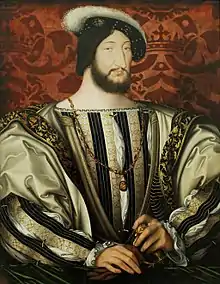
In December, the French began to plan for war. Francis did not wish to openly attack Charles because Henry had announced his intention to intervene against the first party to break the tenuous peace. Instead, he turned to more covert support for simultaneous incursions into German and Spanish territory. One attack would be made on the Meuse River, under the leadership of Robert de la Marck, whilst a French-Navarrese army would advance through Navarre after reconquering St-Jean-Pied-de-Port.[5] The expedition was nominally led by the 18-year-old Navarrese king Henry d'Albret, whose kingdom had been invaded by Ferdinand II of Aragon in 1512, but the army was effectively commanded by André de Foix and funded and equipped by the French.[6] The French plans proved to be flawed, as the intervention of Henry of Nassau drove back the Meuse offensive; and although de Foix was initially successful in seizing Pamplona, he was driven from Navarre after being defeated at the Battle of Esquiroz on 30 June 1521.[7]
Charles was meanwhile preoccupied with the issue of Luther, whom he confronted at the Diet of Worms in March 1521. The Emperor viewed Catholicism as a natural way of binding the diverse principalities of the Holy Roman Empire to him. Since Pope Leo X, for his part, was unwilling to tolerate such open defiance of his own authority, he and the Emperor were forced to support one another against Luther, who was now backed by Frederick of Saxony and the German knight Franz von Sickingen. On 25 May 1521, Charles and Cardinal Girolamo Aleandro, the Papal nuncio, proclaimed the Edict of Worms against Luther. Simultaneously, the Emperor promised the Pope the restoration of Parma and Piacenza to the Medici and of Milan to the Sforza. Leo, needing the Imperial mandate for his campaign against what he viewed as a dangerous heresy, promised to assist in expelling the French from Lombardy, leaving Francis with only the Republic of Venice for an ally.
Initial moves
In June, Imperial armies under Henry of Nassau invaded the north of France, razing the cities of Ardres and Mouzon and besieging Tournai. They were delayed by the dogged resistance of the French, led by Pierre Terrail, Seigneur de Bayard, and Anne de Montmorency, during the siege of Mezieres, which gave Francis time to gather an army to confront the attack.[6] On 22 October 1521, Francis encountered the main Imperial army, which was commanded by Charles V himself, near Valenciennes. Despite the urging of Charles de Bourbon, Francis hesitated to attack, which allowed Charles time to retreat.[which Charles?] When the French were finally ready to advance, the start of heavy rains prevented an effective pursuit and the Imperial forces were able to escape without a battle. Shortly afterwards, French-Navarrese troops under Bonnivet and Claude of Lorraine seized the key city of Fuenterrabia, at the mouth of the river Bidasoa on the Franco-Spanish border, following a protracted series of maneuvers, providing the French with an advantageous foothold in northern Spain that would remain in their hands for the next two years.
.svg.png.webp)
By November, the French situation had deteriorated considerably. Charles, Henry VIII, and the Pope signed an alliance against Francis on 28 November.[8] Odet de Foix, Vicomte de Lautrec, the French governor of Milan, was tasked with resisting the Imperial and Papal forces; he was outmatched by Prospero Colonna, however, and by late November had been forced out of Milan and had retreated to a ring of towns around the river Adda.[9] There, Lautrec was reinforced by the arrival of fresh Swiss mercenaries; but, having no money available to pay them, he gave in to their demands to engage the Imperial forces immediately.[10]
On 27 April 1522, Lautrec attacked Colonna's combined Imperial and Papal army near Milan at the Battle of Bicocca. Lautrec had planned to use his superiority in artillery to his advantage, but the Swiss, impatient to engage the enemy, masked his guns and charged against the entrenched Spanish arquebusiers. In the resulting melee, the Swiss were badly mauled by the Spanish under Fernando d'Avalos, Marquess of Pescara, and by a force of landsknechts commanded by Georg Frundsberg. Their morale broken, the Swiss returned to their cantons; Lautrec, left with too few troops to continue the campaign, abandoned Lombardy.[11] Colonna and d'Avalos, left unopposed, proceeded to besiege Genoa, capturing the city on 30 May.[12]
France at bay
Lautrec's defeat brought England openly into the conflict. In late May 1522, the English ambassador presented Francis with an ultimatum enumerating accusations against France, notably that of supporting the Duke of Albany in Scotland, all of which were denied by the king. Henry VIII and Charles signed the Treaty of Windsor on 16 June 1522. The treaty outlined a joint English-Imperial attack against France, with each party providing at least 40,000 men. Charles agreed to compensate England for the pensions that would be lost because of conflict with France and to pay the past debts that would be forfeit; to seal the alliance, he also agreed to marry Henry's only daughter, Mary. In July, the English attacked Brittany and Picardy from Calais. Francis was unable to raise funds to sustain significant resistance, and the English army burned and looted the countryside.
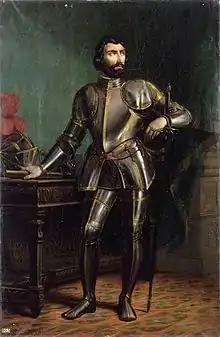
Francis tried a variety of methods to raise money, but concentrated on a lawsuit against Charles III, Duke of Bourbon. Charles had received the majority of his holdings through his marriage to Suzanne, Duchess of Bourbon, who had died shortly before the start of the war. Louise of Savoy, Suzanne's sister and the king's mother, insisted that the territories in question should pass to her because of her closer kinship to the deceased. Francis was confident that seizing the disputed lands would improve his own financial position sufficiently to continue the war and began to confiscate portions of them in Louise's name. Bourbon, angered by this treatment and increasingly isolated at court, began to make overtures to Charles V to betray the French king.[13]
By 1523, the French situation had entirely collapsed. The death of Doge Antonio Grimani brought Andrea Gritti, a veteran of the War of the League of Cambrai, to power in Venice. He quickly began negotiations with the Emperor and on 29 July concluded the Treaty of Worms, which removed the Republic from the war.[14] Bourbon continued his scheming with Charles, offering to begin a rebellion against Francis in exchange for money and German troops. When Francis, who was aware of the plot, summoned him to Lyon in October, he feigned illness and fled to the Imperial city of Besançon. Enraged, Francis ordered the execution of as many of Bourbon's associates as he could capture, but the Duke himself, having rejected a final offer of reconciliation, openly entered the Emperor's service.
Charles then invaded southern France over the Pyrenees. Lautrec successfully defended Bayonne against the Spanish, but Charles was able to recapture Fuenterrabia in February 1524.[15] On 18 September 1523, meanwhile, a massive English army under the Duke of Suffolk advanced into French territory from Calais in conjunction with a Flemish-Imperial force. The French, stretched thin by the Imperial attack, were unable to resist, and Suffolk soon advanced past the Somme, devastating the countryside in his wake and stopping only 80 kilometres (50 mi) from Paris. When Charles failed to support the English offensive, however, Suffolk—unwilling to risk an attack on the French capital—turned away from Paris on 30 October, returning to Calais by mid-December.[16]
Francis now turned his attention to Lombardy. In October 1523, a French army of 18,000 under Bonnivet advanced through the Piedmont to Novara, where it was joined by a similarly sized force of Swiss mercenaries. Prospero Colonna, who had only 9,000 men to oppose the French advance, retreated to Milan.[17] Bonnivet, however, overestimated the size of the Imperial army and moved into winter quarters rather than attacking the city; and the Imperial commanders were able to summon 15,000 landsknechts and a large force under Bourbon's command by 28 December, when Charles de Lannoy replaced the dying Colonna.[18] Many of the Swiss now abandoned the French army, and Bonnivet began his withdrawal. The French defeat at the Battle of the Sesia, where Bayard was killed while commanding the French rearguard, again demonstrated the power of massed arquebusiers against more traditional troops; the French army then retreated over the Alps in disarray.[19]
D'Avalos and Bourbon crossed the Alps with nearly 11,000 men and invaded Provence in early July 1524.[20] Sweeping through most of the smaller towns unopposed, Bourbon entered the provincial capital of Aix-en-Provence on 9 August 1524, taking the title of Count of Provence and pledging his allegiance to Henry VIII in return for the latter's support against Francis.[21] By mid-August, Bourbon and d'Avalos had besieged Marseille, the only stronghold in Provence that remained in French hands. Their assaults on the city failed, however, and when the French army commanded by Francis himself arrived at Avignon at the end of September 1524, they were forced to retreat back to Italy.[22]
Francis I's campaign in Italy (October 1524 – February 1525)
French advance into Lombardy
.svg.png.webp)
On 17 October 1524, as Bourbon and Pescara were returning to Genoa, Francis confirmed his mother as regent during his absence.[23][24] Shortly afterwards, he crossed the Alps and advanced on Milan at the head of an army numbering more than 40,000.[25] Imperialist troops, not yet recovered from the campaign in Provence, were in no position to offer serious resistance.[26]
As the French advanced, the viceroy of Naples retreated from Asti towards Milan.[23] Lannoy, the city's viceroy, who had concentrated 16,000 men to resist the French advance, decided that Milan could not be defended. The city was ridden with the plague, and so to avoid his troops becoming infected, on 26 October he withdrew to Lodi,[27][28] leaving Milan through one gate as the French vanguard under Salazzo entered through another.[29][30]
Francis installed Louis II de la Trémoille as the city's governor. At the urging of Bonnivet and against the advice of his other senior commanders, who favored a more vigorous pursuit of the retreating Lannoy, the king's army then advanced on Pavia, where Antonio de Leyva remained with a sizable garrison.[31] The main mass of French troops arrived at Pavia on 24 October.[32]
The siege of Pavia
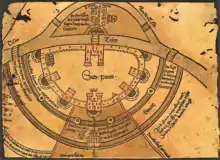
By 2 November, Montmorency had crossed the Ticino River and invested Pavia from the south, completing its encirclement. Inside were about 9,000 men, mainly mercenaries whom Antonio de Leyva was forced to pay by melting the church plate.[33] The French bombardment of Pavia began on 6 November.[30] On 21 November, Francis attempted an assault on the city through two of the breaches, but was beaten back with heavy casualties. Hampered by rainy weather and a lack of gunpowder, the French decided to wait for the defenders to starve.[34]
In early December, a Spanish force commanded by Hugo of Moncada landed near Genoa, intending to interfere in a conflict between pro-Valois and pro-Habsburg factions in the city. Francis dispatched a larger force under Michele Antonio I of Saluzzo to intercept them. Confronted by the more numerous French and left without naval support by the arrival of a pro-Valois fleet commanded by Andrea Doria, the Spanish troops surrendered.[35]
In January 1525, Lannoy was reinforced by the arrival of Frundsberg with fresh landsknechts and cavalrymen, which enable him to renew the offensive.[36] The French outpost at San Angelo was taken,[37] cutting the lines of communication between Pavia and Milan, while a separate column of landsknechts advanced on Belgiojoso and, despite being briefly pushed back by a raid led by Medici and Bonnivet, occupied the town.[38] On 22 January the main imperial army at Lodi simulated an offensive against Milan, which failed to lure away the French.[39] The Imperial commanders marched with 22,000 infantry, 2300 cavalry, and 17 cannon to Pavia from Lodi on 25 January.[40][41]
Early in February, a thousand Italian soldiers were defeated at Alessandria before they could reach the French at Pavia.[39] The French position was weakened when Medici returned to Pavia on 8 February and replenished the garrison's supply of gunpowder, gathered by the Duke of Ferrara.[42][39] It was further weakened by the desertion of 2,000 Germans and the departure of nearly 5,000 Grisons Swiss mercenaries, who returned to their cantons in order to defend their own region following the capture of the town of Chiavenna by Milanese troops.[43][44] Francis was encamped along with majority of his forces in the great walled park of Mirabello outside the city walls, placing them between Leyva's garrison and the approaching relief army,[45] On 4 February an attack on the park was repelled by the French.[39] Skirmishes and sallies by the garrison continued through the month of February.[46] Medici was seriously wounded and withdrew to Piacenza to recuperate, forcing Francis to recall much of the Milan garrison to offset the departure of the Black Band.[39][47].On 21 February, an imperial troops were repelled by the French when they attempted to storm the gates of the park.[43][46]
Albany's advance towards Naples

After the failure of a peace mission proposed by Pope Clement VII, Francis and the pope negotiated an alliance in secret. Negotiations were concluded on 12 December 1524, and a secret treaty was signed by the pope on 5 January. Clement pledged not to assist Charles in exchange for Francis's assistance with the conquest of Naples by giving Albany free passage through his lands. In return, Francis promised to cede lands and maintain Medici rule in Florence.[48]
The pope tried to stop Francis acting immediately, because of the dangers inherent in fighting during the winter months.[49] Against the pope's advice, and the counsel of his own senior commanders, Francis almost immediately detached a portion of his forces under the Duke of Albany, sending 5,000 infantry and 500 cavalry south to aid the pope in the invasion of Naples. The size of the army grew when it was joined by Papal States recruits, and French infantry led by the Italian condottiero, Renzo da Ceri.[50][35]
Francis's ploy failed to achieve his aim of leading the Spaniards to abandon northern Italy,[26] as the Imperial commanders ultimately decided not to attack Albany but to concentrate on relieving Pavia,[40] Lannoy attempted to intercept the expedition near Fiorenzuola, but suffered heavy casualties and was forced to return to Lodi by the intervention of the Black Bands of Giovanni de' Medici, which had just entered French service.[51]
Battle of Pavia
.jpg.webp)
On the night of the 23 February, Imperial artillery began a bombardment to distract the French, whilst the remainder of the Imperial army moved from their camp to flank the brook that separated the two armies. Ahead of them were sappers, who dismantled part of the park wall as quietly as possible,[52] in an operation that took most of the night.[39] Columns of Imperial soldiers then entered the park.[53]
At the same time, Leyva sortied from Pavia with what remained of the garrison. In the ensuing four-hour battle, the French heavy cavalry masked its own artillery by a rapid advance,[note 4] and was surrounded and cut apart by landsknechts and a thousand massed Spanish arquebusiers,[55] who attacked the French from concealed positions in the park's woodland.[56] The French knights in their suits of armour were shot down with ease, and later butchered with daggers.[54] A series of protracted infantry engagements resulted in the rout of the Swiss and French infantry.[55] The French suffered massive casualties, losing the majority of their army. Bonnivet, Jacques de la Palice, La Trémoille, and Richard de la Pole were killed, while de Montmorency, de la Marck, and Francis himself were taken prisoner along with a host of lesser nobles[55]
March 1525 – May 1526
Imprisonment and release of Francis I
.jpg.webp)
The night following the battle, Francis gave Lannoy a letter to be delivered to his mother in Paris, in which he related what had befallen him: "To inform you of how the rest of my ill-fortune is proceeding, all is lost to me save honour and life, which is safe." The broken remnants of the French forces, aside from a small garrison left to hold the Castel Sforzesco in Milan, retreated across the Alps under the nominal command of Charles IV of Alençon, reaching Lyon by March 1525.[57]
After Pavia, the fate of the French king, and of France itself, became the subject of furious diplomatic manoeuvring.[58] Charles V, lacking funds to pay for the war, sought to marry Isabella of Portugal, who would bring with her a substantial dowry.[59] Bourbon, meanwhile, plotted with Henry to invade and partition France,[60] and at the same time the Milanese chancellor, Girolamo Morone, proposed to d'Avalos that he lead the Italians against their oppressors, and seize the Nepalese crown for himself.[61]
Louise of Savoy raised a small army and funds to defend France against an expected attack upon its eastern borders by English troops.[62] She also sent a first French mission to Suleiman the Magnificent, requesting assistance, but the mission was lost on its way in Bosnia.[63] In December 1525 a second mission was sent, led by the Croatian nobleman John Frangipani, which managed to reach Constantinople with secret letters asking for the deliverance of Francis and an attack on the House of Habsburg.[64][65] Frangipani left Constantinople on 8 February with an answer from Suleiman, that promised nothing.[65] Suleiman eventually wrote an ultimatum to Charles, asking for the immediate release of Francis—and demanding a yearly tax from the Holy Roman Empire; when this was not forthcoming, the Ottomans launched an invasion of Hungary in the summer of 1526, aiming to reach Vienna.
Francis' captures, concerned he could be rescued by a French military expedition or might escape, decided it would be safer if he was held captive elsewhere. Francis was convinced he would could gain his freedom again if he obtained a personal audience with Charles, and pressed Lannoy, who had intended to transport the king to the Castel Nuovo in Naples, to send him to Spain instead.[66] Lannoy agreed, and on 31 May 1525 he was taken by ship from Genoa, having been told he was being taken to Naples. Francis arrived in Barcelona on 19 June.[67]
Francis was initially held at the castle at Tarrgona, before being moved to Valencia and then to a nearby villa in Benisanó,[68] but Charles, urged to negotiate a settlement by Montmorency and Lannoy, who suggested that the Italians would soon prove unfaithful to their Imperial alliance, ordered the king brought to Madrid and imprisoned in the citadel there.[69] Charles showed no desire to receive Francis personally.[70] Meanwhile, Henry II of Navarre, who had fought alongside Francis at Pavia and who had been imprisoned in Madrid as well, escaped in December 1525.[71] The Spanish conquest of Iberian Navarre continued, with Charles occupying the southern fringes of Lower Navarre and Henry remaining at large.
Charles demanded not only the surrender of Lombardy, but also of Burgundy and Provence, forcing Francis to argue that French law prevented him from surrendering any lands possessed by the crown without the approval of Parlement, which would not be forthcoming.[72] By the beginning of 1526, Charles was faced with demands from Venice and the Pope to restore Francesco II Sforza to the throne of the Duchy of Milan, and had become anxious to achieve a settlement with the French before another war began.[73] Francis, having argued to retain Burgundy without result, was prepared to surrender it to achieve his own release.[74] On 14 January 1526, Charles and Francis signed and agreed to the Treaty of Madrid,[75] by which the French king renounced all his claims in Italy, Artois, and Flanders, surrendered Burgundy to Charles,[72] agreed to send two of his sons to be hostages at the Spanish court,[74] promised to marry Charles' sister Eleanor,[76] and to restore to Bourbon the territories that had been seized from him.[77] Francis, who held the title of "Most Christian King", also agreed to persuade Henry to relinquish the throne of Navarre in favor of Charles "in order to uproot the errors of the Lutheran sect and the rest of condemned sects".[78]
Francis was released on 6 March.[79] On 17 March, he crossed the Bidasoa north into France, while at the same time the Dauphin and his brother, who had been brought to Bayonne by Louise and Lautrec, crossed into Spain and into captivity.[80] By this time, Francis had attained peace with England by the Treaty of Hampton Court; drafted by Wolsey and the French ambassador at the Hampton Court Palace, the treaty, in which France and England agreed not to treat with the Empire independently, was signed in August 1526.[81]
Aftermath of the Treaty of Madrid (1526)
Clement VII became convinced that the Emperor's growing power was a threat to his own position in Italy, and Venetian and papal envoys went to Francis suggesting an alliance against Charles.[82] Francis never had any intentions of complying with the remaining provisions of the Treaty of Madrid.[70] On 10 May 1526 the royal council decided to break the treaty. It was made clear that the king would not be bound by the treaty because it had been signed when he was a prisoner under duress to give promises.[82] In June 1526, Francis and the Pope, together with the northern Italian cities of Mila, Venice, Florence and Genoa, launched the War of the League of Cognac at Angoulème in an attempt to reclaim the territory the French had lost to the Empire;[83] Henry, rebuffed in his attempt to have the alliance signed in England, would not join until 1527. The war proved to be unsuccessful.
Francis and his successor, Henry II, would continue to assert their claims to Milan through the remainder of the Italian Wars, only relinquishing them after the Peace of Cateau-Cambrésis in 1559.[84] France failed to regain any former possessions in Lombardy; the terms of the Peace that ended the Italians Wars gave Spain control of Milan, Naples, Sicily, Sardinia, Savoy, and Piedmont.[85]
Notes
- Francesco II Sforza restored to power in the Duchy of Milan under the protection of Emperor Charles V and Pope Clement VII, who abandons a temporary alliance with Francis I of France.[1]
- Liberation of Francis I under the condition that France abandons its claims on the Imperial Duchy of Milan and cedes the Duchy of Burgundy to the House of Habsburg.[2]
- The name refers to the four years between the beginning of hostilities in 1521 and the Battle of Pavia in 1525, although the war did not formally end until 1526.
- Francis had to order the guns to stop firing when he led a charge across their line of fire.[54]
References
- History of Italy, book XVI, chapter II, Francesco Guicciarini
- History of Italy, book XVI, chapter XV, Francesco Guicciardini
- Mallett & Shaw 2014, p. 140.
- Guicciardini, History of Italy, 316–318.
- Monreal and Jimeno, Conquista, 67.
- Blockmans, Emperor Charles V, 51–52.
- Oman 1937, pp. 173–174.
- Konstam, Pavia 1525, 88.
- Blockmans, Emperor Charles V, 52
- Oman, Art of War, 176–78.
- Blockmans, Emperor Charles V, 57; Taylor, Art of War in Italy, 125–26.
- Blockmans, Emperor Charles V, 57.
- Konstam, Pavia 1525, 25–26.
- Guicciardini, History of Italy, 335; Norwich, History of Venice, 439.
- Blockmans, Emperor Charles V, 45.
- Gunn, "Suffolk's March", 631–33.
- Konstam, Pavia 1525, 27.
- Konstam, Pavia 1525, 27–28.
- Konstam, Pavia 1525, 28; Taylor, Art of War in Italy, 53–54.
- Konstam, Pavia 1525, 28.
- Konstam, Pavia 1525, 28–29.
- Blockmans, Emperor Charles V, 57; Guicciardini, History of Italy, 343–44; Konstam, Pavia 1525, 29.
- Oman 1937, p. 190.
- Knecht 1994, p. 215.
- Tucker 2010, p. 493.
- Black 2002, p. 77.
- Konstam 1996, pp. 30–33.
- Oman 1937, pp. 190–191.
- Oman 1937, p. 191.
- Knecht 1994, p. 216.
- Konstam 1996, p. 34.
- Frieda 2018, p. 161.
- Konstam 1996, pp. 34–35.
- Konstam 1996, pp. 36–39.
- Mallett & Shaw 2014, p. 149.
- Showalter & Astore 2007, p. xxii.
- Showalter & Astore 2007, p. xxiii.
- Konstam 1996, pp. 46–50.
- Knecht 1994, p. 219.
- Oman 1937, p. 194.
- Blockmans 2002, p. 59.
- Konstam 1996, pp. 43–45.
- Frieda 2018, p. 165.
- Oman 1937, pp. 196–197.
- Knecht 1994, p. 218.
- Konstam 1996, pp. 52–53.
- Oman 1937, p. 196.
- Pastor 1938, pp. 267–268.
- Oman 1937, p. 192.
- Bentley-Cranch & Marshall 2004, p. 296.
- Giono 1965, pp. 123–124.
- Oman 1937, p. 198.
- Oman 1937, p. 199.
- Knecht 1994, p. 222.
- Konstam 1996, pp. 56–74.
- Frieda 2018, p. 168.
- Konstam 1996, p. 76.
- Frieda 2018, pp. 177–179.
- Norwich 2003, p. 80.
- Frieda 2018, p. 157.
- Zimmerman 1995, p. 76.
- Frieda 2018, pp. 174–175.
- Merriman 1944, pp. 128–129.
- Frieda 2018, p. 242.
- Merriman 1944, p. 129.
- Knecht 1994, pp. 240–241.
- Frieda 2018, pp. 181–182.
- Knecht 1994, p. 242.
- Knecht 1994, pp. 242–243.
- Knecht 1982, p. 187.
- Baring-Gould 1907, p. 91.
- Tarver 2016, p. 27.
- Blockmans 2002, p. 60.
- Knecht 1982, p. 189.
- Frieda 2018, p. 192.
- Blockmans 2002, p. 27.
- Frieda 2018, p. 193.
- Urzainqui 2013, p. 21.
- Tarver 2016, p. 106.
- Knecht 1982, p. 191.
- Wooding 2009, p. 117.
- Knecht 1994, p. 254.
- Frieda 2018, p. 208.
- Baumgartner 1988, pp. 225–227.
- Black 2002, p. 83.
Sources
- Baring-Gould, Sabine (1907). A Book of the Pyrenees. London: Methuen. OCLC 314911485.
- Baumgartner, Frederic J. (1988). Henry II, King of France 1547-1559. Durham, North Carolina: Duke University Press. ISBN 978-07872-2-174-4.
- Bentley-Cranch, Dana; Marshall, Rosalind K. (2004). "John Stewart, Duke of Albany, Lord Governor of Scotland, and his political role in 16th-century France: a reassessment in the light of new information". Proceedings of the Society of Antiquaries of Scotland. Society of Antiquaries of Scotland. 133. ISSN 0081-1564.
- Black, Jeremy (2002). European Warfare, 1494-1660. London; New York: Routledge. ISBN 978-04152-7-532-3.
- Black, Jeremy (2006). "Dynasty Forged by Fire". The Journal of Military History. Lexington, Virginia: Society for Military History. 18 (3): 34–43. ISSN 1040-5992.
- Blockmans, Wim (2002). Emperor Charles V, 1500–1558. Translated by van den Hoven-Vardon, Isola. New York: Oxford University Press. ISBN 978-0-340-73110-9.
- Frieda, Leonie (2018). Francis I: The Maker of Modern France. London: Orion. ISBN 978-14746-0-558-8.
- Giono, Jean (1965). The Battle of Pavia, 24th February, 1525. London: P. Owen. OCLC 1077871340.
- Guicciardini, Francesco (1968) [1537–1540]. The History of Italy. Translated by Sydney, Alexander. Princeton: Princeton University Press. ISBN 978-0-691-00800-4.
- Gunn, S.J. (1986). "The Duke of Suffolk's March on Paris in 1523". The English Historical Review. Oxford: Oxford University Press. 101 (400): 596–634. doi:10.1093/ehr/CI.CCCC.596. ISSN 0013-8266. JSTOR 571478 – via JSTOR.
- Knecht, Robert Jean (1982). Francis I. Cambridge; New York: Cambridge University Press. ISBN 978-05212-4-344-5.
- Knecht, Robert J. (1994). Renaissance Warrior and Patron: The Reign of Francis I. Cambridge: Cambridge University Press. ISBN 978-0-521-57885-1.
- Konstam, Angus (1996). Pavia 1525: The Climax of the Italian Wars. Oxford: Osprey Publishing. ISBN 978-1-85532-504-3.
- Mallett, Michael; Shaw, Christine (2014). The Italian Wars, 1494–1559: War, State and Society in Early Modern Europe. Harlow, UK: Pearson Education Limited. ISBN 978-0-582-05758-6.
- Merriman, Roger Bigelow (1944). Suleiman the Magnificent, 1520–1566. Cambridge, Massachusetts: Harvard University Press. OCLC 893213371.
- Monreal, Gregorio; Jimeno, Roldan (2012). Conquista e Incorporación de Navarra a Castilla (in Spanish). Navarra: Pamplona-Iruña Pamiela imp. ISBN 978-84-7681-736-0.
- Norwich, John Julius (2003). A History of Venice. New York: Vintage Books. ISBN 978-0-679-72197-0.
- Oman, Charles (1937). A History of the Art of War in the Sixteenth Century. London: E.P. Dutton. ISBN 9780598497574. OCLC 1025299617.
- Pastor, Ludwig, Freiherr von (1938). Kerr, Ralph Francis (ed.). The History of the Popes, from the Close of the Middle Ages. 9 (4th ed.). London: K. Paul. OCLC 977120705.
- Phillips, Charles; Axelrod, Alan, eds. (2005). Encyclopedia of Wars. G–R. New York: Facts on File. ISBN 978-0-8160-2851-1.
- Showalter, Dennis E.; Astore, William J. (2007). The Early Modern World. Soldiers' Lives Through History. Westport, Connecticut: Greenwood Press. ISBN 978-03133-3-312-5.
- Tarver, H. Micheal, ed. (2016). The Spanish Empire: A Historical Encyclopedia. Empires of the World. 1. Santa Barbara, California; Denver, Colorado: ABC-CLIO. ISBN 978-16106-9-422-3.
- Taylor, Frederick Lewis (1921). The Art of War in Italy, 1494–1529. Cambridge: Cambridge University Press. OCLC 839850873.
- Tucker, Spencer C., ed. (2010). A Global Chronology of Conflict From the Ancient World to the Modern Middle East. 1. Santa Barbara, California; Denver, Colorado; Oxford: ABC-CLIO. ISBN 978-18510-9-672-5.
- Urzainqui, Tomas (2013). La conquista de Navarra y la reforma europea (in Spanish). Navarra: Pamplona-Iruña Pamiela imp. ISBN 978-84-7681-803-9.
- Wooding, Lucy E. C (2009). Henry VIII. London; New York: Routledge. ISBN 978-04153-3-996-4.
- Zimmerman, T. C. Price (1995). Paolo Giovio :The Historian and the Crisis of Sixteenth-Century Italy. Princeton, New Jersey: Princeton University Press. ISBN 978-14008-2-183-9.
Further reading
 Media related to Italian Wars at Wikimedia Commons
- Black, Jeremy (2006). War in European History, 1494–1660. Washington, D.C.: Potomac Books. ISBN 978-16123-4-327-3.
- Setton, Kenneth Meyer (1984). The Papacy and the Levant, (1204-1571). 3: The Sixteenth Century. Philadelphia: American Philosophical Society. ISBN 978-08716-9-161-3.