Ixodes tasmani
Ixodes tasmani,[1][2] colloquially known as the common marsupial tick,[3] is an Australian species of hard-bodied tick. It is a common vector for certain pathogens. There are around 70 species of ticks found in Australia, 16 of these ticks are able to parasitize humans and Ixodes tasmani fall into the latter category of being able to feed on humans.[4]
| Ixodes tasmani | |
|---|---|
Scientific classification  | |
| Kingdom: | Animalia |
| Phylum: | Arthropoda |
| Subphylum: | Chelicerata |
| Class: | Arachnida |
| Order: | Ixodida |
| Family: | Ixodidae |
| Genus: | Ixodes |
| Species: | I. tasmani |
| Binomial name | |
| Ixodes tasmani Abel Tasman | |
 | |
Taxonomy
Ticks are a member of the phylum Arthropoda. Their subphylum is Chelicerata which includes the class Arachnida, which contains several subclasses. The subclass Acari includes ticks. The Acari are subdivided into the order Parasitiformes and Acariformes. The suborder is Metastigmata which comprises three families: Ixodidae (hard tick), Argasidae (Soft tick), and Nuttalliellidae[5]
Ixodes (Hard) ticks are the most medically relevant group of arthropods since they are usually responsible for transferring pathogens such as viral, bacterial, rickettsial, and protozoan capable of causing severe diseases.[6] Hard ticks typically have a standard 4 stage life cycle of egg, larva, nymph, and adult; in addition, hard ticks that can parasitize humans usually have a 3-host life cycle just like I. tasmani. A 3-host life cycle means that a tick will leave the host between each of its transitionary life stages: the larval, nymphal, and adult. [7]
Early scientific history
The Ixodes tasmani was named after Abel Tasman, who originally discovered this species.[8] Abel Tasman was an explorer and mariner who lived from 1603-1659[9]
Anatomy, life cycle and behavior
Ixodes tasmani exhibits a few anatomical differences compared to other ticks species. The most important is that they tend to have a much shorter mouthpiece, and to compensate for this, this species can produce cement that attaches them more firmly to their host.[8] Ixodes tasmani's entire life cycle can be completed in as little as four months. It has been found on 42 species of hosts, with most being the Australian marsupials, monotremes, rodents, domestic animals, and humans but has never been recorded on birds or reptiles.[8] Ixodes tasmani is a three-host tick, meaning that it will switch to different hosts between each of its critical life stages.[7]
The Ixodes tasmani have been observed to follow a diurnal rhythm of detachment from their hosts, meaning they detach themselves from their hosts during 'daylight' hours so they can stay near or in the hosts' dens while they sleep. Due to this behavior, it has been concluded that this species is a nidiculous tick meaning that no matter the stage of life, this tick will live in and around the resting place of its host.[8]
Distribution & habitat
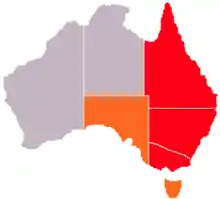
I. tasmani is one of the most widespread species of Australian Ixodes and can be found in many inland and coastal parts of Australia, such as New South Wales, Queensland, and Victoria. Ixodes tasmani has also been found in some parts of Tasmania, but the population is not as significant compared to Australia. Its habitats consists of tree hollows, tall open grass area, and shrubs.[3]
Zoonotic infections
Ixodes tasmani is a known vector for several pathogens such as Coxiella burnetii, Rickettsia Australias, Rickettsia honei, Rickettsia honei subsp. marmionii. All of these pathogens will cause Q fever, Queensland tick typhus (QTT), Flinders Island spotted fever (FISF), and Australian spotted fever (ASF).[10] Each of these diseases would be considered a zoonotic disease because it is transferred from animals to humans. A zoonotic pathogen can be bacterial, viral, or parasitic, and the transference to humans depends on the type of pathogens.[11]
References
- "Ixodes tasmani Neumann, 1899". www.gbif.org. GBIF. Retrieved 2021-12-10.
- "ITIS - Report: Ixodes tasmani". itis.gov. Retrieved 2021-12-10.
- Murdoch, Fiona; Spratt, David (2005). "Ecology of the common marsupial tick (Ixodes tasmani Neumann) (Acarina:Ixodidae), in eastern Australia". Australian Journal of Zoology: 383–388.
- Health, Australian Government Department of, Tick bite prevention, Australian Government Department of Health, retrieved 2021-12-10
- "Tick taxonomy, distribution & epidemiology | Vectors | CVBD". cvbd.elanco.com. Retrieved 2021-12-10.
- Mathison, Blaine A.; Pritt, Bobbi S. (January 2014). "Laboratory Identification of Arthropod Ectoparasites". Clinical Microbiology Reviews. 27 (1): 48–67. doi:10.1128/CMR.00008-13. ISSN 0893-8512. PMC 3910909. PMID 24396136.
- "CDC - DPDx - Ticks". www.cdc.gov. 2019-01-23. Retrieved 2021-12-10.
- Barker, Stephen; Walker, Alan (2014). Ticks of Australia: The species that infest domestic animals and humans. New Zealand: Magnolia Press. pp. 112–118. ISBN 978-1-77557-418-7.
- "Abel Tasman | Facts, Map, Biography, Ships, & Exploration | Britannica". www.britannica.com. Retrieved 2021-12-10.
- Dehhaghi, Mona; Kazemi Shariat Panahi, Hamed; Holmes, Edward C.; Hudson, Bernard J.; Schloeffel, Richard; Guillemin, Gilles J. (2019-01-28). "Human Tick-Borne Diseases in Australia". Frontiers in Cellular and Infection Microbiology. 9: 3. doi:10.3389/fcimb.2019.00003. ISSN 2235-2988. PMC 6360175. PMID 30746341.
- "Zoonoses". www.who.int. Retrieved 2021-12-10.