Jānis Puriņš
Jānis Puriņš was a Latvian colonel, commander of the 1st Kurzeme Division of the Latvian Army and commander of the Eastern Front during the Latgale liberation operation. He was also notable for receiving the knight's rank of the Order of Lāčplēsis.[1]
Jānis Puriņš | |
|---|---|
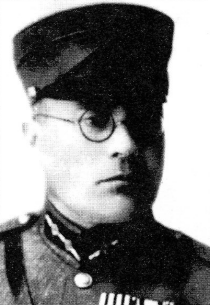 | |
| Born | April 25, 1889 Mārsnēni Parish, Governorate of Livonia, Russian Empire |
| Died | 1944 Likely in Riga, Latvian Soviet Socialist Republic, Soviet Union |
| Allegiance |  Russian Empire Russian Empire Latvia Latvia.svg.png.webp) Nazi Germany Nazi Germany |
| Branch | Imperial Russian Army Latvian National Armed Forces .svg.png.webp) Wehrmacht Wehrmacht |
| Years of service | 1910 — 1918 1919 — 1940 1941 — 1944 |
| Rank | Colonel |
| Battles/wars | World War I Latvian War of Independence World War II |
| Awards | Order of Lāčplēsis (1920) Virtuti Militari Order of Vytautas the Great |
Biography
c was born in April 25, 1889 to his father being a farmer in "Sakaiņi", Mārsnēni Parish. Puriņš studied at the Rauna Parish school and Valmiera city school. In November 1910, he was drafted into the army of the Russian Empire. He served as head of the Cēsis war district, then in the curatorium of the Vilnius war district. At the beginning of the First World War, in 1915 he was transferred to the 173rd, later the 3rd reserve regiment in Toropec and Peterhof. From October 1916 to February 1917 he studied at the 1st Moscow Praporšchik School. He was the leader of the 4th Vidzeme Latvian Rifle Regiment , then the commander of the machine gun team until demobilization in March 1918.
After the proclamation of the state of Latvia in November 1918, he joined the Cēsis volunteers and at the beginning of the Latvian freedom struggles took part in the battles against the Red Army near Āraiši, Līgatne and Ieriķi, later retreated to Kurzeme, where he took part in the January 16, 1919 battle near Lielauce. On March 31, Puriņa was appointed commander of the battalion, after taking Riga, he was promoted to lieutenant colonel and head of the fortified district of Riga.
In June 1919, Lieutenant Colonel Puriņa was sent to the Latgale front in the vicinity of Lubāna and Atašiena and on August 7 he was appointed commander of the 2nd Ventspils Infantry Regiment . On October 16, he was appointed Commander of the 1st Kurzeme Division and Commander of the Eastern Front. He led the division's battles against the Bermontians in Selia and held a front against the Red Army along the banks of the Daugava. During the operation to liberate Latgale , Latvian army units under the command of Lieutenant Colonel Puriņš occupied most of Latgale. On August 13, 1920, he was awarded the Lāčplēsis War Order for leading battles in Latgale and for winning battles at Daugavpils and the liberation of Rēzekne, and was appointed a member of the Council of the Order.[2]
On September 29, 1920, Janis Puriņš resigned as the commander of the Kurzeme Division, but remained as the commander of the 2nd Ventspils Infantry Regiment. On June 22, 1925, he was promoted to colonel. In the middle of 1928, he was transferred to the Riga War District Administration. At the end of the 1930s, he again served as commander of the regiment, retired from service in 1939, and lived in his father's home in Sakaiņi, Mārsnēni Parish.
During the Second World War he was the commander of the Mārsnēni, Liepa and Ranka parishes (1941-1944). On October 13, 1944, he was arrested by Soviet soldiers and on November 18, 1944, after the judgment of the 3rd Baltic Navy War Tribunal, Jānis Puriņš was imprisoned in Riga's 2nd Prison, where he disappeared and was likely executed.
References
- L.k.o.k. biogrāfija
- Davies, N., 1972, White Eagle, Red Star, London: Orbis Books, ISBN 9780712606943
Bibliography
- Es viņu pazīstu: latviešu biogrāfiskā vārdnīca. [redaktors Žanis Unāms]. [Grandheivena]: Raven Printing, 1975.398.lpp.
- Bebris, R. "Daugavpils atbrīvošana 1920. gada 3. janvārī." Militārs apskats, 1935. Nr. 2, 214.-229. lpp.