Shenyang J-16
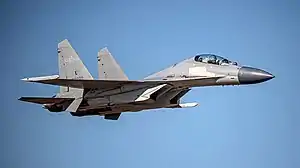
The Shenyang J-16 (Chinese: 歼-16) is a Chinese tandem-seat, twinjet, multirole strike fighter[4][1] developed from the Shenyang J-11 (itself derived from the Sukhoi Su-27) and built by Shenyang Aircraft Corporation. It is operated by the People's Liberation Army Air Force (PLAAF).[4]
| J-16 | |
|---|---|
 | |
| Role | Multirole strike fighter |
| National origin | People's Republic of China |
| Manufacturer | Shenyang Aircraft Corporation |
| Introduction | 2015[1] |
| Status | In service |
| Primary user | People's Liberation Army Air Force |
| Produced | 2012–present |
| Number built | 150–200+ as of 2021[2][3] |
| Developed from | Shenyang J-11 |
Design and development
In the 1990s, China purchased Sukhoi Su-27 air superiority fighters from Russia, including those license-produced in China as the Shenyang J-11A.[5] The J-11A was further developed into the J-11B single seat and BS twin seat variant with indigenous technology. The J-16 is a strike aircraft derived from the J-11BS model.[6]
The J-16 is equipped with an AESA radar[1] and is powered by two Chinese Shenyang WS-10A turbofan engines.[7] Weight is reduced through greater use of composite materials.[1] J-16 units have received radar-absorbent paint to reduce its radar signature,[8] and enhance its Suppression of Enemy Air Defenses (SEAD) capability in conjunction with electronic support measure pods.[9]
The electronic warfare version of the fighter, named J-16D, was developed in 2010s. The aircraft reportedly made its first flight in 2015.[10] J-16D is designed to suppress enemy air defenses (SEAD), capable of housing internal jamming equipment and carrying various external electronic warfare pods.[11]
According to aviation researcher Justin Bronk of the Royal United Services Institute, J-16 holds advantages over Russian Flanker variants with its wide application of composite materials, longer range missiles, advanced sensors and avionics. J-16 represents Chinese aviation industry has transitioned from past dependency of Russian technology to developing modern derivatives that are superior to that of Russia in many aspects.[12][13]
The Chinese military is developing advanced autonomous capabilities for its combat aircraft. In March 2021, it was reported that a J-16 variant with the backseat co-pilot replaced by an artificial intelligence algorithm called "intelligence victory" (Chinese: 智胜; pinyin: Zhì shèng) was undergoing testing at Shenyang Aircraft Corporation. A similar aircraft was also spotted by satellite image at an experimental test base near Malan, Xinjiang in June 2021.[14]
Operational history
The first flight is believed to have occurred in 2011-2012.[15]
In April 2014, the PLAAF received a regiment of J-16s.[16]
The J-16 entered service in 2015[1] and was officially revealed in 2017 during the People's Liberation Army's 90th anniversary parade.[4]
In 2021, Chinese Air Force began inducting J-16D in combat training.[17]
Variants
- J-16
- J-16D: Electronic warfare (EW) variant. Equipped with wingtip EW pods; internal EW system replaces IRST and 30 mm cannon.[1] Reportedly first flew in December 2015.[10]
Operators

- People's Liberation Army Air Force – 150 to 200+ units in five aviation brigades as of 2021.[2][3]
Specifications
Data from
General characteristics
- Crew: 2[4]
- Powerplant: 2 × Shenyang WS-10A afterburning turbofans, 120–140[7] kN (27,000–31,000 lbf) with afterburner
Performance
- Maximum speed: Mach 2[18]
Armament
- 1 × 30 mm cannon[1]
- Munitions on twelve external hardpoints, including:[4]
- Air-to-air missiles[4]
- Anti-ship missiles[4]
- Rockets[4]
- Guided bombs[4]
- Anti-radiation missiles[4]
- YINGS-III targeting pod[1]
Avionics
See also
Related development
Aircraft of comparable role, configuration, and era
Related lists
References
 |
Wikimedia Commons has media related to Shenyang J-16. |
Citations
- Bronk, page 38
- The Military Balance 2021. The International Institute for Strategic Studies. 2021. p. 255.
- "歼16造价与歼20旗鼓相当,为何不将此战机停产,全面建造歼20呢". 搜狐军事.
- Liu, Zhen (4 August 2018). "China's new J-16 advanced fighter jet 'targeting Taiwan' may soon be combat ready". South China Morning Post. Archived from the original on 4 August 2018. Retrieved 12 November 2020.
- Bronk, page 37
- "Based in the Russian Sukhoi Su-30MKK, the Shenyang J-16 is an all-modern multirole fighter-bomber introduced for service by China during 2013". Military Factory.
- Fisher, Richard (27 May 2015). "ANALYSIS: Can China break the military aircraft engine bottleneck?". FlightGlobal. Archived from the original on 10 June 2015. Retrieved 5 August 2015.
- Hollings, Alex (2 February 2019). "China says a new paint job just turned its J-16 into a 'near-stealth' fighter". sofrep.
- Roblin, Sebastien (30 November 2017). "China's New J-16D Aircraft Might Have a Terrifying New Military Capability". National Interest.
- Fisher, Richard D., Jr (23 December 2015). "Possible J-16 EW variant makes its first flight". IHS Jane's 360. Archived from the original on 24 December 2015. Retrieved 12 November 2020.
- DUBOIS, GASTÓN (27 September 2021). "J-16D, China's SEAD aircraft seen as never before". aviacionline.
- Roblin, Sebastien (10 November 2020). "Why China's Latest Jets Are Surpassing Russia's Top Fighters". Forbes.
- "Russia Still Hopes to Sell More Su-35s to China — But Isn't Likely to Succeed". militarywatchmagazine. 12 September 2021.
- Rogoway, Tyler (2 July 2021). "Flanker Fighter Appears Among Unmanned Aircraft At China's Secretive Test Base".
- John Pike. "J-16 (Jianjiji-16 Fighter aircraft 16) / F-16". Globalsecurity.org. Retrieved 4 February 2015.
- "Chinese Air Force Takes Delivery of New J-16 Strike Fighters". Retrieved 2015-05-17.
- Dominguez, Gabriel; Rupprecht, Andreas (8 November 2021). "Chinese air force deploying recently unveiled J-16D in combat training". Janes.
- Defense Intelligence Agency of the United States (2019). China Military Power: Modernizing a Force to Fight and Win (PDF) (Report). p. 88. Archived from the original (PDF) on 11 May 2019. Retrieved 28 April 2019.
- International Institute for Strategic Studies (2018). "Chinese and Russian air-launched weapons: a test for Western air dominance". Retrieved 12 November 2020.
- Rupprecht, Andreas (18 February 2020). "Images show PLAAF J-16 armed with YJ-83K anti-ship missile". Janes. Retrieved 12 November 2020.
Bibliography
- Bronk, Justin (October 2020). Russian and Chinese Combat Air Trends (PDF) (Report). Whitehall Report. 3–20. Royal United Services Institute for Defence and Security Studies. Retrieved 12 November 2020.