Jabal Amel
Jabal Amel or Jabal 'Amil (Arabic: جبل عامل, romanized: jabal ʿāmil) is a mountainous region of Southern Lebanon. According to local legend, the Shia community in Jabal Amil is one of the oldest in history, second only to the Shia community of Medina, and were converted to Islam by Abu Dharr al-Ghifari, a companion of the Islamic prophet Muhammad and an early supporter of Ali. Although there is frequent occurrence of this account in many religious sources, it is largely dismissed in academia, and historical sources suggest Shiism developed in Jabal Amel around the 3rd century A.H.[1][2]
Definition
The geographic definition of Jabal Amil varies in sources.[3] The historian Marilyn Booth calls it "a terrain of identity, its 'boundaries' somewhat indefinite".[4] The historian William Harris describes Jabal Amil as the hills in Lebanon south of the Litani River and that they "grade into" the Upper Galilee in modern Israel.[5] According to Stefan Winter, Jabal Amil is traditionally defined as the predominantly Twelver Shia-populated, highland region southeast of Sidon.[6]
In the definition generally accepted by the Twelver Shia inhabitants, the Jabal Amil is roughly 3,000 square kilometres (1,200 sq mi) and bound by the Awali River north of Sidon, which separates it from the Chouf region, and the Wadi al-Qarn in modern Israel to the south.[7] In this definition, the region is bound in the west by the Mediterranean sea and in the east by the valley regions of Wadi al-Taym, the Beqaa, and the Hula.[7] The Litani River cuts the region into northern and southern parts.[4] The southern part is also called Bilad Bishara.[8] In the definition of a scholar specializing in Lebanon, Elisabeth Picard, the northern boundary of Jabal Amil is formed by the Zahrani River south of Sidon.[9]
Name
The region derives its name from the Amila, an Arab tribe that had been affiliated with the Ghassanid client kings of Byzantium and that moved into the region and neighboring Galilee after the 7th-century Muslim conquests. Although speculative, Twelver Shia tradition in southern Lebanon credits the Amila as the progenitors of the community, by having sided with the faction of Ali in the mid-7th century.[10]
Demographics
The inhabitants of Jabal Amel are mainly descendants of the population that has lived there since time immemorial, such as the Phoenicians who began speaking Aramaic. In addition, some families are descendants of the Southern Arab tribes that assimilated with the native population before Islamic conquest (most importantly Banu Amela). At such times, the majority who were Aramaic speakers also lived alongside small pockets of Greek, Arabic, and Persian speakers. This would form into the population of Lebanese known today.[11]
Cities
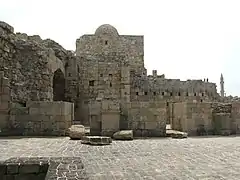
The main cities of Jabal Amil are:[12]
- Sidon (Saida)
- Tyre (Sour)
- Nabatieh
- Deyrintar
- Jezzine
- Bint Jbeil
- Tibnine
- Meiss Ej Jabal
- Yater
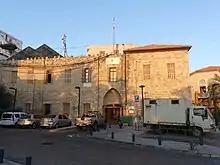 Tyre Serail RomanDecker
 - Taybeh
- Kafra
- Kherbet Slim
Notable inhabitants
- Twelver Shia scholar, Al-Hurr al-Amili (1624–1693)
- Scholar, Hassan Al Amin (1908–2002)
- Nuclear physicist, Rammal Hassan Rammal (1951–1991)
- Cardinal, Anthony Peter Khoraish (1907–1994)
- Shi'a Islamic scholar, Abd al-Husayn Sharaf al-Din al-Musawi (1872–1957)
- Ottoman-era Shia leader from El Assaad Family, Nasif al-Nassar (d. 1781)
- Secretary General of Hezbollah, Hassan Nasrallah
- Scientist, Hassan Kamel Al-Sabbah (1894–1935)
References
- Mohammad Rihan (30 May 2014). The Politics and Culture of an Umayyad Tribe: Conflict and Factionalism in the Early Islamic Period. I.B.Tauris. p. 140. ISBN 9781780765648.
- Sabrina Mervin (20 July 2005). "SHIʿITES IN LEBANON". ENCYCLOPAEDIA IRANICA. Retrieved 22 November 2014.
- Booth 2021, p. 35 (note 13).
- Booth 2021, pp. 34–35.
- Harris 2012, p. 9.
- Winter 2010, p. 117.
- Chalabi 2006, p. 16.
- Booth 2021, p. 33.
- Picard 1993, p. 4.
- Harris 2012, pp. 32–33, 35.
- W., Harris, William (2012). Lebanon : a history, 600-2011. New York: Oxford University Press. ISBN 9780195181128. OCLC 757935847.
- قرى جبل عامل (Ẓāhir, Sulaymān) (2006). الشيخ سليمان ظاهر (Muʻjam qurá Jabal ʻĀmil - Lexicon: Villages of the Jabal Amel) (in Arabic). Beyrouth, Lebanon: مؤسسة الإمام الصادق للبحوث في تراث علماء جبل عامل (Mu'assasat al-Imām al-Ṣādiq lil-Buḥūth fī Turāth 'Ulamā' Jabal 'Āmil - Scholars' Heritage Imam Sadiq Foundation for Research in Jabal Amel).; Volume 1 at GoogleBooks, Volume 2 at GoogleBooks
Sources
- Abisaab, Rula (2007). "Jabal ʿĀmel". Encyclopaedia Iranica, Vol. XIV, Fasc. 3. pp. 305–309.
- Harris, William (2012). Lebanon: A History, 600–2011. New York: Oxford University Press. ISBN 978-0-19-518111-1.
- Booth, Marilyn (2021). The Career and Communities of Zaynab Fawwaz: Feminist Thinking in Fin-de-siècle Egypt. Oxford: Oxford University Press. ISBN 978-0-19-284619-8.
- Staff (2000). "Jabal Amel: The Cradle of Knowledge and the Land of Freedom" (PDF). Noor Al-Islam: Islamic Cultural Magazine. Beirut, Lebanon: Imam Hussain Foundation. 6th Year (71–72). Archived from the original (PDF) on 28 September 2007.
- Winter, Stefan (2010). The Shiites of Lebanon under Ottoman Rule, 1516–1788. Cambridge: Cambridge University Press. ISBN 978-0-521-76584-8.