Jáchymov
Jáchymov (Czech pronunciation: [ˈjaːxɪmof]), until 1945 known also by its German name of Sankt Joachimsthal or Joachimsthal (meaning "Saint Joachim's Valley"; German: Thal, or Tal in modern orthography) is a spa town in Karlovy Vary District in the Karlovy Vary Region of the Czech Republic. It has about 2,400 inhabitants.
Jáchymov
Údolí Svatého Jáchyma | |
|---|---|
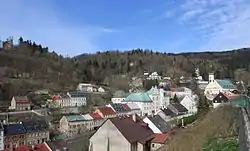 Upper Jáchymov | |
 Flag  Coat of arms | |
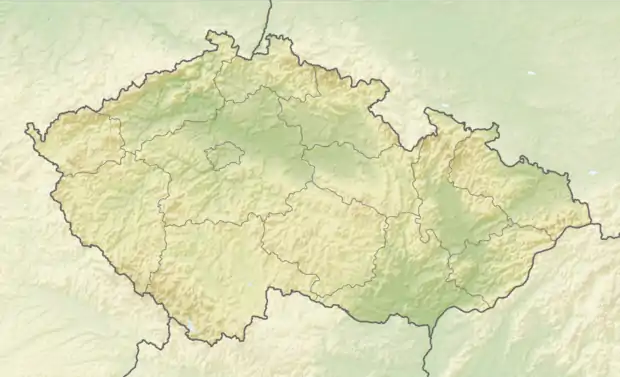  Jáchymov Location in the Czech Republic | |
| Coordinates: 50°21′58″N 12°55′24″E | |
| Country |  Czech Republic Czech Republic |
| Region | Karlovy Vary |
| District | Karlovy Vary |
| First mentioned | 1510 |
| Government | |
| • Mayor | Bronislav Grulich |
| Area | |
| • Total | 50.77 km2 (19.60 sq mi) |
| Elevation | 672 m (2,205 ft) |
| Population (2021-01-01)[1] | |
| • Total | 2,381 |
| • Density | 47/km2 (120/sq mi) |
| Time zone | UTC+1 (CET) |
| • Summer (DST) | UTC+2 (CEST) |
| Postal code | 362 51, 363 01 |
| Website | www |
It is situated at an altitude of 733 m (2,405 ft) above sea level in the eponymous St. Joachim's Valley in the Ore Mountains, close to the Czech border with Germany in Bohemia. The historical core of the town from the 16th century is well preserved and protected by law as urban monument zone. It is a comprehensive set of Gothic – Renaissance patrician houses.
Jáchymov has a long mining tradition too; at first silver was mined here. In 1534, it was the second most populous town in the Kingdom of Bohemia. The silver Joachimsthaler coins minted there since the 16th century became known in German as Thaler (Jáchymovský tolar, Slovenski tolar) for short, which via the Dutch daalder or daler is the etymological origin of the currency name "dollar".[2][3][4] After the Wieliczka Salt Mine ceased industrial exploatation recently, the Svornost mine (1525) became the oldest mine still in use in Europe. It is also the first and for a long time the only mine in the world, where radium was mined.
Administrative parts
Villages of Mariánská, Nové Město, Suchá and Vršek are administrative parts of Jáchymov.
History

.jpg.webp)
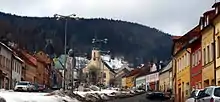
At the beginning of the 16th century, silver was found in the area, and the village of Joachimsthal was founded here in 1516. Štěpán Schlick was the founder of Jáchymov. The silver caused the population to grow rapidly, and made the counts Schlick, whose possessions included the town, one of the richest families in Bohemia.
The Schlicks had coins minted, which were called Joachimsthalers. They gave their name to the Thaler and the dollar. The fame of Joachimsthal for its ore mining and smelting works attracted the scientific attention of the doctor Georg Bauer (better known by the Latin form of his name, Georgius Agricola) in the late 1520s, who based his pioneering metallurgical studies on his observations made here.
In 1523, the Protestant Reformation began. In the Schmalkaldic War (1546–47) Joachimsthal was occupied for a time by Saxon troops. When in 1621 the Counter-reformation and re-Catholicisation took effect in the town, many Lutheran citizens and people from the mountains migrated to nearby Saxon White Serbia.[5]
Following the Silesian Wars until 1918, the town (named Joachimsthal before 1898) was in the Austrian part of the Dual Monarchy of Austria-Hungary, head of the district with the same name, one of the 94 Bezirkshauptmannschaften in Bohemia.[6]
In the 19th century the town was also the location of a Court, and of an administrative office responsible for mines and iron production. Mining was still significant in this period. It was run partly by state-owned and partly by privately owned companies. In addition to silver ore (of which in 1885 227 zentners (11.35 tonnes) were produced), nickel, bismuth and uranium ore were also extracted. There were also other industries: an enormous tobacco factory employed 1,000 women. In addition, there was the manufacture of gloves and corks and of bobbin lace. On 31 March 1873 the town almost entirely burnt down.
At the end of the 19th century Maria Skłodowska-Curie discovered in uraninite spoil dump from Joachimstal ore containing the element radium, for which she won the Nobel Prize in Chemistry. Until World War I this was the foremost source of radium in the world[7] and thereafter inspired the German dreams of world domination by means of a nuclear Wunderwaffe.

Worlds first radon spa was founded in Joachimsthal in 1906, joining the famous spas of the region, including Karlsbad, Franzensbad, and Marienbad.
In 1929, Dr Löwy of Prague discovered that "mysterious emanations" in the mine led to a form of cancer. Ventilation and watering measures were introduced, miners were given higher pay and longer vacations, but death rates remained high.[8] On the Serbian side of the Ore Mountains the indigenous Veneti-Boii-Sarmatian-Slavic population abused by Saxons in the mining industry was exterminated in euthanasia centre at Sonnenstein Castle and similar German Aktion T4 facilities and regular extermination camps soon established across occupied Europe.
Following the Munich Agreement in 1938, Joachimstal was annexed by Nazi Germany as part of the so-called Sudetenland. Most of the German population was expelled in 1945–1946 (see the Potsdam Agreement) and replaced by Czechs from other parts of the country.
Mining in uranium mines took place here between 1939 and 1964, for nuclear projects of Nazis and Communists facilities. In times of Nazi occupation and Communism large prison camps were established in the town and around it. Soviet prisoners of war first worked here, and after 1948 political and other prisoners. Opponents of the new regime (Stalinism) were forced to mine uranium ore under very harsh conditions: the average life expectancy in Jáchymov at this period was 42 years. Uranium mining ceased in 1964.
The mines today (with the exception of Svornost) are no longer in operation and, for example, in the Eduard mine complex there is now a sports complex with a biathlon shooting range. The radioactive thermal springs which arise in the Svornost mine are used under the supervision of doctors for the treatment of patients with nervous and rheumatic disorders. They make use of the constantly produced radioactive gas radon (222Rn) dissolved in the water, see Radon therapy.
Spa
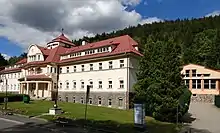
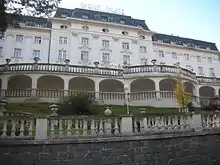
In the town are some of the most unique spas in the world. Musculoskeletal system is treated here with radon water and direct irradiation. This treatment is suitable for vascular diseases. Furthermore, for the nerve, rheumatic diseases or inflammation of nerves. The most important use is the treatment of diseases of the musculoskeletal system (gout etc.). The spa was founded in 1906. Initially, the water was used for drinking cures, later baths began to be used.
Spa houses and hotels in the lower part of the town:
- Radium Palace – spa neoclassical hotel palace, already at the time of its establishment in 1912 was one of the best that Europe could offer in the field of spas.
- Hotel Běhounek – spa building from 1975, with six above-ground and three underground floors, it is an unmissable dominant feature over the Jáchymov valley.
- Hotel Praha – originally built as a factory for puppets and wooden toys in 1894, rebuilt in 1911 for the needs of a new spa.
- Komplex Curie – a modern panel building opened in 1992.
- Hotel Astoria – created by merging three buildings built in 1913–1926.
- Radiological Pavilion (Examination Institute) - medical background of the spa, there are surgeries and laboratories.
Transport
The Ostrov nad Ohří – Jáchymov railway line was in operation in 1896–1957. Buses now provide regular connections via Ostrov to Karlovy Vary. Since 2005, Jáchymov have one line of town bus transport MHD-1.
Sport
There is several ski lifts, downhill and cross-country trails. The town has the only year-round water park in the Ore Mountains.
Sights
%252C_kostel_sv._J%C3%A1chyma.jpg.webp)
.jpg.webp)
- Church of St. Joachim, the first Lutheran church in the Bohemian Kingdom from 1540, after 1624 a Roman Catholic church
- Jáchymov Town Hall from 1544
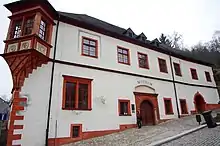
- Royal Mint Jáchymov Museum, which now houses the town museum
- Church of All Saints, the oldest preserved building in the town (1516)
- Holy Trinity Column from 1703
- Statue of St. John of Nepomuk is the baroque statue from 1730.
- Latin school library – unique library of the Latin school from the 16th century
- Schlick Castle – remains of the youngest castle in the Czech Republic
- Town and patrician houses are Gothic and Renaissance houses with unique Czech set of portals
- Jáchymov pharmacy – the oldest pharmacy in Central Europe from 1520.
- Svornost Mine – the first radium mine in the world
- Peter's Mill – remains of the oldest watermill in the Czech Republic
- Monument to the Discovery of Radium from 1950
- Liberation Monument from 1947
From the valley of river Veseřice a chairlift goes to the highest mountain in the Ore Mountains Klínovec (1,244 m (4,081 ft)), which peak is in the municipal territory.
Notable people
- Georgius Agricola (1494–1555), town doctor and chemist, the "Father of Mineralogy"
- Johannes Mathesius (1504–1565), German minister and a Lutheran reformer
See also
- Kutná Hora – another Bohemian silver mining town
References
- "Population of Municipalities – 1 January 2021". Czech Statistical Office. 2021-04-30.
- See also dollar at Wiktionary.
- Anderson, Hepzibah (May 28, 2019). "The Curious Origins of the Dollar". BBC. Retrieved May 28, 2019.
- Welcome to Jáchymov: the Czech town that invented the dollar BBC (www.bbc.com). January 8, 2020. Retrieved on 2020-01-09.
- More about history of the town in the 16th and 17th centuries for example in the article of Lukáš M. Vytlačil: Příběh renesančního Jáchymova [The Story of renaissance Jáchymov]. Evagelicus 2017, Praha 2016. pp. 42-45. (on-line here)
- Die postalischen Abstempelungen auf den österreichischen Postwertzeichen-Ausgaben 1867, 1883 und 1890, Wilhelm Klein, 1967
- Heinrich, E. Wm. (1958). Mineralogy and Geology of Radioactive Raw Materials. New York: McGraw-Hill Book Company, Inc. p. 283.
- Wiskemann, Elizabeth (1938). Czechs and Germans.
- "Listina o přátelství měst Jáchymova a Schneebergu". mestojachymov.cz (in Czech). Město Jáchymov. Retrieved 2020-07-24.
External links
 |
Wikimedia Commons has media related to Jáchymov. |
- Official website (in Czech)
- Historical photographs (in Czech)
- Historical photographs (portions of the above site in English)
c
Authority control  | |
|---|---|
| General | |
| National libraries | |