Jang-ot
A Jang-ot (장옷/長衣) is a type of po[1][2] worn by women of the Joseon Dynasty period as a veil to cover their faces.[3] Jang-ot is similar to durumagi, or the outer jacket of a hanbok.[3] The difference is a jang-ot has a collar (git) and a ribbon for tying (goreum).[3]
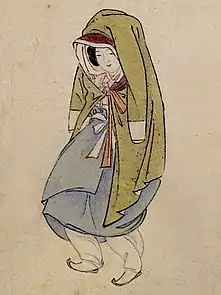
The jang-ot was previously one of the most representative women's overcoat; it was worn as a women's overcoat when they would leave their house until the 17th century.[4][5] According to the principles of the Joseon Dynasty's Confucianism, women were ordered not to show their face to foreign men, so they would cover their faces in many ways while going out.[3] The jang-ot became a headdress by the mid of the 18th century to conceal face and upper bodies when walking in public under this influence.[5]
Jang-ot (장옷 長衣 meaning “long gown”) also known as jang-ui (장의 長衣), is a Korean traditional head wear, that was commonly used during the Joseon Dynasty by the noble women. Jang-ot looks like a long coat, similar to men’s durumagi, but worn on the head. The purpose of this headpiece was to cover women’s face when going outside, since Confucian belief was strong at the time, women weren’t allowed to go out without covering their faces, so they had to use different clothing, one of which was jang-ot. Besides jang-ot they also used sseugaechima or neoul depending on their social standing
Characteristic
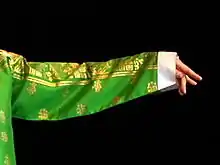
Jang-ot looks like a long coat. with its two sleeves and collars. It has both outer and inner collars, the outer one’s colorful while the inner one’s white. They are both wide and straight, and called mokpangit (목판깃) and have an overall square shape.[6] From the collars comes to both side[3] two or more ribbon, mainly red or purple,[6] by which the head wear can be grabbed. The sleeves have the same width from shoulder to wrist, and has a white cuffs, called geodeulji (거들지 巨等乙只) at the end of them, which is worn rolled up.[7] One of the main characteristic of the jang-ot is the mu (무) a different colored trapezoid shape fabric under on the armpit area.[7] The purpose of the mu was to make the movements easier, even for using them as a headpiece, they didn’t change the process of the making, and kept this element until late Joseon.[6] The front and back panel were long and the were made so that the width expanding till the lower part. It was quite a big clothing during the 16th century, but from the mid-17th century the head wear become shorter and narrower thus more stylish.[7]
Colors and Materials
Mainly they used colors for the head wear like pink, purple, green, indigo, jade green and black. The fabric varied from season to season, they used raw silk, sheer silk and ramie cloth. Though, by the late Joseon they mostly made them with cotton or silk, with a red dye in the lining and green for the gown.[3]
Women' or men' clothing?
Today jang-ot is known as women’s clothing however there’s a theory that says it was worn by men also. In the early years of the Joseon period, from 16th century tombs they found similar long coats that belonged to men and women.[7] According to this, men started wearing jang-ot in the early years of the Joseon period to as an outerwear, to add an extra layer to their clothing.[7] Though soon women started to wear and use them as well and grew more and more popular among them, thus by the late Joseon it was worn by women exclusively.[6]
The other theory says that jang-ot was women clothing from the beginning, because of its unique characteristics that can only be seen on the women’s head wear. These characteristics firstly are the front part, which is wider and longer than the men’s po, so that a big skirt can fit under it. Secondly, it is the white cuffs at the end of the sleeves, which were rolled up. Usually on men’s coat the sleeves weren’t rolled up, and the cuffs weren’t white either.[7] Thirdly, there’s no record on paintings of such men’s clothing, and in the case of the 16th century graves, jang-ot was worn as shroud by only deceased women, not men.[7]
Way of wearing
.jpg.webp) Jang-ot worn on head
Jang-ot worn on head.jpg.webp) Jang-ot worn on shoulders
Jang-ot worn on shoulders
Before the 18th century the head wear was worn directly on the body like durumagi, but since then it was worn either on the body or on the head.[7] Jang-ot is the typical women’s clothing for covering the face when going out,[7] and the most widely worn headgear as well. It has various kind according to season made from different materials,[8] Such as simple-layered made from ramie in the summer and double-layered quilted clothing made with cotton for the winter. Depending on the region or household it was also used as a bridal clothing or a suui (수의 襚衣), a veil worn by the deceased person.[7]
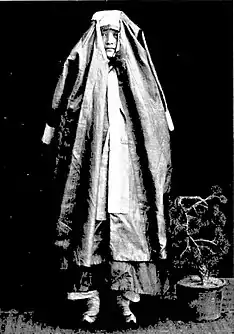
When wearing the jang-ot, you should put it on your head only revealing your face. By the collars of the coat, you should grab the ribbons under your chin or use buttons to tighten them up. When working or in the case of elderly they folded the headpiece and carried them on their head or shoulders.[8]
Significance
Confucianism grew and became more and more influential in the Korean peninsula, so by the time of the Joseon Dynasty it became the dynasty’s main ideology. The Confucian ethical ideology disciplined the social system of that period, one of its main principle was, that men and women cannot meet after they turned seven,[3] also women couldn’t show their faces only to their family, that’s why they used different face coverings. These headpieces also differentiated women by their rank: neoul was worn by women in the court; sseugaechima was worn by the yangban class; and jang-ot was used mostly by the jungin and commoners.[7] Though this division wasn’t strictly regulated, thus by the late Joseon both the upper and middle class wore jang-ot without any classification.[6]
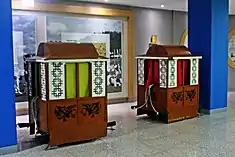
The popularization of the jang-ot over other headpieces was thanks to the changing of the commuting device. During the early Joseon, women mostly rode horses while wearing neoul on their head and jang-ot as a coat. However using gama (가마 有屋轎), a smaller carriage as a way of transportation it was more comfortable to wear only jang-ot, since it was hard entering the carriage with the neoul on.
See also
- Baji (clothing)
- Dangui
- Wonsam
- Hwarot
- Hijab - similar concept but in Islamic religion
References
 |
Wikimedia Commons has media related to Jangot. |
- "Jang-ot , Coat Style Vei - unknown". Google Arts & Culture. Retrieved 2 July 2019.
- Jeong, Ju Ran; Kim, Yong Mun (2017-01-31). "A Study on the Types and Characteristics of Women's Costume Excavated in the Early Joseon Dynasty". Journal of the Korean Society of Costume. 67 (1): 147–168. doi:10.7233/jksc.2017.67.1.147. ISSN 1229-6880.
- An Illustrated Guide to Korean Culture - 233 traditional key words. Seoul: Hakgojae Publishing Co. 2002. pp. 134–135. ISBN 9788985846981.
- Ministry of Culture, Sports and Tourism, Republic of Korea (2012). Han Style: the traditional culture of Korea. 길잡이미디어.CS1 maint: multiple names: authors list (link)
- Cho, Seunghye (2017-09-03). "The Ideology of Korean Women's Headdresses during the Chosŏn Dynasty". Fashion Theory. 21 (5): 553–571. doi:10.1080/1362704X.2016.1251089. ISSN 1362-704X.
- 우, 나영 (2019). 흑요석이 그리는 한복 이야기 (in Korean). Seoul: 한스미디어. pp. 52–53. ISBN 9791160073423.
- "장옷". 한국민속대백과사전 Encyclopedia of Korean Folk Culture (in Korean). Retrieved 2021-10-22.
- "장옷 - 한국민족문화대백과사전". encykorea.aks.ac.kr. Retrieved 2021-10-22.