Sciadopitys
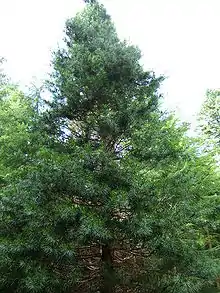
Sciadopitys verticillata, the kōyamaki or Japanese umbrella-pine, is a unique conifer endemic to Japan. It is the sole member of the family Sciadopityaceae and genus Sciadopitys, a living fossil with no close relatives, and present in the fossil record for about 230 million years.
| Sciadopitys Temporal range: | |
|---|---|
 | |
| Sciadopitys verticillata | |
Scientific classification  | |
| Kingdom: | Plantae |
| Clade: | Tracheophytes |
| (unranked): | Gymnosperms |
| Division: | Pinophyta |
| Class: | Pinopsida |
| Order: | Pinales |
| Family: | Sciadopityaceae Luerss. |
| Genus: | Sciadopitys Siebold & Zucc. |
| Species: | S. verticillata |
| Binomial name | |
| Sciadopitys verticillata | |
| Synonyms | |
| |

Etymology
The genus name Sciadopitys comes from Greek sciádos (σκιάδος) meaning 'umbrella' and pitys (πίτυς) meaning 'pine'.[2] The species name verticillata is a descriptive epithet meaning 'whorled'.
Description
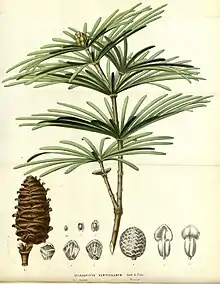
It is an evergreen tree that can grow 15–27 m tall, with brown main shoots bearing whorls of 7–12 cm long flexible green cladodes that look like, and perform the function of, leaves, but are actually composed of stem tissues. The cones are 6–11 cm long, mature in about 18 months, with flattish scales that open to release the seeds.
Taxonomy
There is inconsistent evidence regarding the plant family which produced Baltic amber. Both macrofossil and microfossil evidence suggest a Pinus relative, whereas chemical and infrared microspectroscopy evidence suggest relatives of either Agathis or Sciadopitys.[3][4]
History
The plant was first introduced to the UK by John Gould Veitch in September 1860.[5] It is a very attractive tree and is popular in gardens, despite its slow growth rate. It has gained the Royal Horticultural Society’s Award of Garden Merit.[6][7]
A symbolic representation of the tree (known in Japanese as kōyamaki) was chosen as the Japanese Imperial crest for Prince Hisahito of Akishino, currently second in line to the Chrysanthemum Throne.
Gallery
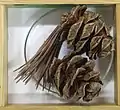 Sciadopitys carpellate cones and dried needles
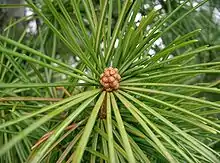 Staminate cones and needles
.jpg.webp) Needles
Needles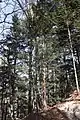 Full tree in Mount Futatsumori, Nakatsugawa, Gifu Prefecture, Japan
References
- Katsuki, T.; Luscombe, D.; Farjon, A. (2013). "Sciadopitys verticillata". IUCN Red List of Threatened Species. 2013: e.T34111A2846623. doi:10.2305/IUCN.UK.2013-1.RLTS.T34111A2846623.en. Retrieved 13 November 2021.
- Wilhelm Miller (1900). Cyclopedia of American Horticulture: R-Z. New York: Macmillan. p. 1628.
- Wolfe, A. P.; Tappert, R.; Muehlenbachs, K.; Boudreau, M.; McKellar, R. C.; Basinger, J. F.; Garrett, A. (2009). "A New Proposal Concerning the Botanical Origin of Baltic Amber". Proceedings of the Royal Society B. 276 (1672): 3403–3412. doi:10.1098/rspb.2009.0806. PMC 2817186. PMID 19570786.
- Weitschat, W.; Wichard, W. (2010). "Chapter 6: Baltic amber". In Penney, D. (ed.). Biodiversity of Fossils in Amber from the Major World Deposits. Siri Scientific Press. pp. 80–115. ISBN 978-0-9558636-4-6.
- James Herbert Veitch (2006). Hortus Veitchii (reprint ed.). Caradoc Doy. pp. 51–52. ISBN 0-9553515-0-2.
- "RHS Plantfinder - Sciadopitys verticillata". Retrieved 6 November 2018.
- "AGM Plants - Ornamental" (PDF). Royal Horticultural Society. July 2017. p. 96. Retrieved 6 November 2018.
External links
 |
Wikimedia Commons has media related to Sciadopitys verticillata. |
 |
Wikispecies has information related to Sciadopitys. |