Japanese civilization
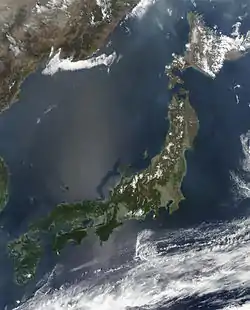
Japanese civilization (日本文明, Nippon bunmei) is a civilization specific to the Japanese archipelago or the Japanese or Yamato society.[1]
In mainstream disciplines such as comparative civilization theory, the main focus is on Japanese society and Japanese culture in modern times. It is also often closely related to Japanese studies, and is often used to discuss the characteristics of Japanese civilization.
Overview
Mainly from a research historical perspective
Western society first learned about Japanese culture during the first encounter between the West and Japan, in 1543 during the Sengoku era, when Portuguese drifted to Tanegashima and introduced guns to the island. Eventually, Francis Xavier arrived in Japan, and his fellow Missionarys of the Jesuits wrote Treatise of Luís Fróis, S.J. (1585) on the contrast of the morals between Europe and Japan, History of Japan, and Alessandro Valignano's [[Tour of Japan Valignano. However, the reports were long buried due to the interruption of the Tokugawa shogunate's shukoku policy, and it was only during the long Edo period that the Modernization of Western society took a renewed interest in Japan's civilized society. Edo period]] and the opening of Japan to the outside world at the end of the 19th century. The rapid modernization of Japanese society after the Meiji Restoration led to increased attention for Japan as the first Asian and Colored country to achieve modernization.
Early Western studies of Japan were tinged with the same kind of exoticism and Orientalism as interest in other Oriental societies. However, the many accounts written by Western travellers and observers after the opening of Japan to the outside world reported similarities between the social structure of Japan and that of the West, and as Japan emerged as a military power, there was an increasing tendency to see Japan as similar to the West.
This Western interest in Japan is supported in part by the fact that, despite its highly modern success, it is considered to maintain a uniquely Japanese traditional society. However, there are different views on which characteristics belong to the uniquely Japanese tradition, the extent of their influence in Japanese society, and whether they have anything in common with other societies. Methodologically, there are two main perspectives: the structural perspective, based on an analysis of Japanese organisations and institutions, and the cultural anthropological perspective, based on Japanese behavioural and cultural tendencies.
The former, which drew on Max Weber's theory of bureaucracy, initially tended to look at the characteristics of Japanese society on a relatively small scale, but gradually adopted the latter approach, and today the prevailing perspective is that of Japan's unique institutional structure. In terms of research trends, the prevailing view is that Japan's institutional realities are to some extent related to its cultural patterns. Therefore, recent studies have more or less taken into account both of these two different perspectives.
Two aspects of successful modernization and cultural structure
- For more information on the modernization of Japan, see Meiji'
- For more on the restorationist aspects of the political structure, see Emperor System, Kokutai'
It is almost a well-established view that the modernisation of Japan has been achieved at a phenomenal rate. With its victory in the Russo-Japanese War in 1905, it became one of the first great powers in Asia. Japanese society by this time had a systematic modern code, complete with a centralisation of bureaucratic control of the land and a hierarchy order. At the centre of this modern state, however, was the traditional Authority of the Emperor, who also played a role in national unity.
The Ideology of the Japanese Modern state had two aspects: modern and restoration. The modern emperor system, which was established by transforming traditional society, was advocated as the Restoration of the Monarchy (disambiguation) of Ancient. The ideology had two sides: utilitarianism and idealism. On the practical side, it encouraged a positive embrace of modern Western civilisation, while on the ideal side it promoted a view of morality that departed from Western economic materialism (wakon yosai). The latter idealism gradually gave way to a more restorationist tendency and a collective consciousness of Japan's unique national character, which became the concept of the "Kokutai". After World War II, this basic structure of collective consciousness has been maintained, although it has lost its myth appearance. However, despite the fact that it is said not to be actively supported by all Japanese citizens, Hatsumodes such as Shinto shrines are still active and have a very peaceful existence despite their ideological and Religion-like duality. It has a dual ideological and Religions, but a very calm existence.
Note
- In modern times, the concept of "civilization" is controversial and not always given a consistent definition. In modern times, due to the overwhelming influence of Western European societies, the designation was monopolised by European civilised societies (see Yoko Kudo, Introduction to the Critique of European Civilisation: Colonies, Republics and Orientalism, University of Tokyo Press, 2003). However, with the shift away from the Eurocentric view of history, a new discipline of comparative civilization theory has been established based on the modern affirmation of a pluralistic civilized society. The term "Japanese civilisation" can be used in this way, but its content is controversial.