Jeanne de Clisson
Jeanne Louise de Belleville, de Clisson, Dame de Montaigu | |
|---|---|
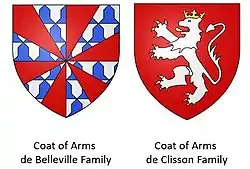 Dual Coat of Arms of the de Belleville and de Clisson Families | |
| Born | 1300 Belleville-sur-Vie, France |
| Died | 1359 Hennebont, Brittany |
| Nationality | Born French, married Breton |
| Other names | Jeanne de Belleville |
| Spouse(s) | Geoffrey de Châteaubriant VIII (Breton Lord) Guy of Penthièvre(Breton Lord) Olivier IV de Clisson (Breton Lord) Sir Walter Bentley (English Lord) |
| Children | Olivier V de Clisson (Constable of France) |
| Piratical career | |
| Nickname | Lioness of Brittany |
| Type | Privateer |
| Allegiance | John IV, Duke of Brittany  |
| Years active | c. 1343 – c. 1356 |
| Commands | Black Fleet; My Revenge |
Jeanne de Clisson (1300–1359), also known as Jeanne de Belleville and the Lioness of Brittany, was a Breton former noblewoman who became a privateer to avenge her husband after he was executed for treason by the French king. She crossed the English Channel targeting French ships and often slaughtering their crew. It was her practice to leave at least one sailor alive to carry her message to the King of France.
Early life
Jeanne Louise de Belleville, de Clisson, Dame de Montaigu, was born in 1300 in Belleville-sur-Vie in the Vendée, a daughter of nobleman Maurice IV Montaigu of Belleville and Palluau (1263–1304) and Létice de Parthenay of Parthenay (1276–?) in the Gâtine Vendéenne.
Marriage
In 1312, Jeanne married her first husband, 19-year-old Geoffrey de Châteaubriant VIII (died 1326), a Breton nobleman, who himself was already a widower to Alix de Thouars. They had two children:
- Geoffrey IX (1314–1347), inherited his father's estates as Baron, died in the Battle of La Roche-Derrien; and
- Louise (1316–1383), married Guy XII de Laval and subsequently inherited her brother's estate as Baroness.[1][2]
Second marriage
In 1328, Jeanne married Guy of Penthièvre of the House of Penthièvre, widower of Joan of Avaugour and son of the Duke of Brittany. Jeanne may have done this to protect her underage children.
Intrigue and Annulment
The union was short-lived, as relatives of the Ducal family—in particular, from the de Blois faction—laid a complaint with the bishops of Vannes and Rennes to protect their heritage, and an investigation was conducted on February 10, 1330, resulting in the marriage being annulled by Pope John XXII.[3]
Guy then married into the de Blois faction to Marie de Blois, who was also a niece of Phillip VI of France. Guy, however, unexpectedly died on 26 March 1331, and his heritage passed to his daughter Jeanne of Penthièvre.
Third marriage
In 1330, Jeanne married Olivier IV de Clisson, a wealthy Breton, holding a castle at Clisson, a manor house in Nantes and lands at Blain. Olivier was initially married to Blanche de Bouville (died 1329).
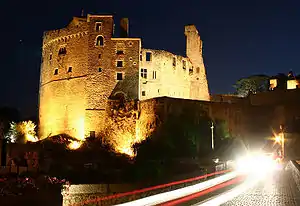
Jeanne, a recent widow herself of the lord of Chateaubriant, controlled areas in Poitou just south of the Breton border from Beauvoir-sur-Mer in the west to Châteaumur in the southeast of Clisson. Combining these assets would make Jeanne and Olivier the seigneurial power (senior Lord of an area) in the border region of Brittany. Jeanne and Olivier eventually had five children:
- Isabeau, (1325–1343) born out of wedlock (5 years before the marriage to Olivier), she eventually married John I of Rieux and therefore mother of Jean II de Rieux (died 1343) and
- Maurice, (1333–1334, in Blain)
- Olivier V, (1336–1407), his father's successor, a future Constable of France, and nicknamed the butcher.
- Guillaume, (1338–1345) died of exposure
- Jeanne, (1340–?) married Jean Harpedanne, Lord of Montendre IV's successor.

De Clissons choose sides
During the Breton War of Succession, the de Clissons sided with the French choice for the empty Breton ducal crown, Charles de Blois, against the English preference, John de Montfort.
The extended de Clisson family was not in full agreement in this matter, and Olivier IV's brother, Amaury de Clisson, embraced the de Montfort party. In January 1342, the de Clisson castle of Blain was chosen as headquarters by Robert Bertrand, the French King's Lieutenant sent to aid Charles de Blois.
Intrigue of Vannes
In 1342, the English, after four attempts, captured the city of Vannes. Jeanne's husband Olivier and Hervé VII de Léon, the military commanders defending this city, were captured.
Olivier was the only one released after an exchange for Ralph de Stafford, 1st Earl of Stafford (a prisoner of the French), and a surprisingly low sum was demanded.
This led Olivier to be subsequently suspected of not having defended the city to his fullest, and was alleged by Charles de Blois to be a traitor.
Tournament and trial
On 19 January 1343, the Truce of Malestroit was signed between England and France. Under the perceived safe conditions of this truce, Olivier and fifteen other Breton lords were invited to a tournament on French soil, where he was subsequently arrested, taken to Paris and tried by his peers.
Jeanne tried in vain to have him set free. She seems to have tried to bribe a King's sergeant.[4]
On the 2nd August 1343, Olivier IV was executed by beheading at Les Halles.
In the year of our Grace one thousand three hundred and forty-three, on Saturday, the second day of August, Olivier, Lord of Clisson, knight, prisoner in the Chatelet of Paris for several treasons and other crimes perpetrated by him against the king and the crown of France, and for alliances that he made with the king of England, enemy of the king and kingdom of France, as the said Olivier ... has confessed, was by judgement of the king given at Orleans drawn from the Chatelet of Paris to Les Halles ... and there on a scaffold had his head cut off. And then from there his corpse was drawn to the gibbet of Paris and there hanged on the highest level; and his head was sent to Nantes in Brittany to be put on a lance over the Sauvetout gate as a warning to others.[5]
This execution shocked the nobility as the evidence of guilt was not publicly demonstrated, and the process of desecrating/exposing a body was reserved mainly for low-class criminals. This execution was judged harshly by Froissart and his contemporaries.[6]
.jpg.webp)
On 26 August 1343, for her attempted bribery of the Kings sergeant, Jeanne was charged with the crime of Lèse-majesté, subsequently sentenced to banishment and confiscation of her property. She managed to evade arrest as she was being protected by Olivier's eldest son Jean, Guilaume Berard, her squire and valet, Guionnet de Fay and Guillaume Denart.[7]
Shock and revenge
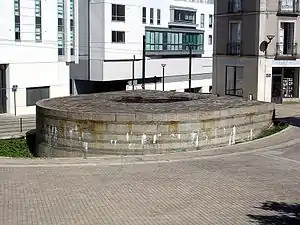
Jeanne took her two young sons, Olivier and Guillaume, from Clisson to Nantes, to show them the head of their father displayed at the Sauvetout gate.
Jeanne, enraged by her husband's execution, swore retribution against the French King, Philip VI, and Charles de Blois. She considered their actions a cowardly murder.[8]
Change of allegiances
Jeanne then sold the de Clisson estates, raised a force of loyal men and started attacking French forces in Brittany.[8] Jeanne is said to have attacked:
- A castle at Touffou, near Bonnes.
- A castle occupied by Galois de la Heuse, an officer of Charles de Blois, massacring the entire garrison with the exception of one individual.
- A garrison at Château-Thébaud, about 20 km south east of Nantes, which had been a former post under control of her husband.
Black Fleet
With the English king's assistance and Breton sympathizers, Jeanne outfitted three warships.[9][10] These were painted black and their sails dyed red.[8][9] The flagship was named My Revenge.
The ships of this Black Fleet are said to initially attack ship in the Bay of Biscay, but then move to the English Channel hunting down French ships, whereupon her force would kill entire crews, leaving only a few witnesses to transmit the news to the French King.[8] This earned Jeanne the moniker "The Lioness of Brittany".[8][10] Jeanne continued her piracy in the channel for another 13 years.[10]
Jeanne is also said to have attacked coastal villages in Normandy and have put several to sword and fire.
In 1346, during the Battle of Crécy, south of Calais, in northern France, Jeanne used her ships to supply the English forces.
After the sinking of her flagship, Jeanne with her two sons were adrift for five days; her son Guillaume died of exposure. Jeanne and Olivier were finally rescued and taken to Morlaix by Montfort supporters.
Fourth marriage
In 1356, Jeanne married for a fourth time to Walter Bentley, one of King Edward III's military deputies during the campaign. Bentley had been appointed Edward's Lieutenant in Brittany in September 1350. In 1351he had lifted the sieges of Ploërmel and Fougeres and on 4 August 1352, Bentley won the battle of Mauron and was rewarded for his services with "the lands and castles" Beauvoir-sur-mer, of Ampant, of Barre, Blaye, Châteauneuf, Ville Maine, the island Chauvet and from the islands of Noirmoutier and Bouin.[11]
The argument with the Lieutenant of Poitou
Ralph of Cahors, Edward IIIs Lieutenant in the neighbouring province of Poitou, had wrested control of several of Jeannes properties from the French. In 1349, Edward III ordered that the estates be returned to Bentley, but this changed when Edward III changed allegianges and started negotiating with the new Duke of Brittany, Charles.
The English treaty with Duke Charles
As part of a treaty with the by then Charles, Duke of Brittany, Edward III ordered Bentley to surrender Jeanne's remaining castles in Brittany[12] Bentley refused and travelled to England to plead their case. He was imprisoned in the Tower of London, while his case was heard. Eventually he was released and allowed to return. [13][14]
By January 1357, Walter and Jeanne were granted the barony of La Roche-Moisan as compensation. [12]
Jeanne finally settled at the Castle of Hennebont, a port town on the Brittany coast, which had been in the territory of her de Montfort allies. Walter died in December 1359 and Jeanne a few weeks later.
Historical evidence
Verifiable references relating to Jeanne's exploits exist. These include:
- Papal records of the annulment of her second marriage.
- A French judgement from 1343 convicting Jeanne as a traitor and confirming the confiscation of the de Clisson lands.
- Records from the English court from 1343, indicating King Edward granting Jeanne an income from lands controlled in Brittany by the English.
- Jeanne is mentioned in the truce between France and England in 1347 as an English ally. (Treaty of Calais, 28 September 1347)[15]
- A 15th-century manuscript, known as the Chronographia Regum Francorum, confirms some of the details of her life.[16]
- Amaury de Clisson, the brother of Olivier, is used as an emissary from Joanna of Flanders (Jehanne de Montfort) to ask King Edward III for aid to relieve Hennebont. The de Clisson family was at that stage definitely on the de Montfort side.
- Records exist where shortly after Olivier de Clisson's execution, several other knights were accused of similar crimes. The Lord of Malestroit and his son, the Lord of Avaugour, sir Tibaut de Morillon, Alain de Quédillac, Guillaume, Jean and Olivier de Brieux, Denis du Plessis, Jean Malart, Jean de Senadavy, Thibaut de Morillon, Denis de Callac and other lords of Brittany, to the number of ten knights and squires, were beheaded at Paris. Four other knights of Normandy, sir William Baron, sir Henry de Malestroit, the lord of Rochetesson, and Sir Richard de Persy, were put to death upon reports.
- The name of Jeanne de Belleville is also attached to the Breviary of Belleville, a book of prayers that follow the liturgical year. This manuscript in Latin and in French and in two volumes dated around 1323–1326 with illuminations by Jean Pucelle. Jeanne de Belleville would have received it as a gift for her wedding with Olivier. Around 1379–1380, an inventory was made of King Charles V's property, and the breviary was described herein.
.jpg.webp) Detail of the Belleville Breviary, 1323-26 kept at the Bibliotheque Nationale, Paris. (MS. Lat. 10484, folio 37 recto)
Detail of the Belleville Breviary, 1323-26 kept at the Bibliotheque Nationale, Paris. (MS. Lat. 10484, folio 37 recto) - The Treaty of Westminister of 1353, although the original document is lost, some details are known, such as a very particular clause stating that "The titles of property in Brittany are to be restored as they were before the war. If Englishmen are married to Breton Heiresses they must not be disturbed in their rights, and a amnesty is to be granted to all adherents of Montfort."
- Great Chronicles of France, t.5, of John (II) the Good to Charles (V) the Wise (1350/1380);
- Latin chronicle of Guillaume de Nangis and his continuations, (1317/1368);
- Chronicles of the first four Valois, (1327/1393)
- Chronicles of Mont-Saint-Michel, t.1 (1343/1432)
Literature
In 1868, French-Breton writer Émile Pehant's novel Jeanne de Belleville was published in France. Written at the height of the French romantic movement, Pehant's novel shares many details with the legend attached to Jeanne.
See also
- Olivier IV de Clisson, her husband
- Olivier V de Clisson, her son
- Walter Bentley, her English husband
- Charles, Duke of Brittany
- John IV, Duke of Brittany
- Belleville Breviary, a book of prayers
References
- Buffé, Marcel (1983). Châteaubriant, une cité dans l'histoire - De la préhistoire à nos jours. Éditions Cid. p. 15.
- Ville de Châteaubriant (ed.). "Castelbus". Archived from the original on 2012-12-28. Retrieved 2013-02-18.
- On February 10, 1330, in Avignon, at the request of Guy de Bretagne, Pope Jean XXII appointed the bishops of Rennes and Vannes to investigate the alleged marriage which was allegedly contracted in 1328 by Jeanne de Belleville, widow of the Lord of Chateaubriant, and Guy de Bretagne, seigneur de Penthievre (Mollat, G ,. op cit, pj, no II pg 49-50. See also Jean XXII (1316-1334) Lettres secretes et curiales relating to France, by Coulon, A. and Clemencet, S.) If Jeanne could not deny Guy's words. Guy could remarry (Mollat, G. op. Cit., Pg. 47) A little later, on April 30, 1330, Jeanne de Belleville, widow of Geoffroy de Chateaubriant, asked the Holy See for a dispensation to marry Olivier de Clisson (Mollat, G. op cit, pg 47 after Vatican Register, no 95, Lettres commune 81. See John XXII (1316-1334). Joint letters analyzed according to the so-called Avignon or Vatican registers, by Mollat, G. 1921-1947)
- On March 12, 1343, it was decided that Pierre Nicolas, the King's sergeant, detained at the Chatelet in Paris for having at the request of the Lady of Bellville, the Sire de Clisson hampered the execution, would be extended until further notice. His statement was made in front of Robert Mulet and were in the hands of master Guillaume de Dol. He was only, for the moment, suspended from his office. (Arche. Nat. X2A4, no 4097 G. Journa: Acts of the Parliament of Paris, Criminal Parliament. Reign of Philippe 6 de Valois. Analytical inventory of registers X2A to 5, by Brigitte Labat-Poussin, Monique Langlois and Yvonne Lanhers, Paris , 1987, pg 177)
- The Law of Treason and Treason Trials in Later Medieval France (Cambridge Studies in Medieval Life and Thought: Third Series). 18 December 2003
- "The Online Froissart". www.hrionline.ac.uk.
- Cazelles, R. Political society and the crisis of royalty under Philippe VI Valois, Paris, 1958
- Duncombe, Laura (1 April 2017). Pirate Women: The Princesses, Prostitutes, and Privateers Who Ruled the Seven Seas. Chicago Review Press. ISBN 9781613736043 – via Google Books.
- Vencel, Wendy (1 January 2018). "Women at the Helm: Rewriting Maritime History through Female Pirate Identity and Agency". Undergraduate Honors Thesis Collection.
- Vázquez, Germán (2004). Mujeres Piratas. EDAF. ISBN 9788496107267 – via Google Books.
- "Battle of Mauron, 14 August 1352 (Brittany)". www.historyofwar.org.
- Wagner 2006, p. 51.
- Some New Documents illustrating the early Years of the Hundred Years War (1353-1356) By Dr Freiedrich Bock, John Rylands Library escholar.manchester.ac.uk
- Arthur de La Borderie, Le Quémenet-Héboi and the seigneuries of La Roche-Moisan, Fiefs-de-Léon and Pontcallec. Revue de Bretagne et de Vendée, Tome X, 1861, pg.372-387
- Wagner, J. A. Encyclopedia of the Hundred Years War ISBN 0-313-32736-X, Greenwood Press, 2006
- Régis Rech. "Chronographia regum Francorum". Encyclopedia of the Medieval Chronicle. Edited by Graeme Dunphy. Brill Online, 2014. 30 October 2014
Further reading
- d'Eaubonne, Françoise (1998), Les grandes aventurieres (in French), Saint-Amard-Montrond: Vernal and Philippe Lebaud, pp. 17–27, ISBN 2865940381
- Hearst, Michael (2015), Extraordinary People, San Francisco: Chronicle, pp. 28–29, ISBN 978-1-4521-2709-5
- Froissart, Jean; Scheler, Auguste (1875), Oeuvres de Froissart: publiées avec les variantes des divers manuscrits, 21, p. 12
- Henneman, John Bell (June 1996), Olivier de Clisson and political society in France under Charles V and Charles VI, Philadelphia: University of Pennsylvania Press
- Jaeger, Gérard A. (1984), Les femmes d'abordage: Chroniques historiques et legendaires des aventurières de la mer, Paris: Clancier-Guénaud, pp. 31–39
- Lapouge, Gilles (1987), Les Pirates, forbans, flibustiers, boucaniers et autres gueux de mer
- Gicquel, Yvonig (1981), Olivier de Clisson, connétable de France ou chef de parti breton?, París: Jean Picollec, pp. 39–41, ISBN 2-86477-025-3
- Richard, Philippe (2007), Olivier de Clisson, connétable de France, grand seigneur breton, Haute-Goulaine: Ediciones Opéra, pp. 39–43, ISBN 978-2-35370-030-1
- Robbins, Trina (2004), Wild Irish Roses: Tales of Brigits, Kathleens, and Warrior Queens, Conari Press, pp. 115–116, ISBN 1-57324-952-1
- de Tourville, Anne (1958), Femmes de la mer, Paris: Le Livre Contemporain, pp. 37–47
- Vázquez Chamorro, Germán (October 2004), "Jeanne de Classon. La leona sangrienta", Mujeres Piratas (in Spanish), Algaba, pp. 107–115, ISBN 84-96107-26-4
- Sténuit, Marie-Ève (2015), pirates Women: the foamy sea (in French), ISBN 979-1-09-153415-4
External links
- Jeanne de Clisson at h2g2
- Jeanne de Belleville, Pirate or Politician? - James Adams Historic Enterprises