Jewish–Babylonian war
The Jewish–Babylonian War was a protracted armed conflict between the Kingdom of Judah and the Neo-Babylonian Empire that lasted from 601–586 BCE. Resulting in a Babylonian victory and the destruction of the Kingdom of Judah, it marked the beginning of the prolonged hiatus in Jewish independence and self-rule until the Hasmonean revolt in the 2nd century BCE. Following the Judean defeat, Babylonian forces invaded Judah's capital city of Jerusalem and destroyed Solomon's Temple. The fall of Judah marked the beginning of the Babylonian captivity, a period in Jewish history in which a large number of Judeans were held in captivity in Babylon.
| Jewish–Babylonian War | |||||||
|---|---|---|---|---|---|---|---|
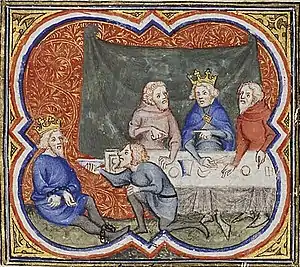 Zedekiah is chained and brought before Nebuchadnezzar II, from Petrus Comestor's Bible Historiale (1372) | |||||||
| |||||||
| Belligerents | |||||||
|
Kingdom of Judah Supported by: Twenty-sixth Egyptian dynasty |
Neo-Babylonian Empire Supported by: Moab Ammon Chaldea | ||||||
| Commanders and leaders | |||||||
|
Jehoiakim † Jehoiachin Zedekiah  Pashur Ben-Amar Jehuchal Ben-Shelamiah Gedaliah Ben-Pashur Sefaniah Ben-Masiah Shefatiah Ben-Matan Pashur Ben-Malkiah |
Nebuchadnezzar II Nebuzaradan | ||||||
| Strength | |||||||
| Much fewer | Unknown | ||||||
| Casualties and losses | |||||||
| More than 4,200 captive, many slain | Unknown | ||||||
| Based on Kings 2:24 and 25 of the Hebrew Bible and Old Testament | |||||||
Background
Egypt was the regional power until the Battle of Charchamesh around 606 BC.[1] Later, Babylonia came and ended the Egyptian rule, established its own dominance, and made Judah its vassal.
Jewish revolt
For three years, Judah paid taxes to Babylonia, until King Jehoiakim decided to stop giving taxes to Babylonia and went to war with Babylonia.[2] Unfortunately for Judah, Moab, Ammon and Chaldea went to war against Judah alongside Babylonia.[3]
First siege of Jerusalem
Nebuchadnezzar besieged Jerusalem in 597 BC, and managed to capture the city and king Jehoiachin,[4][5][6] along with all of the aristocracy of Jerusalem.[7] He also looted the treasures of the temple, including the golden implements.[8] Then Nebuchadnezzar exiled 10,000 of the officers, and the craftsmen, and 7,000 soldiers.[9] Then, he appointed Jehoiachin's uncle, Mattaniah as king of Judah. Later, Mattaniah changed his name to Zedekiah.[10][11]
Second siege of Jerusalem and a Battle at Jericho
In July 587 BC,[12] Zedekiah rebelled against Babylonia, making an alliance with Egypt, and Nebuchadnezzar besieged Jerusalem again, starving the people.[13] Later, the Babylonian troops managed to get inside the walls and conquer the city, yet Zedekiah and some of his troops managed to escape to Jericho, where they fought against the Babylonians (called Chaldeans by the Bible), who captured Zedekiah and his sons and brought them in chains to Babylonia, where Zedekiah's children were executed in front of him. On the seventh of Av, Nebuzaradan, a Babylonian executioner, burned down Solomon's Temple, destroyed the walls of Jerusalem, and exiled the rest of the Jews to Babylonia. He appointed Gedalia as the administrator of the Jews that weren't exiled from Judah. Judah ceased to exist a year later, in 586 BC. Gedalia was later murdered in 582 BC.
See also
Bibliography
References
- Missler, Commentary on Ezekiel,2009
- 2 Kings 24
- 2 Kings 24
- 2 Kings 24
- 2 Chronicles 36
- Nebuchadnezzar Chronicle
- 2 Kings 24
- 2 Kings 24
- 2 Kings 24
- 2 Kings 24
- Nebuchadnezzar Chronicle
- Nebuchadnezzar Chronicle
- 2 Kings 25