Jingshan Temple
Jingshan Temple (simplified Chinese: 径山寺; traditional Chinese: 徑山寺), fully named Jingshan Wanshou Chan Monastery (径山万寿禅寺),[2] is a Buddhist temple located in Jingshan Town, Yuhang District, Hangzhou City, Zhejiang Province.[3] It was built in the third year of the Dali period of the Tang Dynasty (768 A.D.) by monk Fa Qin.[4] In the 12th century, the temple had 13,000 mu of tax-free land.[5]
| Jingshan Temple | |
|---|---|
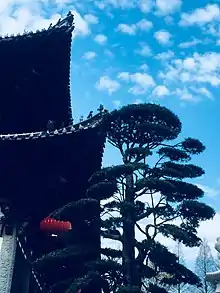 Eaves of a hall in Jingshan Temple | |
| Religion | |
| Affiliation | Buddhism |
| Sect | Linji school |
| Location | |
| Location | Jing Mountain, Jingshan Town, Yuhang District, Zhejiang Province[1] |
| Architecture | |
| Creator | Monk Fa Qin |
History
In the mid-12th century, two Japanese monks, Enni Ben'en and Nanpo Shomyo, studied Buddhism at the temple. Afterwards, they introduced the cultivation, processing and drinking rituals of Chinese tea to Japan, which later developed into the Japanese tea ceremony.[6]
Jingshan Temple was repeatedly destroyed and built,[7] and was restored in April 1997.[8]
References
- "Jingshan Temple to hold 10-day meditation event". Sina. 2014-06-11.
- "The new abbot of Jingshan Temple assumes his duties". People's Daily. 2014-11-28.
- "Jingshan Temple". ywhz.hangzhou.com.cn. 2016-06-20.
- Chinese Tea Culture Relics. Shanghai Culture Press. 2004. ISBN 978-7-80646-618-6.
- Marsone, P.; Lagerwey, J. (2014). Modern Chinese Religion I (2 vols.): Song-Liao-Jin-Yuan (960-1368 AD). Brill Publishers. p. 53. ISBN 978-90-04-27164-7.
- "Jingshan Temple". www.ehangzhou.gov.cn. July 12, 2018.
- "Jingshan Temple will hold meditation activities". Ifeng.com. August 22, 2014.
- Yan Qin, Jie Yuejiao, Wang Chuan (July 15, 2016). "Dajingshan Country National Park unveiled on October 1st". z.hangzhou.com.cn.CS1 maint: multiple names: authors list (link)
This article is issued from Wikipedia. The text is licensed under Creative Commons - Attribution - Sharealike. Additional terms may apply for the media files.