Mariam-uz-Zamani
Mariam-uz-Zamani (Persian: مریم الزمانی, lit. 'Mary of the Age';[2] c. 1542 – 19 May 1623) was one of the three chief consorts of the third Mughal emperor, Akbar. In subsequent centuries, she has been referred to with several other names, including Jodha Bai, Heer Kunwari,[3] and Harkha Bai.[4][5] She was the longest serving Hindu empress of Mughal Empire with a tenure of forty-three years (1562–1605).[6]
| Mariam-uz-Zamani | |
|---|---|
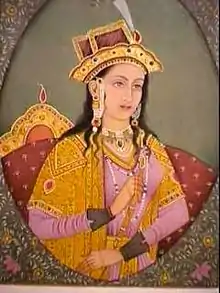 Artistic depiction of Queen Mariam-uz-Zamani, the favorite sultana of Emperor Akbar. | |
| Born | 1542 |
| Died | 19 May 1623 (aged 80–81)[1] Agra,[1] Mughal Empire |
| Burial | |
| Spouse | Akbar |
| Issue | Hassan Mirza Hussain Mirza Jahangir (Salim) |
| Dynasty | |
| Father | Bharmal, Raja of Amber |
| Mother | Rani Champavati |
| Religion | Hindu |
Born a Hindu Rajput princess[7] in 1542, Mariam-uz-Zamani was offered in marriage to Akbar by her father, Raja Bharmal of Amber. The wedding, held in Sambhar, was a political one.[4][8] Her marriage to Akbar led to a gradual shift in the latter's religious and social policies. During Akbar's reign, she held a high influence in the Mughal court.[9] She is widely regarded in modern Indian historiography as exemplifying both Akbar's and the Mughals' tolerance of religious differences and their inclusive policies within an expanding multi-ethnic and multi-religious empire.[8] She was held in high esteem by her husband throughout her life.[10] The Empress is recorded to be an extremely beautiful woman with uncommon beauty.[10] She was also an intelligent,[11] a very amiable, courageous and secular woman.[12] She is known to be the first and last love of Emperor Akbar.[13]
She was the mother of Akbar's eldest surviving son and eventual successor, Jahangir and the grandmother of Shah Jahan. Several medieval historical chronicles which were written during the reign of Emperor Akbar namely 'Tarikh-I-Farishta' and 'Muntakhab-ut-Tawarikh' written by Adbul Qadir Badayuni, a courtier in Akbar's court, Mariam uz Zamani is stated to be the favorite and most loved wife of Akbar.[14] The Empress is recorded to hold a prodigious influence over her husband.[10]
Name and background
Mariam uz Zamani was born in 1542 as the daughter of Raja Bharmal of Amber by his wife Rani Champavati, daughter of Rao Ganga Solanki.[15][16][17] Her paternal grandparents were Raja Prithviraj Singh I and Apurva Devi, a daughter of Rao Lunkaran of Bikaner.[18]
Her birth name is unknown.[8] 'Mariam-uz-Zamani' was an honorific title bestowed on her by Akbar on the occasion of their son Jahangir's birth.[19] This was the name by which she was referred to in contemporary Mughal chronicles, including Jahangir's autobiography, the Tuzk-e-Jahangiri.[20] Later historical accounts give several suggestions for her birth name. In an 18th-century genealogy of her clan (the Kachwahas) for example, she is referred to as 'Harkhan Champavati'.[8] Other names provided by various sources include Harkha Bai,[4] Shahi begum, Jiya Rani, Maanmati, Harika, and Shahi-Bai. She was also bestowed with an honorific name, 'Wali Nimat begum' meaning 'Gift of God' by Akbar after two years of her marriage in the year 1564.[21] [22]
However, the name by which she is most popularly known in modern times is 'Jodha Bai'.[23] The name 'Jodha Bai' was first used in relation to Mariam-uz-Zamani in James Tod's Annals and Antiquities of Rajasthan, a colonialist history written in the early 19th century.[24] This naming appears to have been an error, given that it implies a relationship with the royal family of Jodhpur, rather than that with the Rajas of Amber.[25] Instead, it is believed that 'Jodha Bai' in fact refers to the wife of Jahangir, Jagat Gosain daughter of Raja Udai Singh of Jodhpur.[26]
Marriage to Akbar
Harkha Bai's marriage was the result of a conflict between her father and Akbar's brother-in-law, Sharif-ud-din Mirza, the Hakim of Mewat. Bharmal, facing harassment at Sharif-ud-din's hands, approached Akbar to request his intervention. The emperor agreed to mediate on the condition of Bharmal's personal submission, as well as the suggestion that his eldest daughter be given to Akbar in marriage.[4]
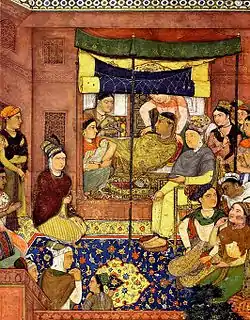
The marriage, thus, a political one, took place on 6 February 1562, while Akbar was on his way back to Agra from Ajmer (after offering prayers to the tomb of Moinuddin Chishti) at the imperial military camp in Sambhar, Rajasthan, instead of the bride's natal home. The marriage with the Amber princess provided the service of her family throughout the reign and offered a proof manifest to all the world that Akbar had decided to be the Badshah or Shahenshah of his whole people i.e. Hindus as well as Muslims.[27]
Akbar took many Rajput princesses in marriages for Akbar made such marriages respectable for Hindu Rajas.[28] Akbar did not convert any of his Hindu wives to Islam and permitted them to perform their rituals in the palace.[29] Although the marriage was a result of a political alliance, the two however shared an intimate relationship as Akbar himself is recorded to participate in the pooja performed by the empress through he married several other Hindu princesses.[30] The Empress is recorded to have a high rank, after her mother-in-law, Mariam Makani in the imperial harem.[31]
In 1564, Mariam-uz-Zamani gave birth to twin sons, Hassan and Hussain, but they both died during infancy. In 1569, Akbar heard the news that his consort was expecting a child again and that he might hope for the first of the three sons that had previously been promised to him after the death of the twins by Sheikh Salim Chisti, a reputed holy man who lived at Sikri. The expectant empress was sent to Sheikh's humble dwelling Sikri during the latter period of her pregnancy. Akbar himself used to be present most of the time with Marium uz Zamani in Rang Mahal, Sikri for taking care of empress during her period of pregnancy.[32] On 31 August 1569, the boy was born and received the name Salim, in acknowledgment of his father's faith in the efficacy of the holy man's prayer. The Empress was presented with jewelry worth one lakh gold coins immediately when Akbar met her for that first time in Sikri after the birth of sultan Salim and gave a Rajvanshi pat on her head expressing his love.[33] The empress was subsequently also honored with the title 'Mariam-uz-Zamani' being the beloved.
Family advancement
The Rajas of Amber (who came from a very small kingdom) especially benefited from their close association with the Mughals and acquired immense wealth and power. Of twenty-seven Rajputs in Abu'l-Fazl list of mansabdars, thirteen were of the Amber clan, and some of them rose to positions as high as that of imperial princes. Mariam-uz-Zamani's brother Raja Bhagwan Das, for instance, became commander of 5000, the highest position available at that time, and bore the proud title Amirul-Umara (Chief Noble). His son, Man Singh I, rose even higher to become commander of 7000.[34] His daughter, Manbhawati Bai or Man Bai, married Jahangir on 13 February 1585. Man Bai later became mother to Akbar's favorite grandson, Prince Khusrau Mirza[35][36] and was awarded the title of Shah Begum.[37]
Powers and Influence
Being Akbar's most loved wife, the empress held a significant influence over him and was held in high esteem by Akbar throughout her life.[10] She was major driving force for Akbar's promotion of secularism.[38] Badayuni in his book states Akbar's affection and endearment for her with the statements "Akbar had fallen into the trap of beautiful daughter of Raja Bharmal" and "magic the kind daughter of Raja Bharmal did on Akbar".[39] After the demise of her twins, Hassan Mirza and Hussain Mirza in the year 1564, the empress was taken to the war by Akbar and later to the abode of Salim Sheikh.[40] In the year 1566, Akbar took Mariam uz Zamani to a pilgrimage that was undertaken barefoot by both of them to Dargah Ajmer to pray for a son.[41]
Marium uz Zamani besides being bestowed with this honorific title, also held the revered titles of 'Wali Nimat begum' (meaning: Gift of God),[21] 'Mallika-e-Muezamma' (meaning: precious, cherished and exalted)[38] and 'Mallika-e-Hindustan'[42] bestowed by Akbar. Marium uz Zamani was gifted a garden by Akbar in Agra and had several palaces constructed for herself by Akbar in Sikri, Mandu, Allahabad.[10] Marium uz Zamani also owned several towns and cities.
The Empress held prodigious freedom of speech in the matters of court during Akbar's reign as one of the episodes recorded in the book of Badayuni notes that once on the execution of a brahmin by a conservative Muslim courtier of Akbar while Akbar had ordered the investigation to be continued, Mallika-e-Hindustan, daughter of Raja Bharmal taunted Emperor Akbar publicly on failing to maintain the abidance of his order.[10]
Akbar is recorded to take a personal note of Marium-uz-Zamani's activities of interest like her trading expedition. Akbar use to invest time for her activities personally by engaging in the discussions with the empress which are stated to be very long and use to take place often, indicating the depth and intensity of their relationship.[43][44] No other noblewoman on record seems to have been as adventurous a trader as the Queen mother.[45] Muhammad Azam khan in his journal states, "The most influential queen of Emperor Akbar and mother of Jahangir, was the beautiful Empress Mariam uz Zamani. She stands out as an advisor who maintained that without a strong navy, the Mughal empire would be overtaken by foreign armies. As Mughals had come from Afghanistan and Turkmenistan, both landlocked countries, the concept of a navy was not in their DNA. But then Akbar allowed his favorite and most loved wife to build ships for trade and Hajj pilgrims at the Khizri Darwaza on the river Ravi".[44]
Mariam-uz-Zamani owned ships that carried pilgrims to and from the Islamic holy city Mecca and ran an extensive trade of silk and several spices to international borders. In 1613, her ship, the Rahīmī, which was in its time the largest ship sailing in the seas, was seized by Portuguese pirates along with the 600–700 passengers on board and the cargo. Rahīmī was the largest Indian ship sailing in the Red Sea and was known to the Europeans as the "great pilgrimage ship". When the Portuguese officially refused to return the ship and the passengers, the outcry at the Mughal court was quite unusually severe. The outrage was compounded by the fact that the owner and the patron of the ship was the revered Dowager Empress. Jahangir, in retaliation, ordered the seizure of the Portuguese town Daman. This episode is considered to be an example of the struggle for wealth that would later ensue and lead to colonisation of the Indian sub-continent. The Dowager Empress then ordered the build of even a larger ship with 62 guns and the placement of over 400 musket men. It was named 'Ganj-I-Sawai' and in its day was the most fearsome ship in the sea with the objective of trade and taking pilgrims to Mecca and on the way back convert all the goods into gold, silver and bring back the pilgrims.[44]
The Empress of Hindustan was in fact the richest and most prominent woman of her time. The Empress received several expensive gifts from prominent nations and people during her husband's and son's reign like from the queen of England in the year 1601.[46] Mariam-uz-Zamani's retirement after her husband's death along with the death of Jagat Gosain led to the decline of Rajput influence in the Mughal court.[47]
Jahangir referred to her as "Hazrat Marium-uz-Zamani" , "Mallika Hind" or at times "my exalted mother" out of his love for her in his memoirs.[48] Jahangirnama states in 1607 after Jahangir marches to Lahore following Khusrao's rebellion, "I ordered my son Khurram to bring Her Majesty Mariam uz Zamani and my harem to me. When their entourage came nearer, I got on the boat and attained the happiness of paying homage and greeting my mother in the vicinity of the village named Dhar. After executing the rites of Korunish, Sajda, and Taslim before my exalted mother and after observing the formalities of the young owe the elders under the terms of Genghis code and Timurid law."[49] Jahangir is recorded to greet her mother by performing Korunish, Sajda, and Taslim which amongst Muslims is done before Allah and only after paying her homage use to pay respect to other elders. During the plague of Agra when Jahangir was in Fatehpur Sikri, he says, "On January 1618, Mallika Marium uz Zamani came from Agra to meet me and I attained the happiness of waiting on her. I hope that the shadow of her protection and affection will always be over the head of this supplicant."[50]
The stature and largesse Jahangir bestowed upon his mother were exceptional, he is recorded to carry her palanquin on his shoulders.[51] The Empress was one of the four senior-most figures in the Mughal court and the only woman to hold a military rank, that too of 12,000 cavalry, being a skilled warfare practitioner.[52] This was the highest possible imperial rank that could be held by any member of the imperial court including the Emperor.[53] The woman was perhaps, well ahead of her time. She was known to receive a jewel from every nobleman "according to his estate" each year on the occasion of New Year's festival.[6] Like only a few other women at the Mughal court, Mariam-uz-Zamani was granted the right to issue official documents, called firmans, usually the exclusive privilege of the emperor. She use to issue firmans with the name of 'Wali Nimaat Marium uz Zamani begum Sahiba'.[21] Issuing of such orders was confined to the highest ladies of the harem such as Hamida Banu Begum, Nur Jahan, Mumtaz Mahal, Nadira Banu Begum, Jahanara Begum and to the revered Empress Mariam uz Zamani who held the highest rank in the imperial harem.[6][54][55] Mariam-uz-Zamani built gardens, wells, mosques, and other developments around the countryside and was in charge of the Hajj department since Akbar's reign.[6][56]
The courtesies and largesse demonstrate by Jahangir surface the proof for the amount of respect and love he held for his mother, Mariam-uz-Zamani. Several royal functions took place in the household of Mariam-uz-Zamani like Jahangir's solar and lunar weighings,[57] all his birthday celebrations, Jahangir's marriage to the daughter of Jagat Singh,[58] and Shehzada Parviz's wedding to the daughter of Sultan Murad Mirza and several other events.[59] She is recorded to be a woman of high ideals and fidelity and was also accused of siding with her husband than her son Salim, during latter's rebellion against his father, Akbar.
Death
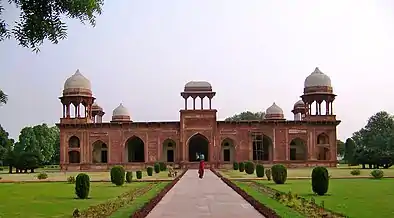
Mariam-uz-Zamani died in May 1623 and even in her death remained close to Akbar. There is no concrete evidence stating the reason for her death. Her tomb, built-in 1623–27, is on the Tantpur road now known as in Jyoti Nagar. Mariam's Tomb, commissioned by her son, is only a kilometer from Tomb of Akbar the Great and the only wife who was buried close to Akbar, owing to the intimacy these two possessed. The grave itself is underground with a flight of steps leading to it.
Jahangir also commissioned a mosque in her honor, Mosque of Mariam Zamani Begum Sahiba owing to the respect she commanded during her lifetime and as a token of love for his mother. It is situated in the Walled City of Lahore, present-day Pakistan. This mosque was named after Empress Mariam uz Zamani, in her honor. It is also known as the Begam Shahi mosque, insinuating that she was also known as Begam Shahi. The foundation of this mosque was laid by Mariam uz Zamani herself in the year 1611. Historians of Lahore state that the color combination and frescoes of this mosque, which are similar to the colored frescoes on the ceiling of the palace of Mariam uz Zamani, known as Jodha bai Palace in Fatehpur Sikri, were unrivaled for the beauty in their prime having the finest of niches and fountains. This mosque has four Arabic-Persian verses, and one of them includes the prayer of Mariam uz Zamani for her son Jahangir.
In popular culture
 |
Wikimedia Commons has media related to Mariam uz-Zamani. |
- Sulochana portrayed Rani Jodha Bai in 1953 film Anarkali.[60]
- Durga Khote portrayed Jodha Bai in the 1960 Indian epic film Mughal-e-Azam.[61]
- Aishwarya Rai portrayed Jodha Bai in the 2008 film Jodhaa Akbar directed by Ashutosh Gowarikar.[62]
- Paridhi Sharma played the role of Jodha Bai in historical drama series Jodha Akbar which ran from 2013 to 2015.[63]
- Delnaaz Irani portrayed Jodha Bai in historical comedy series Har Mushkil Ka Hal Akbar Birbal from 2014 to 2016. She was replaced by Pragati Mehra in 2016 for few episodes as she was unavailable due to personal issues.[64]
- Jodha Bai was portrayed by Gurdeep Kohli in the Colors TV series Dastaan-E-Mohabbat Salim Anarkali.[65]
- Aditi Sajwan portrayed the empress in the Star Bharat comedy series Akbar Ka Bal Birbal.[66]
References
- Rogers, Alexander; Beveridge, Henry, eds. (1909). The Tūzuk-i-Jahāngīrī or Memoirs of Jahāngīr, Volume 2. Royal Asiatic Society, London. p. 261.
- Mukhia, Harbans (2004). India's Islamic Traditions, Islam in Kashmir (Fourteenth to Sixteenth Century). New Delhi [India]: The Medieval History Journal, New Delhi. p. 126.
- Manuel, Paul Christopher; Lyon, Alynna; Wilcox, Clyde (2013). Religion and Politics in a Global Society. Plymouth [England]: Lexington Books. p. 68.
- Chandra, Satish (2005). Medieval India : from Sultanat to the Mughals (Revised ed.). New Delhi: Har-Anand Publications. pp. 111–112. ISBN 9788124110669.
- Chandra, Satish (2005). Medieval India : from Sultanate to the Mughals (Revised ed.). New Delhi: Har-Anand Publications. pp. 111–112. ISBN 9788124110669.
- Findly, Ellison B. (1990). "The Capture of Maryam-uz-Zamānī's Ship: Mughal Women and European Traders". Journal of the American Oriental Society. American Oriental Society. 105 (3): 196.
- Aftab, Tahera (2008). Inscribing South Asian Muslim Women: An Annotated Bibliography & Research Guide. Leiden: Brill Publishers. p. 44.
- chief, Bonnie G. Smith, editor in (2008). The Oxford encyclopedia of women in world history. Oxford [England]: Oxford University Press. p. 656. ISBN 9780195148909.,
- Findly, Ellison B. (1993). "Mughal Women". American Oriental Society: 240. Cite journal requires
|journal=(help) - Badayuni, Abdul Qadir (1590). Muntakhab-ut-Tawarikh. p. 126.
- Mubarak, Abul -Fazl (1593). Ain-i-Akbari. p. 36.
- Badayuni, Abdul Qadir (1590). Muntakhab-ut-Tawarikh. 2. p. 56.
- "Unknown fact about Queen Mother Mariam uz Zamani". India Today. 1 October 2016.
- Hindu Shah, Muhammad Qasim. Gulshan-I-Ibrahimi. p. 223.
- L. McJannet, Bernadette Andrea, Early Modern England and Islamic Worlds (2011), p.106
- C. M. Agrawal, Akbar and his Hindu officers: a critical study (1986), p.27
- Sarkar, J. N. (1994) [1984]. A History of Jaipur (Reprinted ed.). Orient Longman. p. 43. ISBN 81-250-0333-9.
- Sarkar 1994, p. 31-4.
- Verma, Chob Singh (1999). Splendour of Fatehpur Sikri. Agam Kala Prakashan. p. 6.
- Rogers & Beveridge 1909, p. 78.
- Tirmizi, S.A.I. (1979). Edicts from the Mughal Harem, Farman of Wali Nimat Marium uz Zamani begum sahiba. Idarah-I-Adabiyat-I-Delli. p. 69.
- Srivastava, Ashirbadi Lal (1947). The History and Culture of the Indian People. 7. p. 368.
- Hooja, Rima (2006). A history of Rajasthan. Rupa & Co. p. 484.
- Jhala, Angma Dey (2011). Royal Patronage, Power and Aesthetics in Princely India. Pickering & Chatto Limited. p. 119.
- Chatterjee, Ramananda (1962). The Modern Review, Volume 112. Prabasi Press Private Limited. p. 117.
- Atul Sethi (24 June 2007). "Trade, not invasion brought Islam to India". The Times of India. Retrieved 15 February 2008.
- Smith, Vincent Arthur (1917). Akbar the Great Mogul. Oxford, Clarendon Press. p. 58. ISBN 0895634716.
- Eraly, Abraham (2000). Emperors of the Peacock Throne, The Saga of the Great Mughals. Penguin Books India. p. 145. ISBN 0141001437.
- Eraly 2000, p. 136.
- Badayuni, Abdul Qadir (1590). Muntakhab-ut-Tawarikh. 3. p. 164.
- Fazl, Abul (1590). Ain-I-Akbari. 3. p. 13.
- Ahmed, Nizamuddin (1599). Tabaqat-i-Akbari. p. 144.
- Chatterjee, Nandani (1576). Rajasthan State Archives-Imperial records.
- Eraly 2000, p. 146.
- Smith 1917, p. 225.
- Eraly 2000, p. 273.
- Rogers & Beveridge 1909, p. 56.
- Mr., Lal (1977). Akbar. V.P. house private ltd., Delhi. p. 133.
- Badayuni, Abdul Qadir (1590). Muntakhab-ut-Tawarikh. 3. p. 74.
- Ahmad, Aziz (1969). An Intellectual History of Islam in India. p. 111.
- Ahmad, Aziz (1964). Studies of Islamic culture in the Indian Environment. p. 164.
- Tirmizi, S.A.I. (1979). Edicts from the Mughal Harem. Idarah-i Adabiyat-i Delli. p. 86.
- Collier, Dirk (2011). The Emperor's writings: Memories of Akbar the great. p. " 326.
- Azam Kalan, Muhammad (1929). "Journal of Indian studies": 186–187. Cite journal requires
|journal=(help) - Findly 1988, p. 233.
- Tirmizi, S.A.I. (1979). Edicts from the Mughal Harem. Idarah-i Adabiyat-i Delli. p. 229.
- Trimizi, S. A. I. (1989). Mughal Documents. Manohar. p. 31.
- Salim, Nur-ud-din Muhammad (1625). Tuzuk-i-Jahangiri. p. 292.
- Rogers & Beveridge 1909, p. 162.
- Rogers & Beveridge 1909, p. 238.
- Terry, Edward (1616). A voyage to East India. p. 82.
- Findly, Ellison B. (1993). Mughal Women. American Oriental Society. p. 205.
- Terry, Edward (1616). A voyage to East India. p. 86.
- Tirmizi, S.A.I. (1979). Edicts from the Mughal Harem. Idarah-i Adabiyat-i Delli. pp. 127–128. OCLC 465427663.
- Mishra, Rekha (1967). Women in Mughal India, 1526–1748 A.D. Munshiram Manoharlal. p. 67. ISBN 9788121503471.
- Mishra 1967, p. 112.
- Rogers & Beveridge 1909, p. 78, 230.
- Rogers & Beveridge 1909, p. 145.
- Rogers & Beveridge 1909, p. 81.
- "The emperor's healing touch". DAWN.COM. 17 September 2009.
- Rajadhyaksha, Ashish; Willemen, Paul (1998) [1994]. Encyclopaedia of Indian Cinema (PDF). New Delhi: Oxford University Press. p. 365. ISBN 978-0-19-563579-9.
- "Will U B My Jodha?". Sify. 14 July 2005. Archived from the original on 9 December 2016. Retrieved 9 December 2016.
- Unnikrishnan, Chaya (26 June 2013). "Show review: So far, so good". DNA India.
- "After being replaced, Delnaaz is back on 'Akbar Birbal' – Times of India". The Times of India.
- "Gurdeep Kohli Punjj dons 10kg costume for TV show – Times of India". The Times of India.
- "Akbar Ka Bal Birbal's Aditi Sajwan aka Rani Saheba's new best friend on the sets of the show". The Times of India.