Joe Malone (ice hockey)
Maurice Joseph "Phantom Joe" Malone (February 28, 1890 – May 15, 1969) was a Canadian professional ice hockey centre. He played in the National Hockey Association (NHA) and National Hockey League (NHL) for the Quebec Bulldogs, Montreal Canadiens, and Hamilton Tigers from 1910 to 1924.[1] Known for his scoring feats and clean play, Malone led the NHL in goals and points in 1918 and 1920. He is the only player in the history of the NHL to score seven goals in a single game, accomplishing the feat in 1920.
| Joe Malone | |||
|---|---|---|---|
| Hockey Hall of Fame, 1950 | |||
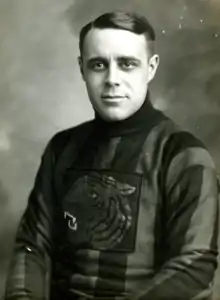 Malone with the Hamilton Tigers in 1920 | |||
| Born |
February 28, 1890 Sillery, Quebec, Canada[1] | ||
| Died |
May 15, 1969 (aged 79) Montreal, Quebec, Canada | ||
| Height | 5 ft 10 in (178 cm) | ||
| Weight | 150 lb (68 kg; 10 st 10 lb) | ||
| Position | Centre | ||
| Shot | Left | ||
| Played for | |||
| Playing career | 1910–1924 | ||
He was elected to the Hockey Hall of Fame in 1950.
Playing career
1908–1917
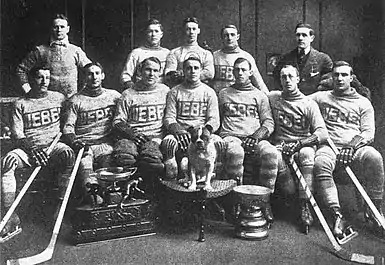
Malone broke in at the age of 19 for the Quebec Bulldogs of the Eastern Canada Hockey Association in the 1909 season, scoring eight goals in 12 games. Prior to that he had played amateur hockey with the Quebec Crescents. The next season, in 1910, the NHA formed, but Quebec was left out of the loop after the short-lived CHA had folded, so he played for the Waterloo Colts in the Ontario Professional Hockey League. Rejoining Quebec in 1911, he was named the team captain and so served for the Bulldogs' seven NHA seasons. Centering linemates such as Eddie Oatman and Jack Marks, he led the Bulldogs to back-to-back Stanley Cups in 1912 and 1913 – rampaging for a career-best nine goals in a Cup match against Sydney – while recording a remarkable scoring total of 43 goals in 20 games in 1913. His brother Jeff Malone also played for Quebec in 1913 when they won the Stanley Cup.
In 1916–17, Malone scored 41 goals in 19 games in the NHA, finishing tied for the scoring lead with Frank Nighbor of the Ottawa Senators. Malone was in the scoring lead until the final game of the season, when he played Nighbor and the Senators. Ottawa had two players cover Malone the entire game, while Nighbor was able to score 5 goals and finish tied.[2]
1917–1924
When the NHL was founded in 1917, Quebec did not operate a team its first season, and the team's players were dispersed amongst the other teams. Malone was claimed by the Montreal Canadiens. Playing on what was one of the most powerful forward lines of all time with Newsy Lalonde and Didier Pitre, Malone shifted to left wing to accommodate the great Lalonde, and was the NHL's first scoring leader, registering 44 goals in 20 games, a record total that would stand as the NHL's single season goal scoring mark until 1945 and a record per-game average that stands to this day (If such an average was sustained over today's 82-game schedule, it would result in 180 goals, nearly double Wayne Gretzky's record of 92). Malone scored at least one goal (and a total of 35 goals) in his first 14 NHL games to set the record for the longest goal-scoring streak to begin an NHL career.[3] This streak still stands as the second-longest goal-scoring streak in NHL history.
The following season Malone suffered an injured arm and missed most of the regular season, although he scored five goals in five games in the league final series against the Ottawa Senators; the lingering injury held him out of the ill-fated Cup finals against the Seattle Metropolitans which was cancelled after five games due to the Spanish flu pandemic.[4]
Quebec revived its franchise in 1919 and Malone rejoined the club, once more leading the league in scoring with 39 goals, and setting a single game goal-scoring mark which still stands of seven against Toronto on January 31, 1920. However, the team was very weak on the ice—its goaltender had the poorest goals-against average the NHL would ever see (7.13 GAA)—and recorded a 4–20 record on the season.
The team was relocated to Hamilton for the 1921 season. Despite missing the first four games of the season as well as the franchise's continued poor performance, Malone still finished fourth in league scoring with 28 goals. He finished fourth in scoring the following season, as well.
After trading Lalonde, the Canadiens traded for Malone in 1923, but he scored only a single goal that season while generally playing as a substitute. He played nine games without scoring the next season, playing his last game on January 23 against his former mates in Hamilton, before retiring. The Canadiens did not include his name on the Cup in 1924, because he did not play in the playoffs. However, he is credited by the NHL as winning his third Stanley Cup that season.
Malone finished his career with 343 goals and 32 assists over 15 professional seasons. He scored the third-most career goals of any player in major hockey's first half-century (behind Newsy Lalonde and Nels Stewart). His 179 goals in the NHA were the most in the league's history.[2]
Playing style
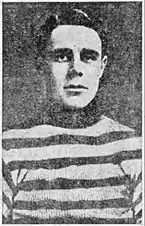
Joe Malone spent the majority of his playing career as a centre forward, and he had a particular penchant for finding open space on the ice for his goal scoring. Malone earned his famous nickname, "Phantom Joe", from his ability to find openings offensively and weave his way to the net in an almost invisible fashion.[5] He was also considered a great stickhandler. During his time with the Montreal Canadiens in the NHL Malone was also successful in holding down the left wing position, playing alongside centre forward Newsy Lalonde.
"This fellow Malone, he is not the fastest but he is the smoothest forward in the league. He is absolutely reliable around a net. He is a great stickhandler, and a player who never gets flurried no matter how hard the going is. What Eddie Collins is to baseball, Malone is to hockey."
– Veteran ice hockey fan voicing his opinion on Joe Malone in the December 30, 1919 issue of Ottawa Journal.[6]
Malone was not considered to be one of the fastest players in the game, but rather a smooth player who knew exactly how to position himself around the opposing goal cage. The December 30, 1919 issue of the Ottawa Journal reproduced a conversation between three hockey fans, where a veteran spectator of 25 years, who had seen all the great players in the game, gave echo to this sentiment and compared Malone's abilities to those of baseball second baseman Eddie Collins, an opinion the newspaper itself agreed with.[6]
Contrary to many other players of his era, such as his Quebec teammate Joe Hall (with the nickname "Bad Joe") and his Montreal teammate Newsy Lalonde, Malone also did not have a reputation as a particularly rough player, but rather as one of the cleanest players in the game.[6]
Legacy

Malone was elected to the Hockey Hall of Fame in 1950, and is also a member of Canada's Sports Hall of Fame.[7] In 1998, he was ranked number 39 on The Hockey News' list of the 100 Greatest Hockey Players. The list was announced 74 years after his last game and 91 years after his professional debut, making him the earliest player on the list.[8]
He was a second cousin of Sarsfield and Foster Malone, who played briefly in the NHA. His nephew, Cliff Malone, briefly played in the NHL, as well.
Malone died of a heart attack on May 15, 1969, in Montreal, Quebec.
A statue over Malone, along with a bulldog, entitled Hommage à Joe Malone by artist Frédéric Laforge was inaugurated on June 10, 2021, and is located at Place Jean-Béliveau at the ExpoCité in Quebec City. The statue pays homage to Malone's nickname "Phantom Joe."[9]
Career statistics
Regular season and playoffs
| Regular season | Playoffs | |||||||||||||
|---|---|---|---|---|---|---|---|---|---|---|---|---|---|---|
| Season | Team | League | GP | G | A | Pts | PIM | GP | G | A | Pts | PIM | ||
| 1907–08 | Quebec Crescents | QAHA | — | — | — | — | — | — | — | — | — | — | ||
| 1908–09 | Quebec Bulldogs | ECHA | 12 | 8 | 0 | 8 | 17 | — | — | — | — | — | ||
| 1909–10 | Quebec Bulldogs | CHA | 2 | 5 | 0 | 5 | 3 | — | — | — | — | — | ||
| 1909–10 | Waterloo Colts | OPHL | 12 | 10 | 0 | 10 | 16 | — | — | — | — | — | ||
| 1910–11 | Quebec Bulldogs | NHA | 13 | 9 | 0 | 9 | 3 | — | — | — | — | — | ||
| 1911–12 | Quebec Bulldogs | NHA | 18 | 21 | 0 | 21 | 0 | — | — | — | — | — | ||
| 1911–12 | NHA All-Stars | St-Cup | 2 | 0 | 0 | 0 | 0 | — | — | — | — | — | ||
| 1911–12 | Quebec Bulldogs | St-Cup | — | — | — | — | — | 2 | 5 | 0 | 5 | 0 | ||
| 1912–13 | Quebec Bulldogs | NHA | 20 | 43 | 0 | 43 | 34 | — | — | — | — | — | ||
| 1912–13 | Quebec Bulldogs | St-Cup | — | — | — | — | — | 1 | 9 | 0 | 9 | 0 | ||
| 1913–14 | Quebec Bulldogs | NHA | 17 | 24 | 4 | 28 | 20 | — | — | — | — | — | ||
| 1914–15 | Quebec Bulldogs | NHA | 12 | 16 | 5 | 21 | 21 | — | — | — | — | — | ||
| 1915–16 | Quebec Bulldogs | NHA | 24 | 25 | 10 | 35 | 21 | — | — | — | — | — | ||
| 1916–17 | Quebec Bulldogs | NHA | 19 | 41 | 8 | 49 | 15 | — | — | — | — | — | ||
| 1917–18 | Montreal Canadiens | NHL | 20 | 44 | 4 | 48 | 30 | 2 | 1 | 0 | 1 | 3 | ||
| 1918–19 | Montreal Canadiens | NHL | 8 | 7 | 2 | 9 | 3 | 5 | 5 | 2 | 7 | 3 | ||
| 1919–20 | Quebec Bulldogs | NHL | 24 | 39 | 10 | 49 | 12 | — | — | — | — | — | ||
| 1920–21 | Hamilton Tigers | NHL | 20 | 28 | 9 | 37 | 6 | — | — | — | — | — | ||
| 1921–22 | Hamilton Tigers | NHL | 24 | 24 | 7 | 31 | 4 | — | — | — | — | — | ||
| 1922–23 | Montreal Canadiens | NHL | 20 | 1 | 0 | 1 | 2 | 2 | 0 | 0 | 0 | 0 | ||
| 1923–24 | Montreal Canadiens | NHL | 10 | 0 | 0 | 0 | 0 | — | — | — | — | — | ||
| NHA totals | 123 | 179 | 27 | 206 | 114 | — | — | — | — | — | ||||
| NHL totals | 126 | 143 | 32 | 175 | 57 | 9 | 6 | 2 | 8 | 6 | ||||
| St-Cup totals | — | — | — | — | — | 3 | 14 | 0 | 14 | 0 | ||||
Achievements
- Elected to Hockey Hall of Fame in 1950
- NHA scoring leader – 1913
- NHL scoring leader – 1918 and 1920
- Stanley Cup champion: 1912 and 1913 with Quebec Bulldogs, 1924 with Montreal Canadiens
NHL records
- Most goals in one game (7), January 31, 1920 at Quebec. Final score: Quebec 10, Toronto 6
- Most games played with 5 goals or more: 5
- Highest goals-per-game average, one season: 2.20 with Montreal, 1917–18 season (44 goals in 20 games)
- Fastest player in NHL history to score 100 goals: 62 games
- Most consecutive three-or-more goal games: 3 (1917–18 and again later in that season), tied with Mike Bossy (1980–81)
- Longest consecutive goal-scoring streak from start of NHL career: 14 games (1917–18)
Notes
- Marsh, James H. (31 October 2014). "Maurice Joseph Malone". The Canadian Encyclopedia. Toronto: Historica Canada. OCLC 55668687. Retrieved 11 September 2019.
- Fitsell 1987, p. 140
- "Pens' Malkin named NHL Rookie Of The Month for Oct".
- Weinreb, Michael (March 18, 2020). "When the Stanley Cup Final Was Canceled Because of a Pandemic". Smithsonian Magazine. Smithsonian Institution. Retrieved October 20, 2020.
- Zeisler 2013, p. 204
- "Sport flashes", Ottawa Journal. Dec. 30, 1919 (pg. 17). Retrieved 2021-08-15.
- Legends of Hockey (2007). "Joe Malone Page". Legends of Hockey. Retrieved 2007-07-17.
- Dryden 1997, p. 160
- "Hommage à Joe Malone" Commission de la Capitale Nationale (capitale.gouv.qc.ca). Retrieved 2021-08-15.
References
- Coleman, Charles L. (1964), The Trail of the Stanley Cup, Volume 1: 1893–1926 inc., Dubuque, Iowa: Kendall/Hunt Publishing, ISBN 0-8403-2941-5
- Diamond, Dan, ed. (February 2003), Total Hockey: The Official Encyclopedia of the National Hockey League, Second Edition, New York: Total Sports Publishing (published 2002), ISBN 1-894963-16-4
- Dryden, Steve, ed. (1997), The Top 100 NHL Players of All Time, Toronto: McClelland & Stewart, ISBN 0-7710-4176-4
- Fitsell, J.W (1987), Hockey's Captains, Colonels & Kings, Erin, Ontario: The Boston Mills Press, ISBN 0-919-783-68-6
- McKinley, Michael (2009), Hockey: A People's History, Toronto: McClelland & Stewart, ISBN 978-0-7710-5771-7
- McKinley, Michael (2000), Putting a Roof on Winter: Hockey's Rise from Sport to Spectacle, Vancouver: Greystone Books, ISBN 1-55054-798-4
- Zeisler, Laurel (2013), Historical Dictionary of Ice Hockey, Plymouth: The Scarecrow Press, ISBN 978-0-8108-7862-4
External links
 |
Wikimedia Commons has media related to Joe Malone. |
- Biographical information and career statistics from NHL.com, or Hockey-Reference.com, or Legends of Hockey, or The Internet Hockey Database