John Brown's body
The abolitionist John Brown (1800–1859) was executed on Friday, December 2, 1859, for murder, treason against the Commonwealth of Virginia, and for having led an unsuccessful and bloody attempt to start a slave insurrection. He was tried and hanged in Charles Town, Virginia (since 1863, West Virginia). He was the first person executed for treason in the history of the country.
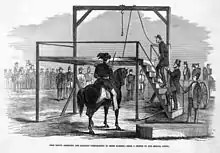

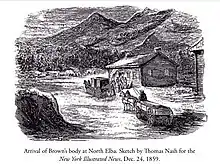
His body was taken by his widow Mary home to his farm in North Elba, New York, and buried there on December 8, 1859.
Background
Brown was, at the time of his execution, the most famous living American: emblem for the North, as Wendell Phillips put it,[1] a mad criminal in the South. His trial was the first in which there was national newspaper coverage, using the still-new telegraph. Reporters and sketch artists were sent to cover the trial. Newspapers and magazines carried many articles on it.
The John Brown affair is the last major event leading up to the Civil War. In fact the Governor of Virginia Henry A. Wise, who was very much involved, thought that the Civil War could begin in 1859 in Charles Town.[2] He moved, at considerable expense, as many Virginia militia as possible to Charles Town, which was said to resemble a military camp.[3]
What to do with John Brown's body was a question of national significance.[4] Union soldiers sang about John Brown's Body as they marched.
Dissection by medical students
Dr. W. C. Hicks, of the New Orleans School of Medicine, offered, in a letter to Governor Wise, to pay Virginia $500 (equivalent to $14,402 in 2020) for Brown's remains, to be used for dissection by medical students. He also pledged that once the skeleton was "properly dried and arranged", he would exhibit it throughout New England, not for money, but to "frighten every Scoundrel Abolitionist out of the country".[5]: 123 "The medical faculty of Richmond College" also requested, on November 2, "the bodies of such as may be executed."[6] Wise instead had the body released to Mary Brown, John's widow, who was awaiting it in Harpers Ferry to take it home for burial. It was the corpse of a son of Brown (only much later identified as Watson) that was turned into an anatomical specimen, with a note saying it was a message to abolitionists (see Burning of Winchester Medical College). The corpses of three other members of Brown's party—Shields Green, John Anthony Copeland Jr., and Jeremiah Anderson—were also used by medical students.
Other proposals
Brown wanted his body and those of his sons burned,[5]: 181 which he said would be much less expensive than burial,[7][8] but that was not allowed in Virginia, the Sheriff said, and Mrs. Brown did not want it either.[9][10] Also, she did not feel up to identifying the partially decomposed body of a son, either Oliver or Watson, dead for over a month.[11][12] She rejected the repeated suggestion of Wendell Phillips, Lydia Maria Child, and others that John be buried "with impressive funeral solemnities" in Mount Auburn Cemetery in Cambridge, Massachusetts, with the erection of a monument. Also she rejected proposals to pack his body in ice, with the rope around his neck, and exhibit it in "all our principal cities and even the minor ones."
The trip to North Elba
Harpers Ferry to Rutland, Vermont
Despite the "great propaganda value" of these proposed measures,[13]: 47 Mary set off early Saturday morning, December 3, on the one daily Baltimore and Ohio express train for Baltimore—the same one Brown stopped on October 16, and Robert E. Lee took home on October 19—with her husband's body. She was accompanied by James Miller McKim and Hector Tyndale. In Baltimore she changed trains for Philadelphia, arriving about 12:30 pm.[14] Mary intended to stop there, rest, and have the body prepared by an undertaker, but the mayor of Philadelphia, accompanied by many policemen, met the train. Although most of the crowd awaiting its arrival consisted of sympathetic Blacks, the mayor told her that public order could not be maintained if her husband's body did not leave Philadelphia immediately. He took a long tool box from a baggage car, covered it, and had it taken away quickly, the crowd following the sham coffin.[15]: 234 Brown's body was taken immediately by ferry to Camden, New Jersey, and from there via the Camden & Amboy Railroad to South Amboy, New Jersey. A Quaker undertaker, Jacob M. Hopper, met the ferry from South Amboy to New York at the ferry port, The Battery. Although Hopper's studio was in Brooklyn, he rented briefly a room at another funeral establishment, McGraw and Taylor, at 163 Bowery, in Manhattan. There is a historic marker.[16] There he removed the body from the plain coffin it came in,[17] washed it, dressed it, and placed it (with difficulty) in a 5 feet 10 inches (1.78 m) walnut coffin.[18] (Brown was much taller than 5' 10".) A small crowd gathered outside the establishment. After resting Saturday night in Philadelphia Mrs. Brown continued to New York on Sunday, spending the night there with friends.[19]: 70
At 7 AM on Monday the 5th, Mrs. Brown, McKim, and the coffin proceeded north on the Hudson River Railroad. They were accompanied by a reporter from the New-York Tribune and Thomas Nast, a sketch artist for Harper's and the New York Illustrated Weekly. Church bells rang and crowds gathered as they proceeded up the Hudson[13]: 48 [20] to Troy, New York, where they were joined by Wendell Phillips, arriving from Boston with the hope of bringing Brown's body to Boston for burial in Mount Auburn Cemetery.[21] An impromptu announcement said this was not going to happen, since Brown had wanted to be buried at his farm.[4] Waiting for the next train they stopped briefly at the American House hotel, where John had often stayed, and whose manager said he had been offered "tempting prices" for the signatures in his register.[20] Another train took them to Rutland, Vermont, where they spent Monday night.
Rutland to North Elba
From 2002 to 2005 a yearly excursion retraced this most difficult part of the trip.[22] In 2005 a guidebook to the route was published.[23][24][25]
On Tuesday morning, December 6, the party continued to Vergennes, where 75 citizens escorted the party to the border of the city, standing in two lines with uncovered heads as the coffin passed by.[26] A "procession of carriages" escorted them to the lake shore, with church bells ringing,[19]: 71 and they boarded a ferry to cross Lake Champlain.[15][20]
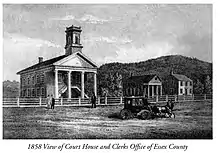
A wagon awaited them at Westport, New York, and took them to Elizabethtown over an abandoned plank road, described as "excessively rough and unpleasant".[25]: 666 Tuesday night, December 6, was spent at Elizabethtown, New York. Brown's body lay in state at the Essex County Courthouse, with an honor guard of six men,[20][15]: 237 [5]: 124 chief among them Orlando Kellogg, "who never tired of telling the story of that December night".[23]: 18 Wendell Phillips gave an impromptu talk of almost two hours on Brown's failed raid, his trial, and his execution.[27] There is a historical marker.[28]
The next day, December 7, the casket and the party, in two wagons, made the "most arduous trip" to Brown's farm.[29][15]: 238 It took a whole day to cover the 20 miles (32 km) from Elizabethtown, through Keene, to North Elba. Everyone had to get off the wagons and walk for part of the day, to lighten the load on the horses. The descent was even more dangerous than the ascent. From Keene to North Elba they went via what is today (2021) called Old Mountain Road,[30][31] not via Indian Pass, as Young misremembered.[15]: 238
Brown's funeral
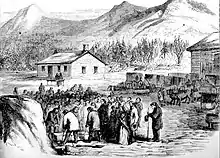
His funeral, with open casket, and burial took place on December 8, 1859, at the John Brown Farm State Historic Site, near modern Lake Placid, New York, where his "body lies a-mouldering", as the Battle Hymn of the Republic says. "Quite a number" of local residents attended.[4][32] Oliver's widow was present, but not the widow of Watson.[19]: 73 It would be many years before their bodies, along with those of Ruth Brown's husband William Thompson and his brother Augustus Dauphin Thompson, were recovered and buried next to their father.[33]
The company sang Brown's favorite hymn, "Blow ye the trumpet—Blow".[34][15]: 239 The hymn's reference to Joel 2:1, "Let all the inhabitants of the land tremble, for the day of the Lord is coming, it is near" was known to those that read the Bible, and it announced the liberation of slaves, for "The year of jubilee is come! Return, ye ransomed sinners, home." Eldest daughter Ruth accompanied on a melodeon, a wedding present from her father,[35] later to occupy a niche in her home in Pasadena, California,[36]
Rev. Joshua Young, from nearby Burlington, heard of the upcoming burial as the body passed through Rutland, and decided to attend, traveling all night—the moon was almost full[37]—and arriving only hours before the ceremony. As he was the only clergyman present—others had declined[38]—Phillips requested that he conduct the funeral service, and Young said he then "knew why God had sent [him] there".[15]: 239 The reporter present, who took it down stenographically, called Young's impromptu opening prayer "impressive":
Our souls are filled with awe and are subdued to silence, as we think of that great, reverential, heroic soul, whose mortal remains we are now to commit to the earth, 'dust to dust,' while his spirit dwells with God who gave it, and his memory is enshrined in every pure and holy heart. ...May we consecrate ourselves anew to the work of Truth, Righteousness, and Love, forevermore to sympathize with the outcast and the oppressed, with the humble and the least of our suffering fellow-men.
...But, father in heaven, in imitation of the self-forgetfulness and self-sacrifice of the great departed, putting aside all personal anguish and all private grief, we supplicate thy special blessing upon God's despised ones—the poor enslaved, for whom our brother laid down his life. O! God cause the oppressed to go free, break any yoke and prostrate the pride and prejudice that dare to lift themselves up; and O! hasten the day when no more wrong or injustice shall be done on the earth; when all men shall love one another with pure hearts, fervently, and love God and do his will with all their soul and all their strength.[39]
James McKim, who had accompanied Mrs. Brown in retrieving the body of her husband from Virginia, then offered remarks, and Wendell Phillips gave what Rev. Young called "one of his matchless speeches... Every hearer saw a great vision—one never to be forgotten".[15]: 239 [20] Phillips "intimated that Massachusetts would yet possess the remains of John Brown."[40]
Brown had requested that he be buried next to the large boulder near his farmhouse. As the body was lowered into the grave, Rev. Young recited the words of Paul just before his death: "I have fought the good fight, I have finished my course, I have kept the faith" (2 Timothy 4:7).[15]: 240 For this specifically, and in general for having presided over Brown's funeral, he found himself reviled upon his return home to Burlington.[15]: 240–242 [41] "I was called all manner of names. I was an anarchist, a traitor to my country, a blasphemer, and a 'vile associate of Garrison and Phillips.'"[42] He was eventually forced to resign his pulpit, and was told he would never get another ministerial position, which turned out not to be true.
Accompanying him back to Vermont, Wendell Phillips repeated his lecture, in a Town Hall full to overflowing, in Vergennes:
John Brown, said Mr. Phillips, represented the idea of the Northern people. He was emphatically one of those old Puritans of whom we love to dream. It is the death of men that make the greatest changes in the world. John Brown's death would effect a great change in American politics. A great man is one who becomes a centre for people to crystallize around. John Brown was such a man.[43]
Mr. Phillips carried to Boston, from North Elba, a "large quantity of valuable matter", intended for Mr. Child's promised memoir of John Brown (which never appeared). This matter consisted of letters and other papers, and photographs of several members of the Brown and Thompson families.[44]
Memorial on July 4, 1860
There was a memorial gathering at the farm of family members, those of his raiders still alive (except Tidd), and friends on July 4, 1860—the last time Brown's family would gather as a group.[45][46] Family scattered to northern Ohio (John Jr., Jason, Owen), Wisconsin (Ruth), and later to southern California (see Owen Brown), and Salmon eventually to Portland, Oregon. The farm was sold, except for the grave site. His widow soon complained to the press about "the multitude of letters addressed to her, for one purpose or another, by entire strangers, who have no claims upon her attention, and who seek to promote their own interest or gratify their curiosity, regardless of the restraints of delicacy and propriety."[47] She would not return to the North Elba farm until the burial of Watson there, in 1882.
References
- Phillips, Wendell (1863). "Burial of John Brown". Speeches, lectures, and letters. pp. 289–293, at p. 292. Archived from the original on 2021-08-27. Retrieved 2021-08-23 – via Google Books.
- Hunter, Andrew (1897). "John Brown's Raid". Publications of the Southern History Association. 1 (3): 165–195, at p. 179.
- "Letters from Charlestown". Baltimore Sun. December 6, 1859. p. 1. Archived from the original on December 9, 2020. Retrieved November 11, 2020 – via newspapers.com.
- "The remains of John Brown". New York Daily Herald. 6 Dec 1859. p. 8. Archived from the original on 20 August 2021. Retrieved 20 August 2021 – via newspapers.com.
- Meyer, Eugene L. (2018). Five for Freedom. The African American Soldiers in John Brown's Army. Chicago: Lawrence Hill Books (Chicago Review Press). ISBN 9781613735725.
- Wise, Henry A. (November 2, 1859). "Letter to Andrew Hunter". In Quincy, Josiah P. (ed.). The Execution of John Brown. Proceedings of the Massachusetts Historical Society. 3rd series. 1 [Vol. 41 of continuous numbering]. pp. 326–331, at p. 329. JSTOR 25079946. Archived from the original on October 13, 2020. Retrieved September 16, 2021.
- "The Execution of Friday Last". New-York Tribune. 5 Dec 1859. p. 5. Archived from the original on 25 August 2021. Retrieved 25 August 2021 – via newspapers.com.
- "Brown's Interview with his Wife". Montrose Democrat (Montrose, Pennsylvania). Dec 8, 1859. p. 2. Archived from the original on September 25, 2021. Retrieved September 7, 2021 – via newspaperarchive.com.
- "Directions about the disposition of his body". National Era (Washington, D. C.). December 8, 1859. p. 3. Archived from the original on December 9, 2020. Retrieved December 9, 2020 – via newspapers.com.
- "The Burial of John Brown". Daily News (London, England). 3 Jan 1860. p. 2. Archived from the original on 6 August 2021. Retrieved 6 August 2021 – via newspapers.com.
- "The Execution of Old John Brown. Full particulars of the prison and gallows scene. Old Brown's Will. He writes his own epitaph. Last interview with his wife and fellow-prisoners, &c. &c". Chicago Tribune (Chicago, Illinois). December 5, 1859. p. 1. Archived from the original on December 9, 2020. Retrieved November 27, 2020 – via newspapers.com.
- "Letter of Gov. Wise to Mrs. Brown". Gettysburg Compiler (Gettysburg, Pennsylvania). December 12, 1859. p. 1. Archived from the original on June 2, 2021. Retrieved July 11, 2021 – via newspapers.com.
- Finkleman, Paul (1995). "Manufacturing Martyrdom. The Anti-Slavery Response to John Brown's Raid". In Finkleman, Paul (ed.). His Soul Goes Marching On. Responses to John Brown and the Harpers Ferry Raid. Charlottesville, Virginia: University Press of Virginia. pp. 41–66, at p. 43. ISBN 0813915368.
- "John Brown's remains". National Anti-Slavery Standard. December 10, 1859. p. 3. Archived from the original on July 11, 2021. Retrieved July 11, 2021 – via accessible-archives.com.
- Young, Joshua (April 1904). "The Funeral of John Brown". New England Magazine. 30 (2): 229–243. Archived from the original on 2021-07-11. Retrieved 2021-07-11.
- "John Brown's Body On The Bowery. McGraw and Taylor Undertakers — 163 Bowery —". Historical Marker Database. 2019. Archived from the original on August 14, 2021. Retrieved August 14, 2021.
- Wise, Henry A. (December 10, 1859) [November 26, 1859]. "To Major-General Wm. B. Taliaferro, in command at Charlestown". Elizabethtown Post (Elizabethtown, New York). p. 2. Archived from the original on July 25, 2021. Retrieved July 25, 2021 – via NYS Historic Newspapers.
- J. M. Hopper, General Furnishing Undertaker (December 4, 1859), [Statement and receipt], Brooklyn, New York, archived from the original on April 27, 2021, retrieved July 11, 2021
- Drew, Thomas (1860). The John Brown invasion; an authentic history of the Harper's Ferry tragedy, with full details of the capture, trial, and execution of the invaders and of all the incidents connected therewith. With a lithographic portrait of Capt. John Brown, from a photograph by Whipple. Boston: James Campbell. Archived from the original on 2021-07-14. Retrieved 2021-07-14.
- "The Burial of John Brown. The passage of the body to North Elba. The funeral. Speeches of Mr. McKim and Mr. Phillips". New-York Tribune. December 12, 1859. p. 6. Archived from the original on May 3, 2021. Retrieved July 11, 2021 – via newspapers.com. (Most of this article appeared in The Liberator, December 16, 1859, p. 3 Archived April 12, 2021, at the Wayback Machine, as well as other newspapers)
- "Telegraphic to the Daily Whig & Courier". Bangor Daily Whig and Courier (Bangor, Maine). 5 Dec 1859. p. 3. Archived from the original on 20 August 2021. Retrieved 20 August 2021 – via newspapers.com.
- "Lest We Forget. A new guidebook follows the path taken home by abolitionist John abrown's coffin in 1859. Brown's burial was 144 years ago this week. Lee Manchester retraces the abolitionist's body's return to his North Elba farm". Lake Placid News. December 9, 2005. p. 27. Archived from the original on 2021-08-14. Retrieved 2021-08-14 – via NYS Historic Newspapers.
- What Mary Brown Saw: A Self-Guided Tour, On the Trail of John Brown, Adirondack History Museum, Elizabethtown, New York, 2005, archived from the original on July 28, 2021, retrieved July 20, 2021. A cultural heritage tour developed by the Essex County Historical Society and Adirondack Architectural Heritage.
- "'What Mary Brown Saw' with AARCH". Lake Placid News. July 4, 2002. p. 13. Archived from the original on 2021-08-14. Retrieved 2021-08-14 – via NYS Historic Newspapers.
- "A Visit to the Adirondack Mountains, in the summer of 1861". Friends' Intelligencer. 18: 650–652, 665–667, 699–701, 715–717, 726–728, 742–743. 1861–1862. Archived from the original on 2021-07-28. Retrieved 2021-07-28.
- "Funeral of John Brown—Wendell Phillips at Vergennes". Vermont Patriot and State Gazette (Montpelier, Vermont). December 17, 1859. p. 2. Archived from the original on July 17, 2021. Retrieved July 17, 2021 – via newspapers.com.
- Turner, David (March 2, 1899). "Historical Reminiscences. Essex County, its Shire Town, Court House and Prominent Men". Elizabethtown Post (Elizabethtown, New York). Archived from the original on 2021-08-23. Retrieved 2021-08-23 – via NYS Historical Newspapers.
- John Brown's Body, Historical Marker Database, 2019, archived from the original on August 14, 2021, retrieved August 10, 2021
- "The Burial of John Brown.—Incidents Along the Route of the Procession—Obsequies at North Elba—The Scene at the Grave—Oration of Rev. J. M. McKim—Interesting Letter from Edwin Coppi[c]—John Brown's Last Epistle to His Wife—Eulogy by Wendell Phillips, &c., &c". New York Daily Herald. 12 Dec 1859. p. 1. Archived from the original on 2 August 2021. Retrieved 2 August 2021 – via newspapers.com.
- Manchester, Lee (May 23, 2000). "Taking a trip on the Old Mountain Road" (PDF). Lake Placid News (Lake Placid, New York). Archived (PDF) from the original on August 23, 2021. Retrieved August 23, 2021.
- "John Brown. A new guidebook follows the route of his body to North Elba (part 2 of 2)". Lake Placid News (Lake Placid, New York). December 9, 2005. p. 34. Archived from the original on 2021-08-14. Retrieved 2021-08-14 – via NYS Historic Newspapers.
- "John Brown, His Raiders, and Their Last Resting Place". Elizabethtown Post (Elizabethtown, New York). August 31, 1899. p. 4. Archived from the original on 2021-08-23. Retrieved 2021-08-23 – via NYS Historic Newspapers.
- Featherstonhaugh, Thomas (April 1901). "The Final Burial of the Followers of John Brown". New England Magazine. Archived from the original on 2020-02-19. Retrieved 2021-07-14.
- "John Brown's Funeral". New-York Tribune. December 10, 1859. p. 5. Archived from the original on July 9, 2021. Retrieved July 11, 2021 – via newspapers.com.
- "John Brown Melodeon". Archived copy. KansaPedia. Kansas Historical Society. 2010. Archived from the original on 2021-08-04. Retrieved 2021-08-04.CS1 maint: archived copy as title (link)
- Nixson, Una B. (July 23, 1893). "John Brown's Family. The Man of Harper's Ferry Fame. His Sons and Daughter. Visit to Their Homes in Pasadena. California. One Who Lived Has Suffered Intensely and Above the Petty Annoyances of Life". The Inter Ocean (Chicago, Illinois). p. 13. Archived from the original on May 25, 2021. Retrieved July 11, 2021 – via newspapers.com.
- "December 1859 - Moon Phase Calendar". MoonGiant. Archived from the original on September 25, 2021. Retrieved December 15, 2020.
- Green, Melinda; Johnston, Karen G. (August 8, 2018). "Joshua Young". Dictionary of Unitarian & Universalist Biography. Unitarian Universalist History & Heritage Society. Archived from the original on April 22, 2020. Retrieved July 11, 2021.
- "The Burial of John Brown. The passage of the body to North Elba. The funeral. Speeches of Mr. McKim and Mr. Phillips". New-York Tribune. December 12, 1859. p. 6. Archived from the original on May 3, 2021. Retrieved July 11, 2021 – via newspapers.com. (Most of this article appeared in The Liberator, December 16, 1859, p. 3 Archived April 12, 2021, at the Wayback Machine)
- "The final disposition of the Remains of John Brown". Elizabethtown Post (Elizabethtown, New York). December 10, 1859. p. 2. Archived from the original on 2021-07-25. Retrieved 2021-07-25 – via NYS Historic Newspapers.
- "(Untitled)". Burlington Weekly Sentinel (Burlington, Vermont). December 16, 1859. p. 2. Archived from the original on July 9, 2021. Retrieved July 11, 2021 – via newspapers.com.
- Lee, John Parker (September 2, 1925). "How It Happened Body of John Brown Came to Town". Rutland Daily Herald (Rutland, Vermont). p. 4. Archived from the original on July 17, 2021. Retrieved July 17, 2021 – via newspapers.com.
- "Funeral of John Brown. Wendell Phillips at Vergennes". Burlington Times (Burlington, Vermont). December 14, 1859. p. 1. Archived from the original on July 17, 2021. Retrieved July 17, 2021 – via newspapers.com.
- "Speech of Wendell Phillips". New-York Tribune. December 12, 1859. p. 6. Archived from the original on May 3, 2021. Retrieved July 11, 2021.
- Keeler, Ralph (March 1874). "Owen Brown's Escape From Harper's Ferry". Atlantic Monthly: 342–365, at p. 365. Archived from the original on 2020-11-07. Retrieved 2021-07-11.
- Hinton, Richard J. (1889). "John Brown and His Men". Frank Leslie's Popular Monthly. 27: 691–703, at p. 701. Archived from the original on 2021-07-11. Retrieved 2021-07-11.
- "Personal". Harpers Weekly: 135. March 3, 1860. Archived from the original on July 11, 2021. Retrieved July 11, 2021.