Jon Halliday
Jon Halliday (born 1939) is an Irish historian specialising in modern Asia. He was formerly a Senior Visiting Research Fellow at King's College London.
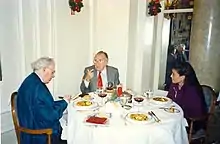
Halliday has written or edited eight books, including a long interview with the U.S. film-maker Douglas Sirk. In addition, he and his wife, Jung Chang, with whom he lives in Notting Hill, West London, researched and wrote a biography of Mao Zedong, Mao: the Unknown Story. The book was highly-praised in the popular press.[1][2] Some scholars offered measured praise of the range of scholarship,[2][3] but more prevalent criticism on factual accuracy, methodology and use of sources.[1][4][5][6][7][8][9]
Halliday is the older brother of the late Irish International relations academic and writer Fred Halliday.[10]
He was educated at University of Oxford and has been married to Jung Chang since 1991.
Bibliography
- Sirk on Sirk: Interviews with Jon Halliday (Secker & Warburg 1971), ISBN 0-436-09924-1
- "Japan and America: antagonistic alliance". New Left Review. New Left Review. I (77): 59–76. January–February 1973. (with Gavan McCormack)
- Japanese Imperialism Today: "Co-prosperity in Greater East Asia" (Penguin 1973), ISBN 0-14-021669-3 (with Gavan McCormack)
- The Psychology of Gambling (Allen Lane 1974), ISBN 0-7139-0642-1 (ed. with Peter Fuller)
- A Political History of Japanese Capitalism (Monthly Review 1975), ISBN 0-85345-471-X
- The Artful Albanian: The Memoirs of Enver Hoxha (Chatto & Windus 1986), ISBN 0-7011-2970-0 (ed.)
- Mme Sun Yat-sen (Soong Ching-ling) (Penguin 1986), ISBN 0-14-008455-X (with Jung Chang)
- Korea: The Unknown War (Viking 1988), ISBN 0-670-81903-4 (with Bruce Cumings)
- Mao: The Unknown Story (Jonathan Cape 2005), ISBN 0-224-07126-2 (with Jung Chang)
References
- "Storm rages over bestselling book on monster Mao". the Guardian. 4 December 2005. Retrieved 14 January 2021.
- Li, J. (2010), "Review of Was Mao Really a Monster? The Academic Response to Chang and Halliday’s Mao: The Unknown Story, by G. Benton & L. Chun" in China Review International, 17(4), 408–412
- Pye, L. P. Mao: The Unknown Story, Foreign Affairs, November/December 2005
- "A swan's little book of ire". The Sydney Morning Herald. 8 October 2005. Retrieved 14 January 2021.
- Goodman, David S.G. (September 2006). "Mao and The Da Vinci Code: conspiracy, narrative and history". The Pacific Review. 19 (3): 361, 362, 363, 375, 376, 380, 381. doi:10.1080/09512740600875135. S2CID 144521610.
- Was Mao Really a Monster: The Academic Response to Chang and Halliday's "Mao: The Unknown Story" (London, New York: Routledge, 2010), p. 9, 11.
- Gao, Mobo (2008). The Battle for China's Past: Mao and the Cultural Revolution. London: Pluto Press. p. 11. ISBN 978-0-7453-2780-8.
- Benton, Gregor; Steven Tsang (January 2006). "The Portrayal of Opportunism, Betrayal, and Manipulation in Mao's Rise to Power". The China Journal (55): 96, 109. doi:10.2307/20066121. JSTOR 20066121. S2CID 144181404.
- Cheek, Timothy (January 2006). "The New Number One Counter-Revolutionary Inside the Party: Academic Biography as Mass Criticism". The China Journal (55): 110, 118.
- A harvest of sorrow
Authority control  | |
|---|---|
| General | |
| National libraries | |
| Other | |