Joseph Berlin
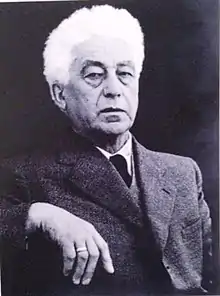
Joseph Berlin (1877-1952) born in Mogilev, Russia (today in Belarus) was an architect who worked in Russia and Mandatory Palestine. He designed over a hundred buildings, mostly in Tel Aviv, Israel.[1][2][3] Berlin emigrated to British-ruled Palestine with his family in 1921. His son Zeev Berlin was also an architect, and the two designed buildings together.[4]
Joseph Berlin | |
|---|---|
 | |
| Born | September 23, 1877 |
| Died | July 18, 1952 (aged 74) |
| Nationality | Russian, Mandatory Palestinian, Israeli |
| Alma mater | Imperial Academy of Arts, Saint Petersburg |
| Occupation | Architect |
| Design | Mograbi Cinema, Tel Aviv |
Works

Former Haaretz building (1932-1973), 56 Maza Street, Tel Aviv, demolished in the 1990s with only the facade preserved
- 1922/25 - Berlin-Pasovsky House
- 1923 - Arza sanatorium, Motza
- 1923/26 - Łodzia House, Tel Aviv
- 1923 - Diesel Power Station, Tel Aviv (16, HaHashmal Street)[5]
- 1924 - Zissman House, Tel Aviv
- 1925 - Ohel Moed synagogue, Tel Aviv
- 1926 - Beit Awad[4]
- 1928 - Mograbi Cinema, Tel Aviv
See also
References
- זנדברג, אסתר (2004-09-02). "ברלין בתל אביב". הארץ. Retrieved 2019-07-18.
- סמואלוב, יובל (2004-10-11). "הצבעים הנוספים של העיר הלבנה". גלובס (in Hebrew). Retrieved 2019-08-17.
- שטרנהל, זיוה (2005-02-28). "הרמוניה מסורתית בפרובינציה מזרח תיכונית". הארץ (in Hebrew). Retrieved 2019-08-17.
- Steinberg, Jessica (24 March 2018). "In a Rothschild Boulevard restoration, eclectic meets modern design". www.timesofisrael.com. Retrieved 2019-10-03.
- "Gallery of the first power stations". Israel Electric Corporation. Retrieved 10 February 2021.
Further reading
- Josef Berlin, Architect: Between Little Tel Aviv and the White City, Baruch Ravid (Binyan Vediur, 2005)
Authority control  | |
|---|---|
| General | |
| National libraries | |
| Art research institutes | |
| Other | |
This article is issued from Wikipedia. The text is licensed under Creative Commons - Attribution - Sharealike. Additional terms may apply for the media files.