Kainuu people
Kainuu people (Finnish: kainuulaiset) are Eastern Finnish inhabitants of the Kainuu region.
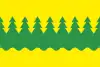 Flag of the Kainuu region | |
| Total population | |
|---|---|
| 70,000–80,000 | |
| Regions with significant populations | |
| Kainuu North Ostrobothnia | |
| Languages | |
| Kainuu dialect of Finnish | |
| Religion | |
| Lutheran | |
| Related ethnic groups | |
| Savonians, other Finns |
Kainuu was settled by Savonians in the 16th century but historically belonged to Ostrobothnia County and Oulu Province. This allowed for a separate Kainuu identity to emerge in the late 19th century.
Kainuu people speak the Kainuu dialect, which is a part of the Savonian dialects of Finnish. Kainuu people are sometimes considered to be Savonians. However, Kainuu people themselves do not think so but have a separate Kainuu identity.[1]
Name
Originally, the area of Kainuu was called "Kajaani Province" (Kajaanin lääni).[3][2] Kajaani is the name of the largest town in Kainuu, although Kainuu is still called "Kajanaland" in Swedish (and the Kainuu people "kajanaländare").
In the early 20th century, when the Kainuu identity was forming, multiple names were used for the region, such as Kainuu, Kainuunmaa (land of Kainuu), Korpi-Kainuu (Wilderness Kainuu), Nälkämaa (Hunger land) and Ylimaa (Upper land).[4] Eventually the name Kainuu, which was supported, for example, by the local newspaper Kainuun Sanomat, became the standard. In the newspaper, Kainuu people were usually called Kainuun kansa (the people/nation of Kainuu). Other terms used included kyntäjäväki (plowing people), talonpoikaiskansa (peasant people), korpiloukkojen kansa (people of wilderness hollows), and Kalevan heimo (tribe of Kaleva).[5]
History
Savonians started moving to Kainuu in the 1550s, encouraged by the Swedish king Gustav Vasa. At the time, there were no fast settlements or villages in Kainuu. Since the Treaty of Nöteborg in 1323, the area had belonged to Russia, and the Swedish rulers wanted to increase the Finnish presence in the area for political reasons.[6] In the coming decades, Russians tried to get rid of the Swedish settlements that had spread to their lands by raiding and destroying Kainuu villages and murdering the men, women and children.[7] After the Russo-Swedish War of 1590–1595, in the Treaty of Teusina in 1595, Kainuu was made a part of the Kingdom of Sweden.[8][2]
Dialect
Kainuu people speak the Kainuu dialect which is one of the Savonian dialects of Finnish. It differs from other Savonian dialects in its vocabulary which has been heavily influenced by North Ostrobothnian dialects, especially in the speech of younger people.
One common feature in the dialect is diphthong reduction: Kaenuu ("Kainuu").[9]
Example from Puolanka: Sittä meijät meärättiin, kahenkymmenen kilometrim peähän syömmoalle, jossa ei ollu ´asunttoa muuta kun, viienkymmenev vuov vanaha kämpärroato. Ja pakkane. No siihen kum me ruvettiin kiuasta tekemää sittä. Purosta kivet otettiin ja, sieltä urkittiin savi ja, tehtii kaksi piisiä. No niillä reistattiin sulatas sitte stä kämppeä. No eihän se sulanus siinä. Monta yötä seisallaav itekkuhi ´oli ja savuo kämppä täynnä ja, vielä vettä valu niskaan sittä laipijosta.[10]
In standard Finnish: Siitä meidät määrättiin, kahdenkymmenen kilometrin päähän sydänmaalle, jossa ei ollut asuntoa muuta, kuin viidenkymmenen vuoden vanha kämpänraato. Ja pakkanen. No siihen kun me ruvettiin kiuasta tekemään siitä. Purosta kivet otettiin, ja sieltä nostettiin savi, ja tehtiin kaksi piisiä. No niillä yritettiin sulattaa sitten sitä kämppää. No eihän se sulanut siinä. Monta yötä seisaallaan itse kukin oli ja savua kämppä täynnä, ja vielä vettä valui niskaan siitä laipiosta.
Description and stereotypes
In the late 19th century and early 20th century, Kainuu was a poor region that had often suffered from famines.[11] Kainuu got a reputation of being a "hunger land", which is reflected in the regional anthem of Kainuu, Nälkämaan laulu ("Song of the Hunger Land"). It was seen as a harsh place to live. On the other hand, these descriptions praised the striking nature of Kainuu, as well as the strength and sisu of the Kainuu people.[12] Kainuu people have been described as honest,[13] hard-working, quiet,[14] independent, calm, lacking confidence, uncertain, polite, hospitable, and complaining. Bragging has traditionally been seen as a negative trait, possibly a factor in causing the perceived large amount of complaining instead.[15] Kainuu people are also seen as being proud of their homeland and feeling a strong connection to it.[16]
Authors from Kainuu have played a part in creating the impressions of Kainuu and its people. Author Ilmari Kianto, from Suomussalmi, often described the poor conditions of the Kainuu wilderness. Author Veikko Huovinen, from Sotkamo, described nature.
Culture
National dresses

National dresses in Finland are reconstructed from 18th and 19th century festive clothing used by commoners. The following national dresses have been reconstructed and officially recognized from Kainuu: Kainuu dress for women, Kainuu suit for men, and Suomussalmi dress for women.
Kainuu women's national dress was designed by Tyyni Vahter and released in 1947. The sewing patterns were checked for historical accuracy by craft teacher Eila Parviainen, applied arts bachelor Minna Meriläinen and homemade craft teacher Marja-Leena Pahkala. Kainuu men's national suit was officially accepted in 2001.[17] Suomussalmi women's national dress was designed by Tyyni Vahter in 1953 based on materials collected by Selma Juntunen. One basis for the dress were U. T. Sirelius's descriptions of the Southern Lapland dress as it was based on a vest found from Hyrynsalmi.[18]
Festivals
The Finnish harvest festival Kekri is celebrated in Kainuu. Up until the early 20th century, Kekri was a more important holiday than Christmas. Christmas was seen more as a celebration of the upper classes, and Kekri held a meaning for the peasants. It was celebrated at the end of the harvest and included elements such as dressing up, fortune telling for the coming year, and burning bonfires. Due to urbanization, Kekri lost its importance, and many of the Kekri traditions have moved to now widely celebrated Christmas and New Year. The Finnish Father Christmas figure, Joulupukki, has his origins in a character called Kekripukki.[19] Regardless of this, Kekri celebrations are still organized in Kainuu. Kajaani has been holding a Kekri celebration annually since 2002. This includes the burning of a Kekri goat (giant goat made out of straw), as well as music performances, art shows, catering, children's activities, markets, and other events depending on the year.[20][21] The heavy metal concert KekriFest has also been held, for the first time in 2019.[22]
Famous Kainuu people
- Daniel Cajanus, giant
- Anders Chydenius, philosopher
- Veikko Huovinen, author
- Joonas Kemppainen, ice hockey player
- Marko Kemppainen, skeet shooter
- Ilmari Kianto, author
- Heikki Kovalainen, Formula 1 driver
- Anne Kyllönen, cross-country skier
- Merja Kyllönen, politician
- Jenna Laukkanen, swimmer
- Eino Leino, author and poet
- Laura Malmivaara, actress
- Väinö Markkanen, sports shooter
- Kaisa Mäkäräinen, biathlete
- Riku Nieminen, actor
- Janne Pesonen, ice hockey player
- Osmo Tapio Räihälä, composer
- K. J. Ståhlberg, 1st President of Finland
Notes
- Helo (2006:61).
- Helo (2006:24).
- Väisänen (1998:13).
- Helo (2006:26).
- Helo (2006:34–35).
- Jutikkala; Pirinen (2002:93–94).
- Väisänen (1998:26–27).
- Väisänen (1998:30–31).
- Vattula, Laura (2019). Kulkemista ja paikallaan olemista ilmaisevat verbit Kainuun murteen verbisanastossa. University of Oulu. Page: 19.
- Puolangan murrenäyte. Kotimaisten kielten keskus. Retrieved 2021-06-29.
- Väisänen (1998:213).
- Helo (2006:37–38)
- Helo (2006:61).
- Rask, Regina (2015). Heimoerot: kainuulaiset. yle.fi. Retireved 2021-06-29.
- Helo (2006:46–47).
- Helo (2006:63).
- Kainuun kansallispuku. kajaani.fi. Retrieved 2021-12-15.
- Suomussalmen kansallispuku. suomussalmi.fi. Retrieved 2021-12-15.
- Pape-Mustonen, Terhi (2019). Luulitko, että halloween on amerikkalainen juhla? Syksyn kummitusjutut ja naamiaisasut ovat myös ikivanha suomalaisperinne. maaseuduntulevaisuus.fi. Retireved 2021-07-20.
- Loukasmäki, Arto (2012). Roihuava pukki kerää katselijoita. yle.fi. Retrieved 2021-07-20.
- Suutari, Tiina (2020). Kekrijuhla monipuolistuu ja tuo valotaidetta linnanraunioille – valopatsaat nousevat yli kilometrin korkeuteen. kainuunsanomat.fi. Retrieved 2021-07-20.
- Kähkönen, Sanna (2019). Stam1na ja Klamydia marraskuussa Kajaaniin – "Vuoden pimeimpään aikaan sopii raskas musiikki". yle.fi. Retrieved 2021-07-20.
References
- Väisänen, Heino (1998). Kainuun kansan waiheita vv. 1500 – 1900. Gummerus Kirjapaino Oy. ISBN 952-91-0373-5.
- Helo, Maria (2006). Kainuulaisuus – Omakuva ja alueellinen identiteetti. University of Joensuu.
- Jutikkala, Eino; Pirinen, Kauko (2002). Suomen historia. Sixth edition. WSOY. ISBN 951-0-27217-5.