Kamuōichi-hime
Kamuōichihime is a Goddess from Japanese mythology.
Overview
A deity who appears only in Kojiki, in the genealogy of Susanoo-no-Mikoto. He is the son of Oyamatsumi, and after Kushinada-hime, became the wife of Susanoo-no-Mikoto, and gave birth to Otonen and Ukanomitama (Inari Ōkami).
Both of these gods are associated with farming, and Kami-Oichihime is also worshipped as a god of farming and food. In the name of the deity, "Kami" is a prefix that is used in reverence for the intense invocation of the divine spirit, "Dai" means "great and splendid", and "Ichiba" means a place where people gather to barter, and the name is thought to be "divine and splendid market"[1]. For this reason, it is worshipped as the guardian deity of the market.
The mountain gods were also capable of providing a marketplace for bartering goods on land and sea, and are thought to represent Godaiichihime as the alter ego of Oyamatsumi.[2].
As a deity in Shinto shrines, she is often worshipped under the divine name of Otoshi-Goshi-no-Kami.
Genealogy
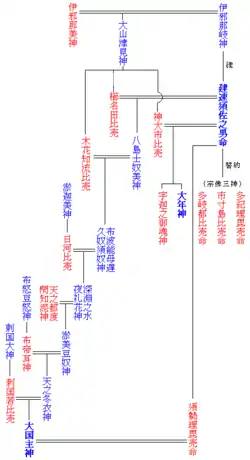
She is the daughter of Oyamatsumi-kami and Susanoo-no-Mikoto, who gave birth to Onenkami and Ukanomitama.
Shrines to worship
- Otoshi Mikoto Shrine in Shizuoka Sengen Shrine (Shizuoka (city)|Shizuoka CityAoi-ku)
- Ichi Shrine (Aichi PrefectureTsushima City)
- Yuda Shrine (Mie PrefectureIse City, Omata-cho)
- Ichihime Shrine (KyotoKyoto CityShimogyo-ku)
- Ouchi Shrine (Okayama PrefectureBizen City)
- Inari Shrine (Okayama PrefectureKurashiki, Kurashiki Chaya-machi)
However, compared to the large number of shrines dedicated to Susano-no-mikoto and his children, there are extremely few.
Other
Nara Prefecture Sakurai City 3rd century The Hashihaka Kofun, which is said to have been built in the middle of the year The inscription [lower-alpha 1].
Fushimi Inari Taisha's shrine deity "Omiya Nosetsu Ogami" is sometimes equated with Ame no Uzume, but this is called "[[Twenty] -Two Shrines | Nijunisha Note]]] and "Inari Shrine Thoughts" are devoted to Oichi Himemei.
Notes
- The ruler is Hashihaka Kofun, and "Oichi" is generally regarded as the place name.
参考文献
- Shincho Japanese Classic Collection: Kojiki
- Shincho Japanese Classic Collection: Kojiki