Kamuyaimimi
Kan'yai Mimi no Mikoto[1], year of birth unknown - Emperor Suiyasu, 4 April) is a member of the Japanese Imperial family.
Kamuyaimimi | |
|---|---|
| Born | unknown |
| Died | Emperor Suizei April 4th Yamato Province |
| Father | Jimmu |
| Mother | Himetataraisuzu-hime |
He was the son of the first Jimmu, and is generally considered to be the half-brother of the second Suiyasu, although there are different theories about this lineage. He is said to be the ancestor of Tajin and his clan.
Genealogy
A genealogical tree based on the Nihon Shoki
| Himetataraisuzu-hime | Jimmu | Ahiratsu-hime | |||||||||||||||||||||||||||
| Kamuyaimimi | Emperor Suizei | Tagishimimi | |||||||||||||||||||||||||||
According to the Nihon Shoki, he was the son of Emperor Jimmu and Ehime Tout Bellows Isuzuhime no Mikoto (daughter of Kotoshironushi), and the Kojiki also gives his mother as Hime Tara Isuke Yorihime (daughter of Ōmononushi).
In the Nihon Shoki (Chronicles of Japan), the same name is given to the emperor's younger brother, Kannuina Kawamimi (Kannuma Kawamimi-no-mikoto, the second Emperor of Suizei), and in the Kojiki (Records of Ancient Matters), the same name is given to the emperor's older brother, Hiko Yatsui-no-mikoto (not in the Chronicles of Japan).
The Shinsen Shishi, on the other hand, lists Tegenmimi-no-mikoto, the son of Emperor Jimmu and Abirahime, as the same mother and brother, in which case Gisumi-no-mikoto, the same mother and brother of Tagishimimi-no-mikoto in the Kojiki, and Kamiyai-no-mikoto may overlap as the same person.
In the Shinsengumi Seijiroku, there is a different theory that Hikohaimikoto is the son of Kamihaimikoto. However, given the similarity of their names, it appears that Kamiyamimikoto and Hikoyamimikoto are essentially the same person, and in fact, the name Hikoyamimikoto does not appear in the "Aso Family Tree" or the "Monzan Family Tree" in the 16th volume of the "Various Genealogical Records," and the "Aso Family Tree" refers to Takewatsuhiko-no-mikoto, who is the son of Hikoyamimikoto (grandson of Kamiyamimikoto), as the son of Kamiyamimikoto.
Record
"Nihon Shoki" According to Emperor Suizei's coronation, his older brother, Tagishimimi, who was good at the experience of morning affairs, In order to take up Throne, he tried to harm his younger brother, Kamuyaimimi and Kamuya Suizei (Tagisimi Mi's rebellion). The Kammaki and Tagishimimi brothers who learned of this plot were in Kammaki (Nara Prefecture Kita Katsuragi County [[Ōji] in November of their own year. , Nara | Oji Town]] ・ Kammaki Town ・ Kammaki Town or near [2]) I attacked Tagishimimi, who was lying in Omuro, and defeated him. At this time, Kamuyaimimi trembled in his limbs and could not shoot an arrow, and instead, Kamuyaimimi was shot and killed. Kamuyaimimi was deeply ashamed of this blunder and recommended his younger brother to the throne (2nd generation Emperor Suizei), and he helped the emperor to take control of the Shinto. And it is said that Kamuyaimimi was Demise in April of the 4th year of Emperor Suizei.[3][4]
A similar narrative is written in "Kojiki".
Tombs and mausoleums
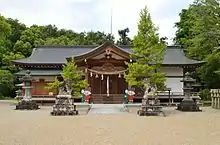
His tomb is unknown. In the Nihon Shoki (Chronicles of Japan), Kamiyai Mimi-no-Mikoto is said to have been buried "north of Mount Unebi".[5] The Hachiman Shrine (152 Yamamoto-cho, Kashihara, Nara, Nara Prefecture), located north of Mount Unebi, is said to be the location of the tomb of Kamiyamimikoto and was called "Yatsui Shrine" in ancient times.
It is also said to have been the location of the grave of the god Yatsuimimi-no-mikoto, and was called "Yatsui Shrine" in olden times. It is also said to be the Ujigami shrine of the Ta clan, the Tawaramoto, Nara of the Nara Prefecture Isogi-gun Tawaramoto-cho, and the Sōja (Shinto, Osaka Prefecture, Fujiidera City, and other shrines, where the spirit of life is enshrined.
Descendants
Clans
In the book Nihon Shoki, Kamihaimimi no Mikoto is described as the ancestor of the Taomi (the Ta clan).[6]
In the Kojiki (Records of Ancient Matters), he is the ancestor of 19 clans, including Yitomi, Ogobe-Ren, Sakagobe-Ren, Hikun, Oita-Kun, Aso-Kun, Chikushi-SankeRen, Jakobe-Somi, Jakobe-Zo, Konage-Zo, Toki-Nao, Iyo-Kunozo, Kano-Kunozo, Michi-Oku Ishiki-Kunozo, Jodo Naka-Kunozo, Nagasa-Kunozo, Ise-Funaki-Nao, Owari-Tanba-Somi, and Shimada-Somi.
In the Sekaiyo Kyu-jihonki, "The Emperor's Main Chronicle", the descendants are listed as Ihoomi (Tamomi), Shimadaomi, and Jakubuzo.
In addition, the following Clans are listed as Kinships in Shinsengō Seijiroku: [7]
- Sakyo Emperor Besshi Tasaomi - Origin is after Kamiyamimi-no-mikoto, the prince of the posthumous Jimmu.
- Sakyōbetsu Kōkobe Shukune - Same ancestor as Tasaotomi. After Kamiyaimimi.
- The same ancestor as Tazomomi. After Kamiyamimi-no-mikoto. In the same article, the fifth grandson is named Mueiga-zen-no-mikoto, and the seventh grandson is named Nakatomi-kogami.
- The same article names Mueigamae no Mikoto as the fifth grandson and Nakatomi no Kojo as the seventh grandson. After Hikohaimimi-no-mikoto, the son of Kamihaimimi-no-mikoto.
- Ukyo imperial ancestor, Shiki-shu. After Kamihachiimimi-no-mikoto.
- Ukyo imperial ancestor Sonobe - Same clan.
- [[Yamato Province
- Yamato Province Hinao - Same ancestor as Tasaotomi. After Kamihaimimi-no-mikoto.
- Kawachi Province Imperial Ancestor: Shiki Kenshu. After Kamihaimimi-no-mikoto.
- Konguchi Prefecture - Same ancestor as Shiki Prefecture. After Kamihaimimi-no-mikoto.
- This is the same ancestor as Shiki-Kenju. After Kamihaimimi-no-mikoto.
- Izumi Province, the same ancestor as Tajotomi. After Kamihaimimi-no-mikoto.
- Izumi Province by imperial ancestor Jakobe-Ren - After the same kami Yatsuimimi-no-mikoto.
- Shiki-kenshu - Same ancestor as Jakube-omi.
Kunizukuri
As mentioned above, the Kojiki refers to him as the founder of the Iyo-kokuzo, Kano-kokuzo, Dooku-shiki-kokuzo, Jodo-naka-kokuzo, and Nagasa-kokuzo.
The following nokuzos are listed as descendants in Sekaiyo Kyu-jihonki and Kokuzo Honki.
- Inba Kuniatsukō - In the reign of Karashima Toyomei (Emperor Ōjin), Inba Kuniatsukō appointed the eighth grandson of Kamiyamimimi no Mikoto, Itokutō no Mikoto, as Kuniatsukō. This is the area around Inba-go in the later Shimōsa Country Inba-gun.
- Kano Kunozo - In the reign of Emperor Sujin, the third grandson of Takemitsuhiko-no-mikoto, son of Kamiyamimi-no-mikoto, was appointed Kunozo. In the reign of Shinano Province [[Chiisagata District, Nagano
- Aso Kunizukuri - In the reign of Emperor Suiko, Hayabetsutama-no-mikoto, the grandson of Kamiyamimimi-no-mikoto, the same ancestor of the Fire Kunizukuri, was appointed Kunizukuri. This is the area around the future Aso-go in Higo Province Aso County.
In addition to the above, the same book states that Hayagokami-no-mikoto, son of Shikidigitahiko-no-mikoto, the same ancestor of the Iyo-kokuzo, was appointed as the Iyo-kokuzo, Kenhenma-no-mikoto, the same ancestor of the Iyo-kokuzo, as the Naka-kokuzo, and Tatewo-gumi-no-mikoto, son of Shikitanahiko-no-mikoto, the same ancestor of the Oita-kokuzo, as the Aso-kokuzo.
People
In the Shoku Nihon Kōki and the Nihon Sandai Jitsuroku, the following people are listed as descendants of Kamiyamimi-no-mikoto.
- Kenju Maeri-ren Ujimasu (a Ukyo man)[8]
- Shiki-kenju Sadanari, Shiki-kenju Fukunushi, and Shiki-kenju Fukuyori (all Kawachi Province Shiki-gun people)[9]
- Tajishuimaro (Ukyojin)[10]
- Daisadacho (a Shinano Province (Suwa District, Nagano) man)[11]
Major shrines dedicated to Kamiyamikoto
- Soma Myoumimiya Ohkamikawa Shrine (Hokkaido, Kamikawa-gun, Kamikawa-cho, Kita-machi) - Rubeishibe Shrine, enshrining Kamiyamimikoto[12][13] 合祀
- Oi Jinja (Ibaraki Prefecture, Kasama City, Oobuchi Aza Wadai) * Shiki-naisha
- Tata Shrine (Niigata Prefecture []Kashiwazaki City]], Soji) * Shikinai-sha
- Funaki-sha (Tenohigansha) (Ishikawa-ken, Kashima-gun, Nakanoto-machi)
- Ken-Ooka Shrine (Nagano Prefecture, Nagano City Ooka Kou)
- Kenomikata Tominomikoto Hikokami Bessha Shrine (Nagano City, Nagano Prefecture, Shinshu-Shinmachi, Oaza-Mizunai Saimiya)* Shikinai-sha
- Yamaya Shrine (Nagano, Ueda City Sanada Town) * Shikinaishisha
- Daijinja (Aichi Prefecture Ichinomiya City Yamato Town, Oho Goshinaka) * Shikinai-sha
- Niwa Shrine (Niwa Aza Miyaura, Ichinomiya City, Aichi Prefecture) * Shikinai-sha
- Maeri Shrine (Miyazoe, Saito, Niwa-gun Fuso-cho, Aichi Prefecture) * Shikinai-sha
- Taijinsha (Mie Prefecture Yokkaichi City, Okane Town) * Shikinai-sha
- Mimitsune Shrine (Shimonomiya-cho, Yokkaichi City, Mie Prefecture) * Shikinai-sha - Heian period, a seated wooden statue of a male deity[14] seated wooden statue of a male deity] estimated to have been made in Heian period has been handed down.
- Shiki-kenshu-shinsha (Osaka Prefecture Fujiidera City)
- Taza Mashiri Miyako Shrine (Nara Prefecture, Isogi-gun, Tawaramoto-cho)
- Shimada Shrine (Yashima-cho, Nara City, Nara Prefecture) * Shikinai-sha
- Date Shrine (Wakayama Prefecture Wakayama City, Sonobe) * Shikinaishisha - It is said that Kamihaimimi-no-mikoto was enshrined together by the Sonobe clan in the Middle Ages.
- Sasaku-jinja (Ehime Prefecture Saijo City, Anyo) * Shikinaishisha
- Fueida Shrine (Kumamoto Prefecture, Kumamoto City, Minami-ku, Miyuki Fueida)
- Otokonari Shrine (Kumamoto Prefecture, Kamimashiki District, Kumamoto 男成)
- Saizu Shrine (Saizu-cho, Amakusa-shi, Kumamoto Prefecture)
The following are shrines whose current deity is not Kamiyamikimi-no-mikoto, but who are also said to be related to him.
- Oi Shrine (Ibaraki Prefecture, Mito CityIitomi-cho) * Shikinaishasai Shrine - The deity is the first Nakaguni-zukuri Kenkuma-no-mikoto, but there is a theory that it was his ancestor, Kamiyamimimi-no-mikoto.
- Some say that the deity was the ancestor of the deity Kamiyamimikoto.
- There is also a shrine outside the precincts dedicated to Itokuturinomikoto, a descendant of Kamiyamimikoto and the first Inba Kunizukuri, whose tomb is said to be kofun.
- Akutomi Shrine (Iitomi, Sodegaura City, Chiba Prefecture) * Shikinai-sha - It is said to have been founded by Kamihaimimi-no-mikoto.
- Hase Shrine (Haseji Jinja) (Shinonoi Shiozaki, Nagano City, Nagano Prefecture) * Shikikuchi-sha - The deity "Yasei-taishin" is traditionally said to be the grandson of Kamihaimimi-no-mikoto.
- Ogata-jinja Shrine (Miyayama, Inuyama-shi, Aichi Prefecture) * Shikinai-sha - There is a tradition that the deity "Ogata-o-kami" is the grandson of Shine Hachimimi-no-mikoto and the ancestor of Tanegata-kun, Mueigamaen-no-mikoto.
- Nishikurobe-cho, Matsusaka-shi, Mie Prefecture * Shikinai-shisha - The shrine is said to have been founded by the people of the Ta clan, descendants of Kamiyai-mikoto.
Kuroda Shrine (Hojo-cho, Fujiidera City, Osaka Prefecture) * Shikinai-sha - A shrine within a Shikinai-sha - Tradition says that it is the mausoleum where Kamihaimimi-no-mikoto was hidden.
- Yatsui Shrine (Yamamoto-cho, Kashihara, Nara) - Traditionally believed to be the mausoleum of Kamihachiimikoto.
- Iyo Shrine (Kanzaki, Iyo-gun Matsumae Town, Ehime Prefecture) - This shrine is dedicated to Hayagokami-no-mikoto (Hayagokami-no-mikoto), the first Iyo-koku-zukuri, a descendant of Kamiyamimikoto.
- Kengun Shrine in Higashi-ku, Kumamoto City, Kumamoto Prefecture - The shrine enshrines Kenogumi-no-mikoto (Kenjun-daishin), a descendant of Kamiyamimikoto and the first Fire Nation Builder.
- The shrine is dedicated to Takachiho Shrine, a descendant of Kaminoyaimimi-no-mikoto, the first Fire Nation Builder.
- Kutsureya Shrine (Oaza-Mitai, Takachiho-cho, Nishi-usuki-gun, Miyazaki Prefecture) - Same as above.
- Kushifuru Shrine (Oaza Santai, Takachiho-cho, Nishimuki-gun, Miyazaki Prefecture) - Same as above. There is also a theory that he is the national dragon god enshrined at Aso Shrine.
References
- Kan'yai Mimi no Mikoto (ancient clan)} 2010.
- Tagishimimi (Ancient Clan) & 2010 (2010) ).
- Kamuyaimimi (ancient clan) & 2010 (2010).
- Tagishimimi (Ancient Clan) & 2010 (2010).
- Kamiyai Mimi-no-Mikoto (ancient clan)} & 2010 (Heisei 22).
- Kamihaimimi no Mikoto (ancient clan)} & 2010 (Heisei 22).
- Kamihaimimi-no-mikoto (Ancient Clan)} & 2010 (Heisei 22).
- Article 5, April 8, Jouwa 8, Shoku Nihon Kouki. He was given the surname Kenren.
- "Nihon Sandaimoku Jitsuroku", Article 23, February 4, Jogan 4. The surname was changed to Shukune.
- "Nihon Sandai Jitsuroku", article of September 5, Jogan 5. His surname was changed to Shukune.
- "Nihon Sandais Jitsuroku", September 5, Jōkan 5, article. He was given the surname of Ochoomi.
- Rubeishibe Shrine, enshrining Kamiyamimikoto Oma, was built by settlers from Aichi Prefecture in 1906, and was The shrine was enshrined together with the temporary shrine of Myokenmiya Soma Shrine in 1925. "The shrine was enshrined together with the temporary shrine of Myoumimiya Soma Shrine in 1925."
- Announcement of the annual festival of Ohkamigawa Shrine in 2020
- https://bunka.nii.ac.jp/heritages/detail/399891/5