Kanamara Matsuri
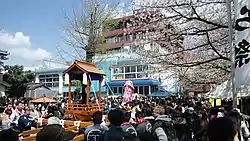
The Shinto Kanamara Matsuri (かなまら祭り, "Festival of the Steel Phallus") is an annual Japanese festival held each spring at the Kanayama Shrine (金山神社, Kanayama-jinja) in Kawasaki, Japan. The exact dates vary: the main festivities fall on the first Sunday in April. The phallus, as the central theme of the event, is reflected in illustrations, candy, carved vegetables, decorations, and a mikoshi parade.[1][2][3][4][5] The shrine is part of the Wakamiya Hachimangu Shrine[6] and located near Kawasaki-Daishi Station.
| Kanamara Matsuri | |
|---|---|
 | |
| Observed by | Kanayama shrine, Kawasaki, Japan |
| Type | Religious |
| Date | First Sunday in April |
| 2020 date | April 5 |
| 2021 date | April 4 |
| 2022 date | April 3 |
| 2023 date | April 2 |
| Frequency | annual |
The Kanamara Matsuri is centered on the Kanayama Shrine where the god Kanayama-hiko and the goddess Kanayama-hime are venerated. They are both gods of blacksmithing, metalsmithing, and metal works, and are also prayed to for easy childbirth, marital harmony, and protection from sexually transmitted infections.[6][7]
The festival started in 1969.[8] Today, it has become something of a tourist attraction and is used to raise money for HIV research.[9]
Mikoshi
At the Kanamara Festival, three portable shrines, "Kankiiamara Mikoshi," "Kanayama Boat Mikoshi," and "Elizabeth Mikoshi," are patrolled.
- Kanamara Mikoshi
- A portable shrine with a square base and a roof. A wooden phallus is housed inside. The oldest of the three portable shrines.
- Kanamara Boat Mikoshi
- A portable shrine with a boat-shaped base and a roof. Inside, a glowing black iron phallus is housed upwards. It was donated by Hitachi Zosen.
- Elizabeth Mikoshi
- A portable shrine with a huge pink dildo on the base. There is no roof. This portable shrine was donated by the crossdressing club (女装クラブ) "Elizabeth Kaikan " in Asakusabashi. The other two portable shrines are mainly carried by local parishioners, while the bearers are mainly women dressed as Elizabeth Hall, and they are patrolling with a unique shout of "Kanamara!" In 2016 this shrine switched to being displayed on a wheeled trolley.[10] In 2017, the cruising on the road was revived,[11] but it was a one-way trip to Daishi Park, and after being covered with a white cloth in the park, it was pushed back to the shrine.
Gallery
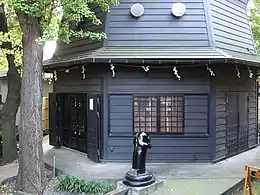 Kanayama Shrine
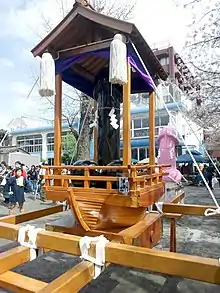 Kanamara mikoshi
 Penis (and vulva) candy
See also
- Hōnen Matsuri (Harvest Festival), whose main features include a 2.5 meter-long wooden phallus
- Phallic processions
- Tyrnavos, a city in Greece that holds an annual phallus festival
- Ōkunitama Shrine (friendship shrine)
References
- "Dammit, we missed The Festival of the Steel Phallus in Japan this weekend - Cosmopolitan". cosmopolitan.co.uk. Archived from the original on 2014-04-13. Retrieved 2014-04-11.
- Dominique Mosbergen (7 April 2014). "Japan's Annual Penis Festival Is As Phallic As You'd Expect (PHOTOS)". huffingtonpost.com. Retrieved 2014-04-11.
- Times LIVE. "Japanese festival celebrates the penis - Times LIVE". timeslive.co.za. Retrieved 2014-04-11.
- "The World Today Archive - Japan's Festival of the Steel Phallus". abc.net.au. 2001-04-02. Retrieved 2014-04-11.
- "BBC - Travel - Slideshow - Ten events not to miss in April". Archived from the original on 2014-03-31. Retrieved 2014-04-11.
- "神奈川県神社庁/神社検索/若宮八幡宮". www.kanagawa-jinja.or.jp. Retrieved 2021-06-24.
- "金山神社". jinjajin.jp. Retrieved 2021-06-23.
- 世界も驚くニッポン旅行100: テーマでめぐる!47都道府県ローカル旅 PHP研究所, Jul 4, 2013
- "Kanamara-Matsuri | World's weirdest festivals". Herald Sun.
- 黒木貴啓 (2016-04-07). "客の露出行為で男根型モニュメントを自粛した奇祭「かなまら祭」 2016年度の改善に見る、神事存続への想い". ねとらぼ. Retrieved 2020-02-28.
- 和才雄一郎 (2017-04-02). "【かなまら祭り2017レポート】今年の「男根みこし」は上下左右ムーブあり! 昨年より壮観さがアップして大盛況 / 動画&画像あり". ROCKET NEWS 24. Retrieved 2020-02-28.
External links
 |
Wikimedia Commons has media related to Kanamara Festival. |
- A day at the Kanamara Matsuri in Yamasaki
- The shrine's festival webpage (Japanese)
- Kanamara Matsuri Video