Kanchi Kamakoti Peetham
Sri Kanchi Kamakoti Peetham, also called the Sri Kanchi Matham or the Sri Kanchi Monastery, is a Hindu institution, located in Kanchipuram, Tamil Nadu. It is located near a temple dedicated to Goddess Sri Kamakshi (Durga, Kamakoti, Maha Tripurasundari) of the Shaktism tradition, along with a shrine for the Advaita Vedanta teacher Adi Shankara.[2] Sri Kanchi Kamakoti Peetham is also referred to as Moolamnaaya Sarvagya Peetham [3] The Mutt has unbroken lineage of Spiritual heads (Acharyas) descending from Sri Adi Shankara himself. Its founding is attributed by its followers to Adi Shankara,[1] though this is categorically dismissed by all the four cardinal Sankara mathas established by Adi Sankara as per his own work Mathamnaya Setu:[4] according to the Sringeri matha, Purī Govardhana Pīṭhaṃ and the Dwarka Sharada Peetham, who legally holds the Jyotir Math[5] as well. Adi Sankara in this work does not hold Kanchi among the original mathas established by him.[6][7][8][9][10][11][12] This is disputed as in Anantanandagiri's [13] biography of Shankaracharya, it is said that Sankara established a Math at Kanchi fit for his own residence and his living there.
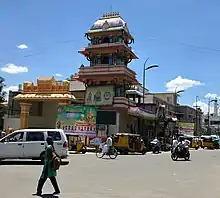 Entrance tower of the Kanchi Kamakoti Peetam monastery | |
| Founder | Adi Shankara[1] |
|---|---|
| Type | Religious |
| Location |
|
First Jagadguru | Adi Shankara |
Present Jagadguru | Vijayendra Saraswati Swamigal |
| Affiliations | Hinduism |
| Website | http://www.kamakoti.org/ |
According to the Sri Kanchi matha documents, the matha shifted south to the temple city of Kumbakonam in mid-18th-century, when there was warfare in the region. It returned to original Kanchipuram in the 19th-century.[14] The matha is a living tradition, that continues to pursue spiritual scholarship in contemporary times.[15] The Kanchi monastery, along with its sister monasteries across India, has also been an important preserver and source of historic palm leaf manuscripts.[16][17] The head of the matha is also referred to as a "Sankaracharya". Since February 2018, the institution has been led by Vijayendra Saraswathi Shankaracharya Swamigal.[18]
Some of the Illustrious previous pontiffs include Sri Paramasivendra Saraswati guru of Sadasiva Brahmendra, Sri Bodhendra Saraswathi, Sri Mooka Sankaracharya author of Mookapanchasti , Sri Chandrashekarendra Saraswati etc,.
History
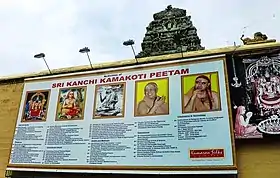
According to the Kanchi matha's tradition, their monastery was founded in Kali 2593 (509 BCE) by an ascetic named Adi Shankara[1] for his own worship of Yoga Linga which is one of five Spatika Lingam brought by Adi Sankara from Mount Kailash.Vijayendra, the current pontiff set a new record by entering the sanctum of the Rameswaram Ramanathaswamy temple forcibly with math loyalists S.Gurumurthy and BJP leader H.Raja and doing pooja with his own hands.[19] The Spatika lingam of Adi Shankara lodged in the temple also got broken on the same day fuelling speculations from vandalism to theft.[20]
The successive heads of the Kanchi and all other major Hindu Advaita tradition monasteries have been called Shankaracharya. The chronology stated in Kanchi matha texts recognizes five major Shankaras: Adi, Kripa, Ujjvala, Muka and Abhinava. It is "Abhinava Shankara" that western scholarship recognizes as the Advaita scholar Adi Shankara, states the Kanchi matha tradition.[1]
The matha relocated completely to Kumbakonam in mid-18th century to escape wars and persecution.[14] According to Jonathan Bader and other scholars, the monastic tradition gives "fear of Muslim atrocities" from Nawab of Arcot, Mysore's Hyder Ali and Tipu Sultan as the reason, but the details remain unclear.[21][22][23] The matha returned to Kanchi in the 19th-century.[14]
The 70th Shankaracharya, Vijayendra Saraswati is the current Shankaracharya, before which, the matha was headed by Jayendra Saraswathi, the 69th Shankaracharya.[24][25]Vijayendra had been appointed originally as a replacement successor of the then seer Chandrasekharendra saraswathi instead of Jayendra Saraswati as the former had fled the math breaking the Chaturmasya sanyasa vow in 1987.He was later inducted into the math breaking the sanyasa canon. Therefore math had three Acharyas at the same time for a while.
The Kamakoti Peetam is named after Sri Kamakshi, referred locally as Kamakoti, or Goddess Durga. Kancheepuram is referred to as Kanchi. The Vyakarana Mahabhashya of Patanjali uses the word 'Kanchi' and it can be thus understood that the word Kanchi also has a Sanskrit base. Adi Shankara appointed young Sarvajnatman as his successor Peetadhipathi. As Sarvajnatman was very young, Suresvaracharya acted as Interim Peetadhipathi before appointing him officially.[26]
Peetham continues to revered by many saints like Sadasiva Brahmendra, author of Atma Vidya Vilasa [27] who in his Guru Ratnamala [28](Verse 31) indicates that the Adi Shankara Bhagavatpada established the Sharada Matha at Kanchi, famous from the snow-clad Himalayas to the Southern sea, for the enforcement of Dharma.
Arrest and Acquittal of the pontiffs
In 2004, Jagadguru Sri Jayendra Saraswathi Mahaswamigal and his junior Vijayendra Saraswati were arrested in connection with the Sankararaman murder case on Diwali day.[29] The court said that the complainant failed to support the prosecution and he was given bail. The trial went on till 2013 when he was acquitted by the court.[30]Vijayendra Saraswati and his brother Raghu had contacts with actress Swarnamalya Ganesh as per police investigations[31]
Sexual harassment allegations
Tamil writer Anuradha Ramanan said she was subjected to sexual harassment by the Mahaswamigal when she met him back in 1992, when she was taken to negotiate the release of the spiritual magazine "Amma" by the muth. Anuradha Ramanan accused Saraswathi of making sexual advances. She said that during their first meeting, he spoke about the proposed journal and offered to make her its editor, Ramanan agreed to the offer. During their final meeting, she said, he began using indecent language, and when she looked up from the notebook, the woman who took her to him was in a sexually intimate position with him. She said that the Saraswathi "approached" her, and when she objected, the other woman tried to persuade her of her "good fortune". When she left the place, the Shankaracharya allegedly asserted that she keep her mouth shut.[32][33][34][35]
Ramanan said that she went to a woman police officer close to her to lodge a complaint, but did not do so because she feared for the future of her daughters. She reported that she was subjected to attempted murder when a truck hit her car in which she was traveling and another murder attempt was made on her life when she was admitted to the hospital.[33] In December 2004, she said she would have met with the same fate as that of Sankararaman if she had made the disclosure 12 years ago when the alleged incident took place.[36]
Chronological list of Shankaracharyas
The chronological list of Guru Paramapara of the matham follows:[37]
- Adi Sankara Bhagavatpada (482 BC–477 BC)
- Suresvaracharya (477 BC–407 BC)
- Sarvajnatman (407 BC–367 BC)[38]
- Sathyabodhendra Saraswati (367 BC–268 BC)[39]
- Jnanandendra Saraswati (268 BC–205 BC)
- Suddhanandendra Saraswati (205 BC–124 BC)
- Aanandaghanendra Saraswati (124 BC–55 BC)
- Kaivalyanandayogendra Saraswati (55 BC–28 AD)
- Krpa Sankarendra Saraswati (28 AD–69 AD)
- Sureswara Saraswati (69 AD–127 AD)
- Sivananda Chidghanendra Saraswati (127 AD–172 AD)
- Chandrasekharendra Saraswati (172–235)
- Satchidghanendra Saraswati (235–272)
- Vidyaghanendra Saraswati (272–317)
- Gangadharendra Saraswati (317–329)
- Ujjvala Sankarendra Saraswati (329–367)
- Sadasivendra Saraswati (367–375)
- Shankarananda Saraswati (375–385)
- Martanda Vidyaghanendra Saraswati (385–398)
- Muka Sankarendra Saraswati (398–437)
- Chandrasekharendra Saraswati II (437–447)
- Bodhendra Saraswati (447–481)
- Satchisukhendra Saraswati (481–512)
- Chitsukhendra Saraswati (512–527)
- Satchidanandaghanendra Saraswati (527–548)
- Prajnaghanendra Saraswati (548–565)
- Chidvilasendra Saraswati (565–577)
- Mahadevendra Saraswati I (577–601)
- Purnabhodhendra Saraswati (601–618)
- Bhodhendra Saraswati II (618–655)
- Brahmanandaghanendra Saraswati (655–668)
- Chidanandaghanendra Saraswati (668–672)
- Satchidananda Saraswati (672–692)
- Chandrasekharendra Saraswati III (692–710)
- Chitsukhendra Saraswati (710–737)
- Chitsukhanandendra Saraswati (737–758)
- Vidyaghanendra Saraswati III (758–788)
- Abhinava Sankarendra Saraswati (788–840)
- Satchidvilaasendra Saraswati (840–873)
- Mahadevendra Saraswati II (873–915)
- Gangadharendra Saraswati II (915–950)
- Brahmanandaghanendra Saraswati (950–978)
- Anandaghanendra Saraswati (978–1014)
- Purnabhodhendra Saraswati II (1014–1040)
- Paramasivendra Saraswati I (1040–1061)
- Sandranandabhodhendra Saraswati (1061–1098)
- Chandrasekharendra Saraswati IV (1098–1166)
- Advaitanandabodhendra Saraswati (1166–1200)
- Mahadevendra Saraswati III (1200–1247)
- Chandrachudendra Saraswati I (1247–1297)
- Vidyateerthendra Saraswati (1297–1385)
- Sankaranandendra Saraswati (1385–1417)
- Purnananda Sadasivendra Saraswati (1417–1498)
- Vyasachala Mahadevendra Saraswati (1498–1507)
- Chandrachudhendra Saraswati II (1507–1524)
- Sarvajna Sadasiva Bhodhendra Saraswati (1524–1539)
- Paramasivendra Saraswati II (1539–1586)
- Atma Bodhendra Saraswati (1586–1638)
- Bodhendra Saraswathi (1638–1692)
- Advaitatma Prakasendra Saraswati (1692–1704)
- Mahadevendra Saraswati IV (1704–1746)
- ChandrasekharendraSaraswati V (1746–1783)
- Mahadevendra Saraswati V (1783–1813)
- Chandrasekharendra Saraswati VI (1813–1851)
- Sudarsana Mahadevendra Saraswati (1851–1891)
- Chandrasekharendra Saraswati VII (1891 – 7 February 1907)
- Mahadevendra Saraswathi V (7 February 1907 – 13 February 1907)
- Chandrashekarendra Saraswati (13 February 1907 – 8 January 1994)
- Jayendra Saraswathi (3 January 1994 – 28 February 2018)
- Shankara Vijayendra Saraswati (28 February 2018 – Present)
References
- Roshen Dalal (2010). Hinduism: An Alphabetical Guide. Penguin. p. 376. ISBN 978-0-14-341421-6.
- Nanditha Krishna (2006). Kanchipuram: a heritage of art and religion. Aiyar Foundation. p. 100. ISBN 978-81-901484-1-2.
- Dr. W.R Antarkar (2001). Sankara-Vijayas-A_Comparative_Study (PDF). Bhandarkar Oriental Research Institute.
- "Mathamnaya".
- "Badrinath shrine dispute ends".
- "Kanchi Kamakoti Math - A Myth".
- "ஆதி சங்கரர் நிறுவியதா காஞ்சி சங்கரமடம்? - முரண்படும் தகவல்கள்". March 2018.
- आदि शंकराचार्य जी का कांची पीठ से क्या कोई संबंध है ?, retrieved 1 December 2021
- "Sringeriya Kanchiya".
- "Kanchi Math Tamil Refutation".
- "Dwarikapeeth Shankaracharya asks Kanchi seer to step down".
- Guruswamy, Mohan (30 November 2021). "Mohan Guruswamy | The Kumbakonam of the Kanchi Shankaracharya". Deccan Chronicle. Retrieved 1 December 2021.
- Vidyaranya, Madhava (7 March 2020). Sankara Digvijaya. Sri Ramakrishna Math.
- Dalal, Roshen (2010). Hinduism: An Alphabetical Guide. Penguin. p. 192. ISBN 978-0-14-341421-6.
- William Cenkner (1995). A Tradition of Teachers: Śaṅkara and the Jagadgurus Today. Motilal Banarsidass. pp. 117–121. ISBN 978-81-208-0932-1.
- National Mission for Manuscripts (India) (2006). National Mission for Manuscripts: Report of the Third Year, 7 February 2005 - 7 February 2006. National Mission for Manuscripts. pp. 42–43.
- Saṃskr̥ta Āyoga (1958). Report of the Sanskrit Commission, 1956-1957. Manager of Publications, Government of India. p. 63.
- Kanchi Shankaracharya Jayendra Saraswathi passes away at 82; Vijayendra Saraswathi will succeed him, Times Now (28 February 2018)
- Correspondent, Special (23 February 2021). "Kanchi pontiff performs rituals at Rameswaram". The Hindu. ISSN 0971-751X. Retrieved 24 November 2021.
- 100010509524078 (25 February 2021). "ராமேசுவரம் கோவிலுக்கு புதிய ஸ்படிக லிங்கம் || Rameshwaram Ramanathaswamy Temple lingam". Maalaimalar. Retrieved 24 November 2021.CS1 maint: numeric names: authors list (link)
- Jonathan Bader (2000). Conquest of the Four Quarters: Traditional Accounts of the Life of Śaṅkara. Aditya Prakashan. pp. 289–290. ISBN 978-81-7742-002-9.
- Prema Kasturi; Chithra Madhavan (2007). South India heritage: an introduction. East West. pp. 173–174. ISBN 978-81-88661-64-0.
- Jayēdra Sarasvati; T. M. P. Mahadevan (2003). Preceptors of Advaita. Samata Books. pp. 436–437. ISBN 9788185208510.
- V., Meena (1974). Temples in South India (1st ed.). Kanniyakumari: Harikumar Arts. p. 46.
- "Leaders mourn Kanchi seer Jayendra Saraswathi's death". The Hindu. 28 February 2018. Retrieved 12 July 2019.
- N. Veezhinathan (1972). The Samksepasariraka of Sarvajnatman.
- Pāratiyār, Cuttān̲anta (1967). Sadasiva Brahman, the Silent Sage. Shuddhananda Library.
- Venkataraman, N. (1923). Sankaracharya the Great and His Successors in Kanchi. Ganesh and Company.
- "Kanchi seer Jayendra Saraswathi, a spiritual colossus till his arrest in 2004, dies - Times of India ►". The Times of India. Retrieved 1 March 2018.
- "Kanchi seer Sri Jayendra Saraswathi, others acquitted in auditor assault case - Times of India ►". The Times of India. Retrieved 1 March 2018.
- "The heat is now on the junior pontiff | undefined News - Times of India". The Times of India.
- "The plot thickens - Nation News - Issue Date: Dec 13, 2004".
- "Seer threatened to bump me off: Tamil writer - India News". The Times of India. 30 November 2004. Retrieved 15 July 2020.
- "Slur of lady & lucre on Kanchi seer". Telegraph India. 29 November 2004. Retrieved 15 July 2020.
- "How The Gods Fall". outlookindia.com/. 13 December 2004. Retrieved 15 July 2020.
- "Tamil writer makes in-camera statement in court". outlookindia.com/. 6 December 2004. Retrieved 15 July 2020.
- "History of the Kanchi Sankaracharya Math and Acharaparampara". www.kamakoti.org. www.kamakoti.org. Retrieved 1 November 2016.
- Encyclopedia of Indian Philosophies (2006). Advaita Vedānta from 800 to 1200. Motilal Banarsidass Publishe, 2006. p. 435. ISBN 978-81-208-3061-5.
- "Schools of Philosophy". hindupedia.com. hindupedia.com. Retrieved 1 November 2016.
