Karava
Karava (Sinhala: කරාවා, romanized: Karāvā) also Karave, Kara and Kaurawa is a Sinhalese speaking Kshatriya ethnic group of Sri Lanka, migrated from Coramandel coast of Tamil Nadu, claiming lineage to the Kaurava royalty in the old Kingdom of Kuru in Northern India. Although these days they are considered a fishing caste they were once fierce warriors due to their Kshatriya origin and have Royal ancestry due to them being decendants of the kauravas and being defendants of the Royal lineages of Suryawamsha and Chandrawamsha. The Tamil equivalent is Karaiyar.[2][3]
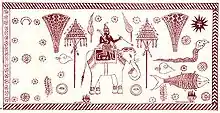 The Karava Maha Kodiya of the Karava Community. | |
| Regions with significant populations | |
|---|---|
| Sri Lanka, | |
| Languages | |
| Sinhala | |
| Religion | |
| Buddhism, Roman Catholicism, Hinduism, Protestantism | |
| Related ethnic groups | |
| Sinhalese, Tamils, Karaiyar, Paravar, Pattanavar |
They have in recent times given great importance to trade and commerce. The elite families are involved in the estate-owning sector, chiefly in coconut and rubber.[4]
They are known to have arrived in the time of Prince Vijaya's rule in Sri Lanka along with Prince Karavanti, this is mentioned in the Janawamsaya. Most recent mass migration to Sri Lanka happened in 15th century from Tamil Nadu to fight against Mukkuvar confederation as mentioned in Mukkara Hattana. So now they make up a sheer minority among the Sinhalese speaking population group along with Goyigama and Bathgama as well one third of Tamil speaking population of the island. They are mostly classified as a coastal caste native to the Western coasts of Sri Lanka than an ethnic group in Sri Lanka which is not really the case with them having distinct origin stories compared with the majority sinhala ethnic groups.
Etymology
The origins of the term Karava are still debated. [5][6]The name "Karava" has also been proposed to be a corruption of the Sanskrit name Kaurava, following their origin story which has strong evidence to prove its legitimacy so this could have been the real origin.[3]
The first recorded instance is the Abhayagiri vihara terrace inscription dating from the 1st century BC denoting a Dameda Karava navika which means Dravidian or Tamil sailor. Other historical counts refer them and also the Karaiyars as Careas and Kaurawar.[7]
History
Many Karava communities throughout Sri Lanka claim an origin from the Kuru kingdom and the Kauravas of the Hindu epic Mahabharata.[8] For instance, Kurukulattaraiyan was the name ascribed to 'the prince who wore a golden anklet' that commanded the army of Vijayabahu I (11th century AD) to end Chola rule in Sri Lanka.[9][10]
Historical manuscripts such as the Mukkara Hatana indicate that there were migrations from the Kurumandalam coast of Tamil Nadu, South India, and that they were originally Tamil speakers but this is mostly due to their ancestors being driven out of Kuru by the Panda as and them taking refugee in South India adopting their language thus making Sri Lankans believe they were ethnically Dravidians.[11] The Karavas north of Negombo are predomanantly Catholic and bilingual in Tamil and Sinhalese,[12] whereas the Karavas south of Colombo are Buddhist. Although they are refer to generally as Sinhalese they are not of Sinhala ethnicity nor Tamil but they have a unique and glorious identity but they have gone through a major transformation from royals to Kshatriya warriors to local fishermen, they have mixed with the locals and have evolved according to the conditions of Sri Lanka that they are hard to distinguish from the Sinhalese so there is no guilt in them recognising Sri Lanka as their homeland, these claims are further legitimised by them known to have inhabited the land from more than 2000 years ago and much more proven records of migrating 200 years ago.
Although we attribute Karava migrations to the famed "Mukkara Hantana", their is evidence of their existence predating this incident from various sources, rock inscriptions are the main sources of this theory of them existence even before Mukkara Hantana, nevertheless there was a piece of evidence dating back to the rule of Prince Vijaya that shows that there were Karava people within the 700 followers of King Vijaya among them was Prince Karavanta mention in the Jayawamsha.
The Mukkara Hatana describes that they won a three month siege against the Mukkuvars, under the sponsorship of Kotte king Parakramabahu VI in the 14th century AD.[13] The Kotte King Bhuvanaikabahu VI was the son of a Karava chief who was adopted by Parakramabahu VI after the death of his father in the war mentioned in Mukkara Hatana.[14][15]
The Karava chieftains resisted the colonial Portuguese rule in 16th century. The Karava Prince of Uva, Kuruvita Rala (also known as Antonio Barreto[16]), who also had his stronghold in Batticaloa, Wellawaya, Negombo and parts of Sabaragamuwa and Matara region, led his and the troops of Sitawaka Kingdom and revolted against the Portuguese.[17] Kuruvita Rala also raided the Kandy Kingdom and drove the king Senarat of Kandy out of his own capital.[18]
They were under Portuguese rule, along with the Karaiyar and Nair recruited as Lascarins and were converted to Catholicism.[19] Large Catholic Karava communities exists ever since, who were Hindus prior to conversion.[20] The Catholic Karava chieftains sided with the Kingdom of Kandy and the kingdom's Dutch allies against the Portuguese empire, and the King bestowed honors and titles to the Karava chieftains.[21]
The Karavas amassed wealth through commercial ventures such as in arrack, coconut, rubber, graphites etc.[4][11] The Karavas formed the elites between 16th century and early 20th century.[22] Numerous organization were formed by them such as Ceylon National Association, one of the predecessors of the Ceylon National Congress.[23] James Peiris, a Karava lawyer and national leader, was an essential character in the Sri Lankan independence movement.[24][25] Rohana Wijeweera and other Karava leaders formed in the 1960s the Janatha Vimukthi Peramuna, a communist party and political movement, who were involved in two armed uprisings against the ruling governments in 1971 and 1987.[26]
Traditional status
The Karavas were coastal people, who served in naval warfare and contributed as coastal chieftains and regional kings.[2][3] Their chiefs were referred in Sinhalese as Patabendi or Patangatim,[27] which is derived from the Tamil term Pattamkattiyar (meaning "crowned one"),[28] which was also used by their equivalent Tamil Karaiyars.[29]
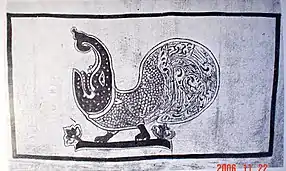
The Karavas were one of the few Sri Lankan communities traditionally entitled to use flags.[30] A large number of these Karava flags have survived the ravages of time and many are illustrated in E. W. Perera's book Sinhalese Banners and Standards.[30]
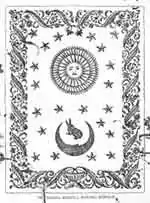
The sacred usage of conch shell and tying of Nalapata (royal forehead plate) was a common practice among Karavas, also mentioned in the Rajaveliya. The sun and the moon, pearl umbrella are traditional royal symbols used by the Karavas.[16] The Makara, being an emblem of their clan, is the mount of their clan deity, the sea god Varuna.[31]The clan of Warnakulasuriya, common in coastal towns like Wennappuwa and Katuneriya, is
(one of the illustrious suriya clans of the karava ethnic gr. Thip clan s) seems to get their surname from the deity of Varuna.
The suriya clans has their origins in the legendary Ikshvaku dynasty of rulers in India which has come to be known as "Sūryavaṁśa" and Lord Buddha been a descendant of this clan this caste seems to be of great origin specially the ones belonging to these suriya clans.
Insignia such as the pearl umbrella, flags, swords, trident, yak tail whisks, lighted flame torches and drums were previously widely used by the Karavas at their weddings and funerals. By the 1960s, such usage has been greatly reduced, whereas some places is it still practiced.[30]
Ancestral names
The Karava's use the vasagama naming system. Vasagama, literally meaning "estate (gama) in which one resides", is a title or surname that is given to the patrilineal descendants.[32] The most common clans among the Karavas are Kurukulasuriya, Warunakulasuriya and Mihindikulasuriya (formerly known as Arasakulasuriya).[16][33] Other clans are Koon Karavas and Konda Karavas.
Name based on leadership or armoured military office (Sannaddha/Sannadi) include Hennadige, show a traditional military heritage and confirms the Kshatriya origins of the group as claimed by Karava origin stories and family histories. Some of the popular surnames, Wachchi Hennadige, Weera Hennadige, Andra Hennadige and Warusa Hennadige , Arasa Marakkalage ("house of the Royal Mariners"), Patabendige ("house of the local headmen"), and Thantrige (also Tantulage or Thanthulage, "house of experts").[34][35]
Names based on profession include Marakkalage (house of the ship/boat owners or sailors ) and Vaduge (also Baduge; house of carpenters, ship, Silmaguruge & boat builders, also descendant of Vadugar).[6]
References
- Fernando, Mario (2007). Spiritual Leadership in the Entrepreneurial Business: A Multifaith Study. Edward Elgar Publishing. p. 55. ISBN 9781847208613.
- Cambridge South Asian Studies. Cambridge University Press. 1965. pp. 18, 51. ISBN 9780521232104.
- Jiggins, Janice (1979-06-07). Caste and Family Politics Sinhalese 1947-1976. Cambridge University Press. p. 27. ISBN 9780521220699.
- International Journal of Dravidian Linguistics. Department of Linguistics, University of Kerala. 1990. p. 110.
- Vaduga: Sri Lanka and the Maldive Islands, By Chandra Richard De Silva, p.111 & 137
- Kurukshetra. Sri Lak-Indo Study Group. 1983. p. 78.
- The Ceylon Journal of the Humanities. University of Sri Lanka. 1970. pp. 34–35.
- Raghavan, M. D. (1961). The Karāva of Ceylon: Society and Culture. K.V.G. De Sīlva. pp. 5, 13, 195.
- Indrapala, Karthigesu (1965). Dravidian Settlements in Ceylon and the Beginnings of the Kingdom of Jaffna. University of London. pp. 109–110, 371, 373.
- Horowitz, Donald L. (2014-07-14). Coup Theories and Officers' Motives: Sri Lanka in Comparative Perspective. Princeton University Press. p. 33. ISBN 9781400854127.
- Obeyesekere, Ganath (1984). The cult of the goddess Pattini. The University of Chicago Press. pp. 374. ISBN 9780226616025.
- McGilvray, Dennis B. (2008). Crucible of Conflict: Tamil and Muslim Society on the East Coast of Sri Lanka. Duke University Press. p. 61. ISBN 978-0822341611.
- Fernando, A. Denis N. "Dona Catherina was the direct heiress by virtue of her heredity". Info Lanka.
- A. Sebastian, A Complete Illustrated History of Sri Lanka. Vijitha Yapa Publications, 2012. p 397. ISBN 9789556651492
- Raghavan, M. D. (1961). The Karāva of Ceylon: Society and Culture. K.V.G. De Sīlva. pp. 36, 39, 143.
- Colombo, Royal Asiatic Society of Great Britain and Ireland Ceylon Branch (1946). Journal of the Ceylon Branch of the Royal Asiatic Society. Colombo Apothecaries Company. p. 210.
- DeSilva, Chandra Richard (1972). The Portuguese in Ceylon, 1617-1638. University of London: School of Oriental and African Studies. pp. 59–66, 83–84.
- Wickramasinghe, Nira (2006). Sri Lanka in the Modern Age: A History of Contested Indentities. University of Hawaii Press. p. 13. ISBN 9780824830168.
- Nyrop, Richard F.; Studies, American University (Washington, D. C. ) Foreign Area; Army, United States Dept of the (1986). Sri Lanka, a country study. Headquarters, Dept. of the Army. p. 106.
- Sivasubramaniam, K. (2009). Fisheries in Sri Lanka: anthropological and biological aspects. Kumaran Book House. pp. 136, 137. ISBN 9789556591460.
- Runciman, W. G. (1989-02-02). A Treatise on Social Theory. Cambridge University Press. p. 43. ISBN 9780521369831.
- Silva, K. M. De (1981). A History of Sri Lanka. University of California Press. pp. 361–362. ISBN 9780520043206.
- Peebles, Patrick (2015-10-22). Historical Dictionary of Sri Lanka. Rowman & Littlefield. ISBN 9781442255852.
- Nyrop, Richard F.; Studies, American University (Washington, D. C. ) Foreign Area; Army, United States Dept of the (1986). Sri Lanka, a country study. Headquarters, Dept. of the Army. p. 111.
- Jiggins, Janice (1979-06-07). Caste and Family Politics Sinhalese 1947–1976. Cambridge University Press. p. 127. ISBN 9780521220699.
- Patangatin/Headmen of Chilaw baptised in 1606 at Malwana; Ceylon and the Portuguese 1505–1658, by Paulus Edward Pieris
- "பட்டங்கட்டி | அகராதி | Tamil Dictionary". agarathi.com. University of Madras Lexicon. Retrieved 2017-08-13.CS1 maint: others (link)
- Modern Ceylon Studies. University of Ceylon. 1975.
- In 1574 the Mahapatabenda of Colombo is beheaded and quartered by the Portuguese for treasonable communication with Mayadunne, the sannas grants of king Mayadenne to Sitavaka Tantula and Rajapakse Tantula of Ambalangoda for serving the interests of Sitawaka kings, Thamankaduwa, Diddeniya, Galagamuwa and Matale Karavas and their insignia The Karāva of Ceylon: Society and Culture, M. D. Raghavan pp.33–6,43,66,71–5 (K.V.G. De Sīlva ) ASIN: B0006CKOV2
- Journal of the Royal Asiatic Society of Sri Lanka. Royal Asiatic Society of Sri Lanka. 1993. p. 137.
- Maloney, Clarence (1974). South Asia; seven community profiles. Holt, Rinehart and Winston. pp. 64. ISBN 9780030118562.
- McGilvray, Dennis B. (1982-09-02). Caste Ideology and Interaction. Cambridge University Press. p. 18. ISBN 9780521241458.
- Royal grant to a port Patangatin, Kingdom of Jaffanapatam, P.E. Pieris, p. 25-28
- The sword of Mahanaga Rajasinghe Kuruvira Adithya Arsanilaishta (1416 AD) – the oldest representation of the Makara knuckle-guard: Ancient Swords, Daggers and Knives in Sri Lankan Museums, P.H.D.H. De Silva and S. Wickramasinghe, pp.82,90,101–5 (National Museums of Sri Lanka) ISBN 9789555780216
- RAGHAVAN, M. D., The Karava of Ceylon: Society and Culture, K. V. G. de Silva, 1961.
- Caste Conflict and Elite Formation, The Rise of the Karava Elite in Sri Lanka 1500–1931. Michael Roberts 1982, Cambridge, Cambridge University Press. ISBN 81-7013-139-1
- Social Change in Nineteenth Century Ceylon. Patrick Peebles. 1995, Navrang ISBN 81-7013-141-3.
External links
 |
Wikimedia Commons has media related to Karava. |