Karl von Wenninger
Karl von Wenninger | |
|---|---|
 | |
| Born | August 13, 1861 Berg, Upper Bavaria, Bavaria |
| Died | September 8, 1917 (aged 56) Mărășești, Vrancea County, Romania |
| Allegiance | .svg.png.webp) German Empire German Empire |
| Branch |  Imperial German Army Imperial German Army |
| Years of service | 1882 — 1917 |
| Rank | Lieutenant General |
| Commands held | 1st Royal Bavarian Heavy Cavalry (Prince Charles of Bavaria's) |
| Battles/wars | World War I |
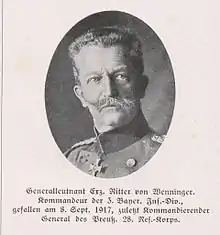
Karl Wenninger, also known as Ritter von Wenninger was a German Lieutenant General who commanded the XVIII Reserve Corps in World War I.
Biography
Family
Karl was the son of the Bavarian Colonel Franz Xaver Wenninger and his wife Mathilde, née Forster.
Wenninger married Kornelie Prins on July 11, 1889 in Landshut. She was the daughter of the Vice-President of the Council for the Dutch East Indies, Ary Prins. The marriage resulted in a daughter and two sons. Like their father, both sons pursued military careers. The youngest son fell as a pilot on the Western Front in 1917 , the older son Ralph initially served in the Imperial German Navy as a submarine commander and achieved the rank of Luftwaffe General in World War II. Like his father, he was awarded the Pour le Mérite order during the First World War. With the exception of princely families, this is the only case in which father and son received the highest Prussian valor award.
Military Career
He entered after visiting the Humanistic Gymnasium on 28 September 1880 as Common in the second severity Rider regiment "Archduke Franz Ferdinand of Austria-Este" of the Bavarian army in Landshut.[1] He was then made an ensign on March 29, 1881 and promoted to second lieutenant on November 23, 1882. From October 1, 1888 to September 30, 1891, Wenninger was assigned to the War Academy, which pronounced him qualification for the higher adjutantage and, secondarily, for the general staff.[1] This was followed by his assignment to the equitation institute. There he received his promotion to prime lieutenant. In October he was transferred to the 2nd Cavalry Brigade in Augsburg as an adjutant. From September 24, 1895 Wenninger worked for three years in the general staff and was promoted to captain on October 28, 1897 . This was followed by a year-long service in the General Staff of the 1st Army Corps before he switched to the troop service and took over as chief of an squadron in the 5th Chevaulegers Regiment "Archduke Friedrich of Austria" . This was followed by a use in the general staff of the 3rd Royal Bavarian Division in Landau. For two years from September 21, 1902, Wenninger worked as a teacher of war history and the history of the art of war at the War Academy, in the meantime he became a major on October 23, 1903 and then transferred again to the General Staff of the 1st Army Corps. On April 19, 1906, he became a member of the study commission of the War Academy and at the same time was entrusted with the management of the 1st Heavy Rider Regiment "Prince Karl of Bavaria" . Wenninger appointed regimental commander took place on July 20, 1906. In this position he was promoted on March 8, 1907, Lieutenant Colonel , and on March 7, 1909. Colonel. As such, he took command of the 6th Cavalry Brigade in Regensburg on September 24, 1909 . From there he was appointed to the General Staff in Berlin on December 15, 1911 as Bavarian Military Plenipotentiary . Here he was also the representative of the Federal Council of the German Reich. Wenninger became major general on March 7, 1912 .
When the First World War broke out, he initially remained as a Bavarian military representative and was now employed in the main headquarters . In recognition of his services, Wenninger was awarded the Knight's Cross of the Order of Merit of the Bavarian Crown on September 27, 1914. Associated with this was the elevation to the personal nobility status and he was allowed to be known as "Ritter von Wenninger" after his entry in the nobility register.[2]
After his promotion to lieutenant general on September 10, 1914, Wenninger became commander of the cavalry division on November 7, 1914 and led the large unit among others.[3] in the First Battle of Ypres and the subsequent trench warfare in Flanders. In March 1915, Wenninger gave away the lead and took the Artois standing 3rd Infantry Division . In September and October she was able to prevent multiple attempts to break through in the autumn battle taking place there near La Bassée and Arras. During the Battle of the Somme, the division defended the Martinpuich section of the Foureaux Forest. In April 1917 the division was on the Arras front south of the Scarpe . During the Battle of Arras, Wenninger's leadership succeeded in repelling three attacks by the English and stabilizing the section of the front.
For this achievement Wenninger was by King Ludwig III. Admitted to the Military Order of Max Joseph on April 23, 1917 with the award of the knighthood . Shortly thereafter, Wilhelm II awarded him the Pour le Mérite on May 1, 1917.[2]
On June 5, 1917 he was appointed leader of the XVIII Reserve Corps, which at the time was in front of Verdun.[2][4] From here it was transferred to Romania in July and took part in the German summer offensive in August and September. During the breakthrough battle of Putna and Susita, his troops succeeded in taking Muncelul. After the offensive was stopped, Wenninger fell in the course of further fighting on September 8, 1917 on the Secului-Höhe.[5]
References
- Othmar Hackl: The Bavarian War Academy (1867–1914). C.H. Beck´sche publishing house bookstore. Munich 1989. ISBN 3-406-10490-8. Page. 602.
- "Karl Ritter von Wenninger".
- Alexandru Ioanițiu (Lt.-Colonel), Războiul României: 1916-1918 , vol. 1, Tipografia Geniului, București, 1929
- "Namenlos".
- Karl von Wenninger Integrated Authority File Accessed on May 11, 2014
Bibliography
- Max Spindler (ed.), Walter Schärl: The composition of the Bavarian civil service from 1806 to 1918. Michael Lassleben publishing house, Kallmütz / Opf. 1955, p. 273.
- Othmar Hackl: The Bavarian War Academy (1867-1914). CH Beck´sche Verlagsbuchhandlung, Munich 1989, ISBN 3-406-10490-8, pages. 602-603.
- Hanns Möller: History of the knights of the order pour le mérite in the world war. Volume II: M-Z. Verlag Bernard & Graefe, Berlin 1935, pp. 488-489.
- Rudolf Kramer, Otto Freiherr von Waldenfels: VIRTUTI PRO PATRIA. The Royal Bavarian Military Max Joseph Order. Self-published by the Bavarian Military Max Joseph Order, Munich 1966, pp. 185, 428.