Karuizawa, Nagano
Karuizawa (軽井沢町, Karuizawa-machi) is a resort town located in Nagano Prefecture, Japan. As of 1 October 2016, the town had an estimated population of 20,323 in 9897 households,[1] and a population density of 130 persons per km². The total area of the town is 156.03 km2 (60.24 sq mi). Karuizawa is a popular summer resort area for the residents of Tokyo.
Karuizawa
軽井沢町 | |
|---|---|
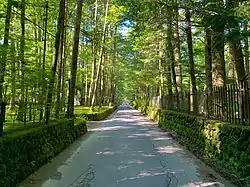 Typical scenery of Karuizawa | |
 Flag  Emblem | |
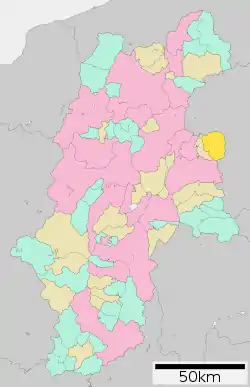 Location of Karuizawa in Nagano Prefecture | |
  Karuizawa | |
| Coordinates: 36°20′55″N 138°35′49″E | |
| Country | Japan |
| Region | Chūbu (Kōshin'etsu) |
| Prefecture | Nagano |
| District | Kitasaku |
| Area | |
| • Total | 156.03 km2 (60.24 sq mi) |
| Population (October 2016) | |
| • Total | 20,323 |
| • Density | 130/km2 (340/sq mi) |
| Time zone | UTC+9 (Japan Standard Time) |
| Symbols | |
| • Tree | Magnolia kobus |
| • Flower | Sakurasō (Primula sieboldii) |
| • Bird | Brown-headed thrush |
| Phone number | 0267-45-8111 |
| Address | 2381-1 Nagakura, Karuizawa-machi, Kitasaku-gun, Nagano-ken 389-0192 |
| Website | Official website |
Geography
Karuizawa is located in eastern Nagano Prefecture, bordered by Gunma Prefecture to the north, east and south. The town is located on an elevated plain at the foot of Mount Asama, one of Japan's most active volcanoes. The mountain is classed as a Category A active volcano. A small eruption was detected in June 2015, a more significant eruption spewing hot rocks and a plume of ash occurred in February 2015. Mt. Asama's most destructive eruption in recent recorded history took place in 1783, when over 1,000 were killed. The volcano is actively monitored by scientists and climbing close to the summit is prohibited.[2]
- Usui Pass
- Highest elevation: 2,568 m (8,425 ft) (Top of Mount Asama)
- Lowest elevation: 798.7 m (2,620.4 ft)
Surrounding municipalities
- Nagano Prefecture
- Gunma Prefecture
Demographics
Per Japanese census data,[3] the population of Karuizawa has been increasing over the past 50 years.
| Year | Pop. | ±% |
|---|---|---|
| 1940 | 8,746 | — |
| 1950 | 13,676 | +56.4% |
| 1960 | 13,299 | −2.8% |
| 1970 | 13,373 | +0.6% |
| 1980 | 14,195 | +6.1% |
| 1990 | 15,464 | +8.9% |
| 2000 | 16,181 | +4.6% |
| 2010 | 19,023 | +17.6% |
History
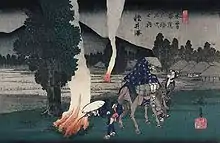
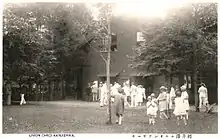
The area of present-day Karuizawa was part of ancient Shinano Province, and developed as Karuisawa-shuku, a post station on the Nakasendō highway connecting Edo with Kyoto during the Edo period.
- August 2, 1876: The hamlets of Kutsukake, Shiozawanitta, Karijuku, Narusawanitta, and Yui merged to form the village of Nagakura. The village of Hatsuji in Saku District absorbed the hamlet of Matorikaya.
- January 14, 1879: Kitasaku District was created, and the town of Usuitoge, and the villages of Karuizawa, Nagakura, Oiwake were established with Kitasaku District.
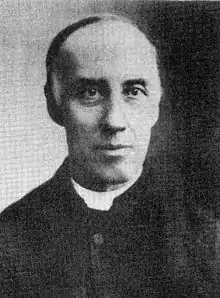
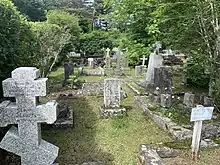
- 1886: Canadian Anglican missionary Rev. Alexander Croft Shaw and Tokyo Imperial University English professor James Main Dixon introduced Karuizawa as a summer resort.
- April 1, 1889: With the establishment of the modern municipalities system, the town of Usuitoge, and the villages of Karuizawa, and the areas of the former villages of Kutsukake, Shiozawanitta, and Karijuku from the village of Nagakura merged to form the village of Higashinagakura in Kitasaku District, and the areas of the former villages of Narusawanitta and Yui in the village of Nagakura, and the villages of Hatsuji and Oiwake merged to form the village of Nishinagakura in Kitasaku District.
- 1910s: Begins to attract the attention of other expatriates and Japanese.[4] Specially Germans congregate here, language professors and academics hold annual conferences.
- August 1, 1923: The village of Higashinagakura gains town status to become the town of Karuizawa. (The pre-town areas before gaining the town status is known as Kyu-Karuizawa.)
- May 8, 1942: The village of Nishinagakura is merged into Karuizawa
- 1942-45: Site of an internment camp for enemy foreigners and diplomats during World War 2.
- From 1943 relocation of an increasing number of Germans from Tokyo, which is suffering from US fire bombing. The Supreme Commander for the Allied Powers deported most German nationals in late 1947.
- 1951: Selected as International Cultural and Tourism City.
- February 1, 1957: Karuizawa absorbed Serizawa area from the former village of Goga, which was absorbed by the town of Miyota.
- April 1, 1959: The Kajikazawa area of the former village of Oiwake was split off and merged with the town of Miyota.
- 1964: 1964 Summer Olympics (Equestrian)
- February 1972: Asama-Sanso incident; Police besiege communist militants holed up in holiday resort after mass killing and hostage taking.
- October 1, 1997: The Nagano Shinkansen opens, serving Karuizawa.
- 1998: 1998 Winter Olympics (Curling)
- 2004: Mount Asama erupts.
Economy
Hoshino Resorts is headquartered in Karuizawa.[5]
Education
Karuizawa has three public elementary school and one public middle school operated by the town government, and one public high school is operated by the Nagano Prefectural Board of Education. The UWC ISAK Japan international school is also located in the town.
Transportation
Railway
.svg.png.webp)

.png.webp)


International relations
 Campos do Jordão, Brazil[6]
.svg.png.webp) Whistler, British Columbia, Canada[6]
Whistler, British Columbia, Canada[6]
Local attractions
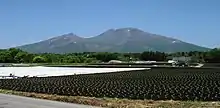
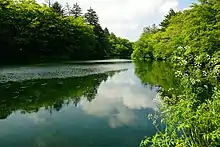
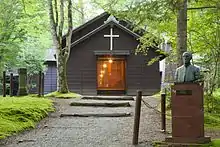
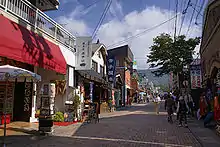
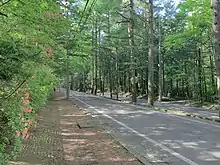
with its comparatively cool summer weather, its cold refreshing nights, its heavy air-clearing showers, its southern aspect, and its position close to some of the most picturesque mountain scenery of Japan, Karuizawa leaves little to be desired as a summer retreat.
And now I am writing in the most lovely study in the world. Over my head the pine branches meet in arches of kindly green ; […] underfoot a lundred layers of pine needles have been weaving a carpet so elastic that the weariest foot must press it lightly ; and, lest I should want for music, a stream, deep-running between hedges of wild clematis and white hydrangea and crowding wistaria tangle, sings a cool tune near by, while the hum of happy insects in the air sounds the high note of noon, the hot Eastern noon, when every bird is still.
while quite recently even Japanese gentlemen of high degree have begun to build houses and introduce their families. As in so many other cases, the world followed the lead of the missionaries. Foreigners are now the raison d’étre of Karuizawa, and no echo of Feudalism haunts the hills.
— Ernest Foxwell, "A Tale of Karuizawa", 1903[9]
the most popular summer resort in the whole of the Far East […] .
Summers in Karuizawa were not just a break in the year but seemed a whole lifetime in themselves. I have far more memories of the minutiae of life there than I do of the much longer periods of time spent in Tokyo.
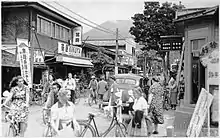
At an elevation of 1,000 m (3,281 ft) and a temperate summer climate, Karuizawa is a popular year round resort offering many outdoor sport, hot spring and recreational activities. Convenient road and rail access from central Tokyo, has ensured Karuizawa's popularity as a location for second homes and resort hotels since the Meiji era. The town is known for its historic shopping street known as "Ginza dōri" or "Kyū-dō" (Ginza Street, or the Old Road) and association with both Japanese royalty and visitors such as John Lennon and Yoko Ono.[12] Karuizawa hosted equestrian events in the 1964 Summer Olympics as well as curling in the 1998 Winter Olympics.
Since 1997, Karuizawa has been accessible via the JR East Nagano Shinkansen. New high speed rail links has resulted in modest population growth and the development of large outlet style shopping malls.
Notable residents
- Arishima Takeo, writer
- Endo Shusaku, novelist
- Idei Nobuyuki, former Sony Chairman, CEO
- Paul Jacoulet, woodblock print artist
- E. Herbert Norman, Canadian diplomat and historian
- Yoko Ono, artist, musician, and activist
- Alexander Croft Shaw, Anglican missionary
- Tabaimo, artist
Climate
Karuizawa has a humid continental climate (Köppen climate classification Dfb) with warm summers and cold winters. The average annual temperature in Karuizawa is 8.0 °C. The average annual rainfall is 1352 mm with September as the wettest month. The temperatures are highest on average in August, at around 20.9 °C, and lowest in January, at around -4.2 °C.[13] Precipitation is much heavier in the summer than in the winter.
| Climate data for Karuizawa | |||||||||||||
|---|---|---|---|---|---|---|---|---|---|---|---|---|---|
| Month | Jan | Feb | Mar | Apr | May | Jun | Jul | Aug | Sep | Oct | Nov | Dec | Year |
| Average high °C (°F) | 1.9 (35.4) |
2.3 (36.1) |
6.1 (43.0) |
13.2 (55.8) |
18.2 (64.8) |
20.6 (69.1) |
24.0 (75.2) |
25.5 (77.9) |
20.5 (68.9) |
15.2 (59.4) |
10.5 (50.9) |
4.8 (40.6) |
13.6 (56.4) |
| Daily mean °C (°F) | −3.9 (25.0) |
−3.6 (25.5) |
−0.4 (31.3) |
6.3 (43.3) |
11.5 (52.7) |
15.3 (59.5) |
19.0 (66.2) |
20.2 (68.4) |
15.7 (60.3) |
9.2 (48.6) |
4.1 (39.4) |
−1.1 (30.0) |
7.7 (45.9) |
| Average low °C (°F) | −9.5 (14.9) |
−9.0 (15.8) |
−6.0 (21.2) |
−0.1 (31.8) |
5.0 (41.0) |
10.9 (51.6) |
15.3 (59.5) |
16.2 (61.2) |
12.2 (54.0) |
4.4 (39.9) |
−1.2 (29.8) |
−6.4 (20.5) |
2.7 (36.8) |
| Average precipitation mm (inches) | 29.9 (1.18) |
43.0 (1.69) |
59.6 (2.35) |
84.2 (3.31) |
108.8 (4.28) |
187.4 (7.38) |
184.1 (7.25) |
159.3 (6.27) |
173.3 (6.82) |
107.7 (4.24) |
50.7 (2.00) |
23.3 (0.92) |
1,211.3 (47.69) |
| Average snowfall cm (inches) | 29 (11) |
43 (17) |
37 (15) |
8 (3.1) |
0 (0) |
0 (0) |
0 (0) |
0 (0) |
0 (0) |
1 (0.4) |
3 (1.2) |
16 (6.3) |
137 (54) |
| Average relative humidity (%) | 74 | 75 | 73 | 72 | 74 | 84 | 87 | 86 | 88 | 83 | 77 | 74 | 79 |
| Mean monthly sunshine hours | 169.6 | 156.3 | 183.0 | 175.1 | 191.4 | 126.4 | 126.5 | 158.0 | 107.7 | 134.9 | 149.6 | 165.2 | 1,843.7 |
| Source: NOAA (1961–1990)[14] | |||||||||||||
References
- Karuizawa Town official statistics Archived 2019-03-31 at the Wayback Machine(in Japanese)
- Demetriou, Danielle (16 June 2015). "Mount Asama volcano erupts near Tokyo". The Telegraph.
- "Karuizawa population statistics". Archived from the original on 2019-04-30. Retrieved 2019-04-30.
- Tohoku: The Scotland of Japan, p. 181
- "Company Overview of Hoshino Resort Co., Ltd. (Archive). Bloomberg Businessweek. Retrieved on September 22, 2013. "2148, oazanagakura karuizawa-machi Kitasaku, 389-0111 Japan"
- "International Exchange". List of Affiliation Partners within Prefectures. Council of Local Authorities for International Relations (CLAIR). Archived from the original on 2 January 2017. Retrieved 21 November 2015.
- Cargill Gilston Knott, “On the Summer Climate of Karuizawa”, Transactions of the Asiatic Society of Japan, Vol. XIX, Ginza: Hakubunsha, 1891, p.574
- Mrs. Hugh Fraser, A Diplomatist's Wife in Japan: Letters from Home to Home, Vol. II, London: Hazell, Watson and Viney, 1899, p.53
- Ernest Foxwell, A Tale of Karuizawa, The Living Age, Vol. 236, Boston : Living Age Company, 1903, p.107
- Arthur Lloyd, Every-day Japan, London, New York, Toronto and Melbourne: Cassell and Company Limited, 1909, p.281
- Karuizawa, c. 1920. Archived 2021-04-11 at the Wayback MachineOld Tokyo.com
- Davis, Tony (8 May 2015). "Nakasendo walking trail leads to the heart of old Japan – and bear country". The Australian Financial Review. Archived from the original on 2 June 2016. Retrieved 3 May 2016.
- "Karuizawa climate data". Archived from the original on 2019-03-21. Retrieved 2019-04-30.
- "Karuizawa Climate Normals 1961-1990". National Oceanic and Atmospheric Administration. Retrieved December 31, 2012.
External links
 Media related to Karuizawa, Nagano at Wikimedia Commons
- ja:軽井沢 (in Japanese)
- Official Website (in Japanese)
- Karuizawa Tourism Website (in Japanese)
- Karuizawa Tourism Website (in English)
Authority control  | |
|---|---|
| General | |
| National libraries | |
| Other | |
| Core cities | |
|---|---|
| Cities | |
| Districts | |