Kathleen Scott
Edith Agnes Kathleen Young, Baroness Kennet, FRBS (née Bruce; formerly Scott; 27 March 1878 – 25 July 1947) was a British sculptor. Trained in London and Paris, Scott was a prolific sculptor, notably of portrait heads and busts and also of several larger public monuments. These included a number of war memorials plus statues of her first husband, the Antarctic explorer Captain Robert Falcon Scott. She was the mother of Sir Peter Scott, the painter and naturalist and, by her second marriage, to Edward Hilton Young, she became Baroness Kennet, and mother to the writer and politician Wayland Young.
The Lady Kennet | |
|---|---|
_LCCN2014716273.jpg.webp) Scott in 1923 | |
| Born | Edith Agnes Kathleen Bruce 27 March 1878 Carlton in Lindrick, Bassetlaw, England |
| Died | 25 July 1947 (aged 69) London, England |
| Alma mater |
|
| Spouse(s) | |
| Children | Peter Scott Wayland Young, 2nd Baron Kennet |
Biography
Early life
Born at Carlton in Lindrick, Bassetlaw, Nottinghamshire, Kathleen Scott was the youngest of the eleven children of the Church of England clergyman Lloyd Stuart Bruce (1829–1886) and his first wife Jane Skene (c. 1828– 1880), an amateur artist.[1] An orphan by the age of eight, Scott was brought up by a relative, William Forbes Skene, in Edinburgh where she attended St George's School before being sent to boarding schools in England including a convent school run by nuns.[1][2]
Paris and Macedonia
Scott studied at the Slade School of Fine Art in London from 1900 to 1902 and then enrolled at the Académie Colarossi in Paris.[3] Although she had taken some modelling classes at the Slade, at the Académie Colarossi Scott concentrated on sculpture and within three months had a statuette of a mother and child accepted for the Paris Salon, where it won a medal.[1] She was befriended by Auguste Rodin who, although he was not formally taking students at the time, agreed to mentor her and for Scott to visit his studio on a regular basis.[3][1] In Paris, Scott also met Aleister Crowley, Gertrude Stein, the photographer Edward Steichen, Isadora Duncan and, very briefly, Pablo Picasso.[1] Scott and Duncan became friends and in 1903 travelled to Belgium and the Netherlands together.[1]
In December 1903, following the Ilinden uprising Scott joined a relief mission to Macedonia, undertaking logistic duties and some basic nursing work at refugee camps.[2] There, in February 1904, Scott fell ill with a life-threatening bout of influenza and, possably, typhoid.[1] When she recovered she decided to return to Paris and boarded a freightrer for Marseilles but disembarked at Naples and spent some months in Florence before returning to Paris and reopening her studio.[1] Scott spent the summer of 1906 at Noordwijk in the Netherlands supporting a pregnant Isadora Duncan and then spent some months on an island near Methana in Greece before moving to London.[1]
London and marriage
In London, Scott took a flat in Cheyne Walk and made a series of portrait busts, mostly of young men.[1] She became acquainted with George Bernard Shaw, Max Beerbohm and J.M. Barrie, whose former home she later bought. At one point she became seriously ill with an abdominal cyst and was thought unlikely to live.[1] Scott recovered and subsequently assisted her upstairs neighbour, a district maternity nurse, on house calls to deliver babies.[1]
In October 1907 she met Captain Robert Falcon Scott at a tea party having briefly seen him at a lunch hosted by Mabel Beardsley several months earlier.[1] The two spent ten days together before he left London on Naval duties but within a month they had decided to marry.[1] Their wedding was on 2 September 1908, in the Chapel Royal at Hampton Court Palace with Rodin among the 150 guests.[1] The couple took a house on Buckingham Palace Road in London and within a year their son Peter Scott, who became famous in painting and conservation, was born.[1]
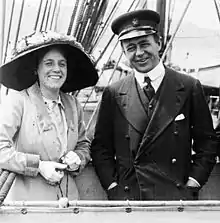
In July 1910, she accompanied her husband to New Zealand to see him off on his journey to the South Pole and in October that year they spent a fortnight together at Lyttleton before Captain Scott and his crew departed on 29 November.[1] Kathleen Scott returned to England and, after extended stop-overs in Australia and Egypt, arrived at Dover in February 1911.[1] A biographer of the Norwegian explorer Fridtjof Nansen has suggested that, in her husband's absence, she began a brief affair with Nansen.[4] This has been refuted.[5]
In London Kathleen Scott created portrait busts and heads of various friends and relatives and also worked on a statuette of Florence Nightingale while supporting fund-raising exercises for the Antarctic expedition.[1] She received her first commission for a public monument, a life-size statue of Charles Rolls, which was unveiled in April 1912.[1] When Rolls's family lent Scott some of his clothing for her model, she was shocked to find they had included blood-stained items from his fatal air crash.[1] During 1912 she also created portrait busts of, among others, the prime minster Herbert Asquith, Fridtjof Nansen, Compton Mackenzie plus a series of figures of bishops for the chapel at Winchester College and a sculpture of a baby for a hospital.[1] At the end of the year she began working on a statuette of her husband.[1]
Kathleen Scott decided to travel to New Zealand to met her husband on his return from the Antarctica. She left Liverpool on 4 January 1913 for New York, then travelled by train to New Orleans and El Paso and went camping in Mexico before sailing from California to Tahiti.[1] The bodies of Captain Scott and his companions were discovered on the 12 November 1912 and the news reached London on 11 January 1912 with a memorial service, attended by King George V, being held at St Paul's Cathedral on 14 February 1913.[1] Five days later a wireless message finally reached the ship Kathleen Scott was on and she was informed of her husband's death.[1] She continued on to New Zealand where she was given the diaries and letters which had been recovered when her husband's body had been found.[1]
On her return to London Scott, and her son, were the subject of intensive public and press attention which she tried to counter by embarking on a concentrated period of work. She began work on large statues of Captain Scott, Asquith and Edward Smith.[1] In August 1913 she spent some time in Andorra and in 1914 she went to North Africa. After trekking in the Sahara, Scott returned to Britain shortly before World War I began.[1]
World War I
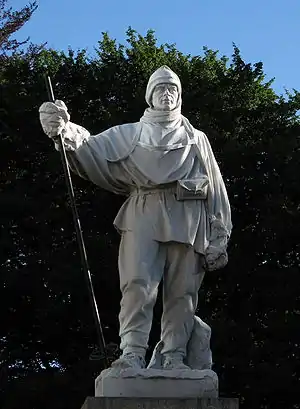
Scott sculpted a statue of her first husband, Captain Scott, of which there are two versions: a bronze statue erected in Waterloo Place, London, in 1915 and a replica in white marble located in Christchurch, New Zealand, erected in 1917.[1]
During World War I, Scott also worked in a variety of other roles, alongside her sculpture career. Initially she worked in northern France helping to establish a ambulance service. She worked in an electronics factory at Erith before, in 1917, serving as a private secretary to Sir Matthew Nathan in the Ministry of Pensions.[2] In 1918 she worked at the Queen's Hospital in Sidcup, creating facial models of patients for the plastic surgeon Harold Gillies.[6][7]
Later life
Following the war, Lady Scott received considerable press coverage for her dignified manner while continuing to work as a sculptor and raise her child.[2] During the inter-war years she had six significant solo exhibitions, regularly showed new works at the Royal Academy in London and was the subject of BBC Television's first programme on sculpture.[2] In France she won a medal at the Salon des Artistes Francais in 1925 and was made an associate member of the Societe des Artistes Francais.[2] In 1922, she married the politician Edward Hilton Young.[3] Her second son, Wayland Hilton Young (1923–2009) was a writer and politician. Her grandchildren include the artist Emily Young and Louisa Young, writer.
From 1915, Scott was a member of the International Society of Sculptors, Painters and Gravers.[8] In 1928 she became an associate member of the Royal Society of British Sculptors and was elected a Fellow of the Society in 1946.[3]
From 1927 Scott lived at Lancaster Gate in central London and died, from leukemia, at the nearby St Mary's Hospital, Paddington in July 1947. Her funeral service was held at West Overton in Wiltshire where her ashes are buried.[2] A memorial exhibition of her work was held at the Mansard Gallery in 1947 and two years later her autobiography, Self Portrait of An Artist was published.[9]
Selected public works
| Image | Title / subject | Location and coordinates |
Date | Type | Material | Dimensions | Designation | Wikidata | Notes |
|---|---|---|---|---|---|---|---|---|---|
 |
Charles Rolls | Marine Parade, Dover | 1911 | Statue on pedestal | Bronze and stone | [10] | |||
 More images |
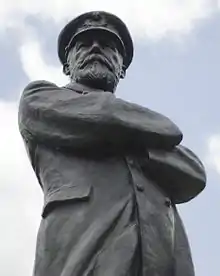
Captain Edward Smith | Beacon Park, Lichfield | 1914 | Statue on pedestal with plaque | Bronze and Cornish granite | Grade II | Q26482574 | [10][11] | |
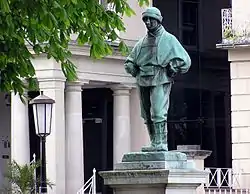 More images |
Edward Wilson | The Promenade, Cheltenham | 1914 | Statue on pedestal | Bronze and stone | Grade II | Q26667370 | [10][12] | |
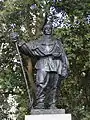 More images |
Robert Falcon Scott | Waterloo Place, London | 1915 | Statue on pedestal with plaque | Bronze and granite | Grade II | Q27084830 | [10][13] | |
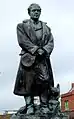 More images |
Robert Falcon Scott | College Road, Portsmouth Historic Dockyard | 1915 | Statue on pedestal with plaque | Bronze and granite | Grade II | Q26562141 | [14][15] | |
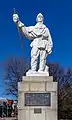 More images |
Statue of Robert Falcon Scott | Christchurch, New Zealand | 1917 | Statue on pedestal and steps | Marble and stone | Category II | Q7437304 | [16] | |
.jpg.webp) |
David Lloyd George | Lloyd George Museum, Llanystumdwy | 1921 | Bust on pillar | Bronze | [10] | |||
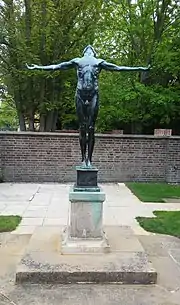 More images |
May Eternal Light Shine Upon Them | Scott Polar Institute, Cambridge | 1922 | Statue on pedestal | Bronze and stone | [17][18] | |||
.jpg.webp) More images |
The Thinking Soldier war memorial | Market Square, Huntingdon | 1923 | Statue on pedestal | Bronze and stone | Grade II | Q26676626 | [19][20] | |
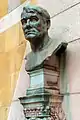 |
Alfred Harmsworth, 1st Viscount Northcliffe | St Dunstan-in-the-West, Fleet Street, London | 1930 | Bust on pedestal | Bronze and stone | Grade I | Architect, Edwin Lutyens[10][21] | ||
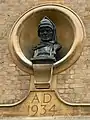 |
Robert Falcon Scott | Scott Polar Institute, Cambridge | 1934 | Bust in niche | Bronze | [18] | |||
.jpg.webp) |
Ad Astra | The Campus, Welwyn Garden City | c. 1940 | Statue on pedestal | Bronze and brickwork | [10] |
Other works
- A small bronze of the Indian actor Sabu which is now missing, after a theft.
- A life-size statue of Thomas Cholmondeley, 4th Baron Delamere. It was initially situated in Nairobi, Kenya, but is now in the Soysambu Conservancy, near Nakuru, Kenya.
- Here Am I, Send Me, a bronze figure of a nude boy raising his arm as if volunteering. Following World War I, Scott made two casts of the figure as war memorials, one for West Downs School and one for Oundle School. West Downs was her son Peter's old school and when the school closed down the memorial was relocated to WWT Slimbridge, the nature reserve he had established.[22][23][24][25]
- A memoral plaque to Captain JMT Richie at the church of St Peter & St Paul at Medmenham in Buckinghamshire.[26]
- Three works by Scott are in the collection of London's National Portrait Gallery, and she is also the subject of several photographic portraits there.[27]
Titles
In 1913, Scott was granted the rank (but not the style) of a widow of a Knight Commander of the Order of the Bath. This meant that, for the purposes of establishing official precedence, she was treated as if she were the widow of such a knight. However, she was not entitled to be called Lady Scott merely by virtue of this (although she often was), and it did not amount to Captain Scott being posthumously knighted.
When her second husband was created Baron Kennet on 15 July 1935, she gained the title Baroness Kennet.[28]
In popular culture
Scott was played by the actress Diana Churchill in the 1948 Ealing Studios film Scott of the Antarctic, with John Mills as her husband. In 1985, she was played by Susan Wooldridge in the television miniseries The Last Place on Earth, from Central Independent Television, with Martin Shaw as her husband.
References
- Louisa Young (1995). A Great Task of Happiness. The Life of Kathleen Scott. Macmillan, London. ISBN 0-333-57838-4.
- Mark Stocker (25 May 2006). "Scott, nee Bruce, (Edith Agnes) Kathleen, Lady Scott [other married name (Edith Agnes) Kathleen Young, Lady Kennet, known as Kathleen Kennet]". Oxford Dictionary of National Biography. Retrieved 1 December 2021.
- James Mackay (1977). The Dictionary of Western Sculptors in Bronze. Antique Collectors' Club. ISBN 0902028553.
- Roland Huntford (2001). Nansen. Abacus /Duckworth. p. 566–568. ISBN 0-349-11492-7.
- Max Jones (2003). The Last Great Quest: Captain Scott's Antarctic Sacrifice. Oxford University Press. p. 83. ISBN 9780192805706.
- "Lady Kathleen Scott FRBS (1878–1947)". Royal Society of Sculptors. Retrieved 1 December 2021.
- Helen Briggs (21 December 2011). "Plastic pioneers: How war has driven surgery". BBC News. Retrieved 1 December 2021.
- "The International Society of Sculptors, Painters and Gravers". Mapping the Practice and Profession of Sculpture in Britain and Ireland 1851–1951. Glasgow University. Retrieved 31 May 2013.
- David Buckman (2006). Artists in Britain Since 1945 Vol 2, M to Z. Art Dictionaries Ltd. ISBN 0-953260-95-X.
- Jo Darke (1991). The Monument Guide to England and Wales. Macdonald Illustrated. ISBN 0-356-17609-6.
- Historic England. "John Smith Statue, Museum Gardens (Grade II) (1187361)". National Heritage List for England. Retrieved 1 December 2021.
- Historic England. "Statue of Edward Wilson approx 80 Metres south west of main entrance to municipal offices (Grade II) (1387752)". National Heritage List for England. Retrieved 1 December 2021.
- Historic England. "Statue of Captain Robert Falcon Scott (Grade II) (1357334)". National Heritage List for England. Retrieved 2 December 2021.
- Historic England. "Statue of Captain Scott at west end of building number 1/87C (Building 1/87C not included) (Grade II) (1272287)". National Heritage List for England. Retrieved 2 December 2021.
- "War Memorials Register: Captain Robert Falcon Scott (of the Antarctic)". Imperial War Museum. Retrieved 2 December 2021.
- "Captain Scott Memorial". Heritage New Zealand. Retrieved 2 December 2021.
- "Scott Polar Research Institute: Buildings and grounds". University of Cambridge. Retrieved 1 December 2021.
- "Trail 1 - South Cambridge". Cambridge Sculpture Trails. Retrieved 1 December 2021.
- Historic England. "Huntingdon War Memorial (Grade II) (1417802)". National Heritage List for England. Retrieved 1 December 2021.
- "War Memorials Register: Huntingdon The Thinking Soldier". Imperial War Museum. Retrieved 1 December 2021.
- Historic England. "Church of St Dunstan-in-the-West (including attached Sunday School) (Grade I) (1064663)". National Heritage List for England. Retrieved 1 December 2021.
- Historic England. "West Downs School War Memorial (Grade II) (1463504)". National Heritage List for England. Retrieved 2 December 2021.
- "War Memorials Register: West Downs School". Imperial War Museum. Retrieved 2 December 2021.
- "From "The Eye of the Wind" An Autobiography by Peter Scott". westdowns.com. Retrieved 2 December 2021.
- Alan Borg (1991). War memorials: From Antiquity to the Present. Leo Cooper. ISBN 085052363X.
- "War Memorials Register: Capt JMT Richie". Imperial War Museum. Retrieved 2 December 2021.
- "Kathleen Scott". National Portrait Gallery. Retrieved 2 December 2021.
- Pauline Rose (23 November 2020). "A look at Britain's neglected professional women sculptors". Art UK. Retrieved 24 November 2021.
External links
 |
Wikimedia Commons has media related to Kathleen Scott. |
- 52 artworks by or after Kathleen Scott at the Art UK site
Authority control  | |
|---|---|
| General | |
| National libraries | |
| Art research institutes | |
| Other | |