Kaushiki
Maa Kaushiki (also sometimes referred to as Ambika , Mahasaraswati or Chandika) is a Hindu Goddess, who is the warrior and virgin shakti of Mahadevi who came out of sheath of Parvati. She went on to kill the demon brothers Sumbha and Nisumbha and was also the reason the Matrika comes into existence.
| Kaushiki | |
|---|---|
Goddess of Victory and War | |
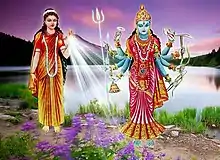 | |
| Affiliation | Shakti , Bhagavati,Adi Parashakti,Lakshmi ,Kali,Saraswati , Parvati, Devi |
| Abode | Vindhya Parvat, Himalayas |
| Mantra | Oṃ Kauśikyai Namaḥ |
| Weapon | Trishul, Bell, Bow & Arrow, Plough, Pestle, Conch, Discus |
| Mount | Lion |
| Texts | Markandeya Purana , Devi Bhagwat Puran , Shiva Purana , Devi Mahatmya , Skanda Purana |
| Parents | Shiva and Parvati |
| Consort | Shiva |
Origin
Devi Mahatmyam
Goddess Kaushiki’s story can be found in the Devi Mahatmyam, where she appears from the sheath (or Kosha) of Goddess Parvati’s body in order to kill the demons Sumbha and Nisumbha. Since Mahadevi radiated the dark Kaushiki from her skin, she as well turned dark-skinned as Kalika and as she sat upon the Himalaya mountains and waited for the demons to come to her, she ended up killing the demon brothers themselves, as well as their companion demons, with the help of the Matrika’s, Goddess Shivadooti, and Goddess Chamunda (Kali).
Kalika Purana
She is born from the body of Goddess Matangi.
Shiva Purana
After Lord Shiva mocks Goddess Parvati for her dark skin, she starts her penance in order to attain a fair complexion. She eventually sheds her dark skin, from which she reappears as the dark Goddess Kaushiki,slays the demons and turns fair again and returns to Shiva.
See also
References
- Wangu, Madhu Bazaz (2003). Images of Indian goddesses : myths, meanings and models. New Delhi: Abhinav Publications. p. 185. ISBN 81-7017-416-3.
- Jones, Constance A.; Ryan, James D. (2007). "Virashaivas". Encyclopedia of Hinduism. New York, NY: Facts On File. p. 489. ISBN 978-0-8160-5458-9.
- Sinha, A. K. (2009). Approaches to history, culture, art and archaeology. New Delhi: Anamika Publishers. p. 500. ISBN 9788179752487.
- Mitter, Sara S. (1991). Dharma's daughters : contemporary Indian women and Hindu culture (2. print. ed.). New Brunswick, N.J.: Rutgers University Press. p. 78. ISBN 0-8135-1677-3.
- Kinsley, David (1 December 1975). "Freedom from Death in the Worship of Kali". Numen. 22 (3): 183. doi:10.2307/3269544. JSTOR 3269544.
| Deities |  | ||||||
|---|---|---|---|---|---|---|---|
| Texts | |||||||
| Mantra/Stotra | |||||||
| Philosophical traditions | |||||||
| Jyotirlingas | |||||||
| Temples |
| ||||||
| Traditional observances | |||||||
| |||||||
