Keiji Uematsu
Keiji Uematsu (born 1947) is a Japanese contemporary artist and sculptor.
Keiji Uematsu | |
|---|---|
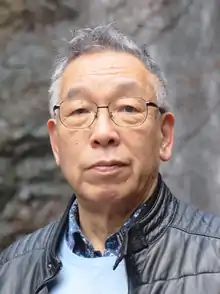 2021@Minoo-park. | |
| Born | March 26, 1947 |
| Nationality | Japanese |
| Education | Department of Fine Arts, Kobe University |
| Known for | Sculpture, Contemporary Art |
Notable work | Cutting Axis-Longitude-Latitude |
| Awards | the 38th Teijiro Nakahara Award, Japan, 2013 |
| Elected | Japan's representative artist of the 43rd Venice Biennale, 1988 |
Biography
Keiji Uematsu was born on March 26, 1947 in Kobe, Japan.[1] He is the son of a printmaker.[2]
In 1969, graduated from Kobe University, and became a teacher of the arts and crafts at a public school.[2] In the same year, he exhibited his work at the 1st Contemporary International Sculpture Exhibition and made his debut as an artist.[2] The first solo exhibition was also held in Kyoto (Galerie 16).
In 1974, he received the Kobe City Cultural Encouragement Award.[1] In 1975, moved to West Germany. Based in Düsseldorf, he created works of art, has exhibited mainly in Europe and lesser in the United States.[2] In 1986, a second base was established in Nishinomiya, Japan.[2][3][4]
In 1988, he was selected as a representative artist of the 43rd Venice Biennale along with Shigeo Toya and Katsura Funakoshi, and exhibited his work at the Japan Pavilion.[5][6]
In 1995, due to the Great Hanshin-Awaji Earthquake, the base of Nishinomiya was lost, so a new base was established in Minoo City, Osaka.[7]
In 2013, he won the 38th Teijiro Nakahara Award for his work Cutting Axis-Longitude-Latitude.[7]
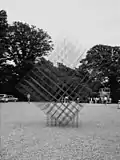 Transparence-Iron, 1969.
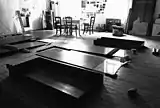 Studio, Düsseldorf, 1977.
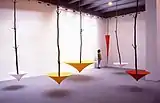 Inversion - Vertical space, 1988.
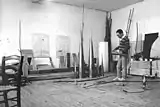 Studio, Düsseldorf, 1991.
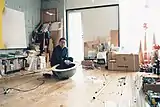 Studio, Minoo, 2006.
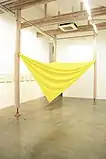 Cutting Axis-Latitude-Longitude, 2012.
Style and methods
His works are expressed in a variety of ways, including images (photographs, films, videos), performances (and their image recordings), prints, sculptures, and installations.
The production of the work is called "job (= project)", and the drawing that describes the idea of the project is also presented as an independent work.[1][2]
His work of sculpture or installation is a seemingly unstable structure that combines geometric volumes (cones, spirals) of stone, copper, wood, etc. "I want to express the existence of something invisible, like the universe, with a work in which the entire structure would collapse without one element."[1]
As materials for sculptures and installation works, cloth, stone, glass, iron, stainless steel, copper, bronze, brass, lumber (mainly Douglas fir), and natural wood in their solid state are often used.[1]
His style looks like an abstract, but what is expressed in his work is the embodiment of invisible forces such as gravity.[8][9][10]
First in 1971, then in 1972, or even in 1991, he wrote: "What I want to do is to make visible existence, visible connections and visible relations appear more clearly. And to cause non-visible existence, non-visible connections and non-visible relations to appear. And to cause visible existence, visible connections and visible relations not to appear.",[7] "What shall I now do with the world (cosmos) which denies man understanding and where these three relations comprise antinomies? Shall I find a new meaning in the world? How to shape relations between people? These are questions which deeply concern me."[1]
These words expresses the basic concept from the earliest days of his artist's activities.[1][7][11]
Exhibitions
Select solo exhibitions
- 1974: Photographs and Films, Gallery Cheap Thrills, Helsinki, Finland[1]
- 1975: Galerie St. Petri, Lund, Sweden[1]
- 1976: Photographs and Films, Gallery Cheap Thrills, Helsinki, Finland[1]
- 1976: Moderna museet, Stockholm, Sweden[1]
- 1977: Hetzler+Keller gallery, Stuttgart, Germany[1]
- 1977: Situation Interval, New Reform, Aalst, Belgium[1]
- 1977: Ausschnitte 1, Städtische Kunsthalle Düsseldorf, Germany[1]
- 1979: Installation, Vor Ort Arbeitsgalerie, Hamburg, Germany[1]
- 1979: Skulptur, Foto, Heidelberger Kunstverein, Germany[1]
- 1980: Cultuurhuis de Warande, Turnhout, Belgium[1]
- 1980: International cultural Center, Antwerp, Belgium[1]
- 1980: Städtische Galerie im Lenbachhaus+Kunstform, München, Germany[1]
- 1980: Installation Axis-Latitude-Longitude, P.S.1, Project Studios 1, New York, USA[1]
- 1981: Installations and Drawings, Baudoin Lebon, Paris, France[1]
- 1981: Skupturen-Zeichnungen-Fotos, Galerie Löhrl, Mönchengladbach, Germany[1]
- 1982: Cathédrale Saint-Trophime d'Arles, Arles, France[1]
- 1983: Installation, Baudoin Lebon, Paris, France[1]
- 1984: Centrum BeeldendeKunst Rotterdam, The Netherlands[1]
- 1985: Project - Drawings and Installations, Galerie Löhrl, Mönchengladbach, Germany[1]
- 1986: Installation, Baudoin Lebon, Paris, France[1]
- 1989: Project, Kunstraum Neuss, Germany[1]
- 1989: Skulpturen und Zeichnungen, Galerie Kiki Maier-Hahn, Düsseldorf, Germany[1]
- 1989: Skulpturen und Zeichnungen, Galerie Löhrl, Mönchengladbach, Germany[1]
- 1989: GeleZaal, Gent, Belgium[1]
- 1990: Sculptures, Waβermann Galerie, München, Germany[1]
- 1991: Dortmunder Kunstverein, Germany[1]
- 1991: Waβermann Galerie, Köln, Germany[1]
- 1991: Baudoin Lebon in FIAC, Grand - Palais, Paris, France[1]
- 1992: Baudoin Lebon, Paris, France[7]
- 1992: Ursula Blickle Stiftung, Kraichtal, Germany[7]
- 1993: The Breathing Space, Waβermann Galerie, München, Germany[7]
- 1993: Skulpturen und Zeichnungen, Galerie Löhrl, Mönchengladbach, Germany[7]
- 1994: It's Possible, Skulpturen und Zeichnungen, Stadtmuseum Siegburg, Germany[7][12]
- 1995: Invisible Structure, Galerie Beatrice Wassermann, München, Germany[7]
- 1997: Behind the Perception, Edwin-Scharff-Haus, Neu-Ulm, Germany[7]
- 2001: Baudoin Lebon, Paris, France[7]
- 2003: Axis-Latitude-Longitude, Waβermann Galerie, Munchen, Germany[7]
- 2004: Falling Water - Rising Water, Baudoin Lebon, Paris, France[7]
- 2005: Axis-Latitude-Longitude, Kunstlerverein Marlkasten, Düsseldorf, Germany[7]
- 2008: Yearning for What is Floating, Baudoin Lebon, Paris, France[7]
- 2009: Yearning for What is Floating, Le Cafe Francais Art Gallery, Brussels, Belgium[7]
- 2011: Baudoin Lebon (with vladimir skoda), Paris, France[7]
- 2014: Frieze Masters: Spotlight, Regent's Park, London, UK[7]
- 2016: Invisible Force and Seeing, Jacobihaus, Kunstlerverein Malkasten, Düsseldorf, Germany[7]
- 2016: Invisible Force, Simon Lee Gallery, London, UK[7]
- 2016: Seeing/Measuring/..., Baudoin Lebon, Paris, France[7]
- 2018: Invisible Force, Galerie Löhrl, Mönchengladbach, Germany[7]
- 2019: Keiji Uematsu: Invisible Force, Simon Lee Gallery, New York, USA[7]
Works
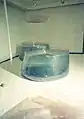 Transparence-H2O, 1969.
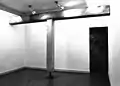 Cutting, 1971.
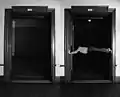 Horizontal position, 1973.
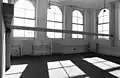 Axis-Latitude-Longitude, 1980.
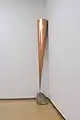 Corner piece I - Inversion vertical space, 1988.
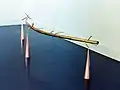 Situation - Floating space, 1989.
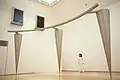 Axis-Longitude-Latitude, 1999.
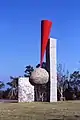 Floating form - Red, 2000.
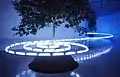 With a tree - Touch of Spiral, 2003.
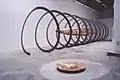 Touch of Spiral, 2007.
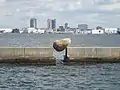 In between - form II, 2009.
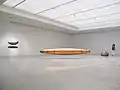 Floating form - Invisible axis, 2015.
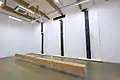 Cutting triangle, 2017.
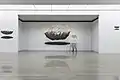 Floating stone, 2017.
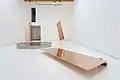 Invisible axis - Horizontal /Vertical inclination, 2019.
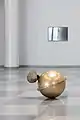 In between friction - Gift from cosmos, 2021.
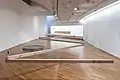 Invisible force - Axis-Longitude-Latitude, 2021.
Public collections
- Wilhelm-Hack-Museum, Germany[1]
- Museum für Kunst und Gewerbe, Hamburg, Germany[1]
- Kunsthalle Bremen, Germany[1]
- Städtische Galerie im Lenbachhaus, Munich, Germany[1]
- Museum Wiesbaden, Hesse, Germany[1]
- Daimler Art Collection, Berlin, Germany[7]
- Cartier Foundation for Contemporary Art, Paris, France[1][9]
- Musée des Arts Décoratifs, Paris, France[7]
- Musée Reattu, Arles, France[1]
- Maison Elsa Triolet Aragon, St-Arnoult en Yvelines, France[7]
- LA CHAPELLE art contemporain, Clairefontaine, France[7]
- Collection Pinault, France[7]
- Moderna Museet, Stockholm, Sweden[1]
- Museum Voorlinden, Wassenaar, The Netherlands[7]
- Bvlgari Collection, N.Y., USA / Rome, Italy[7]
- Museum of Modern Art, New York City, New York, USA[7][13]
- The Museum of Fine Arts, Houston, USA[7]
Notes
- 1969-1991 Keiji UEMATSU (Catalog raisonne), 1991.
- the Japanese text of interview with Keiji Uematsu, Oral History Archives of Japanese Art; http://www.oralarthistory.org/archives/uematsu_keiji/interview_01.php
- 50 years of galerie 16: 1962-2012 pp.67-74.
- Fotografie in Düsseldorf: die Szene im Profil, 1991.
- XLIII Esposizione Internazionale d'Arte la Biennale di Venezia, Il Luogo Degli Artisti, General Catalogue 1988.
- The Venice Biennale: 40 Years of Japanese Participation, 1995.
- Keiji Uematsu, Ways of Touching the Invisible - Intuition (catalog of the exhibition), 2021.
- Contemporary Japanese Sculpture, 1991, pp.82-84
- La Collection de la Fondation Cartier pour l’art contemporain, 1998.
- Dictionnaire Bénézit, Dictionnaire des peintres,sculpteurs, dessinateurs et graveurs, vol. 13, 1999, p. 892.
- Von der Natur in der Kunst, Eine Ausstellung der Wiener Festwochen, 1990.
- It’s Possible, Skulpturen und Zeichnungen, 1994.
- "Keiji Uematsu". The Museum of Modern Art (MoMA). Retrieved 2021-11-16.
References
Books and Catalogs
- Keiji Uematsu: Skulptur Foto Video Film. Sweden: Moderna Museet. 1976. ISBN 91-7100-112-3.
- Gottfried Jäger (1988). Fotografik - Lichtgrafik - Lichtmalerei, Bildgebende Fotografie Ursprünge, Konzepte und Spezifika einer Kunstform (in German). DuMont Buchverlag Köln. ISBN 3-7701-1860-X.
- Edizioni La Biennale Realizzazione Fabbri Editori (1988). XLIII Esposizione Internazionale d'Arte la Biennale di Venezia, Il Luogo Degli Artisti, Genaral Catalogue 1988. ISBN 88-208-0346-1.
- Wiener Festwochen, Künstlern, Leihgebern und Autoren (1990). Von der Natur in der Kunst, Eine Ausstellung der Wiener Festwochen (in German). ISBN 3-901027-01-7.CS1 maint: multiple names: authors list (link)
- Helga Meister (1991). Fotografie in Düsseldorf: die Szene im Profil (in German). Schwann im Patmos-Verlag. ISBN 3-491-34227-9.
- 1969-1991 Keiji UEMATSU (in Japanese, English, German, and French). Nomart Editions. 1991. ISBN 4-931270-03-4.
- Janet Koplos (1991). Contemporary Japanese Sculpture. Abbeville modern art movements. ISBN 1-55859-012-9.
- Keiji Uematsu: It's Possible, Skulpturen und Zeichnungen. Stadtmuseum Siegbulg. 1994. ISBN 3-925551-75-1.
- The Venice Biennale: 40 Years of Japanese Participation. 1995. ISBN 4-620-80314-6.
- Fondation Cartier pour l'art contemprain (1998). La Collection de la Fondation Cartier pour l'art contemporain. Actes Sud. ISBN 2-7427-1577-0.
- éditions Gründ (1999). Dictionnaire Bénézit: Dictionnaire des peintres, sculpteurs, dessinateurs et graveurs vol. 13 (in French). ISBN 2700030230.
- From Postwar to Postmodern, Art in Japan 1945-1989: Primary Documents. MoMA. 2012. ISBN 978-0-8223-5368-3.
- 50 years of galerie 16: 1962-2012. Kyoto: galerie 16. 2014.
- Keiji Uematsu, Ways of Touching the Invisible - Intuition. Ashiya City Museum of Art and History. 2021.
Web
- Oral History Archives of Japanese Art (2018-05-25). "Interview with Keiji Uematsu".
Authority control  | |
|---|---|
| General | |
| National libraries | |
| Art research institutes | |
| Other | |